Short answer: Running your own search work takes roughly 20 hours a month once the setup is behind you, and that is a reasonable estimate rather than measured data. The cheapest monthly plans on the three pricing pages we read on September 3, 2026 run from $799 to $999, which comes down to about $40 to $50 for each of those 20 hours. If one hour of your own time is worth less than that, do it yourself. If it is worth clearly more, and those hours are already spoken for by paying work, hire someone.
Is DIY SEO for small business actually realistic?
Yes, for part of it. No, for the rest. The honest version of this question has three answers, not two, and we will spend real space on the two that make us no money.
First, something worth knowing before you read anything on this question, this post included. Nobody writing about it is neutral. A software company benefits when you do the work yourself, on their subscription. We benefit when you hire. So read the arithmetic rather than the conclusion, wherever you find it.
The comparison usually on offer is a cheap tool subscription set against the most expensive retainer tier a provider sells. Neither end of that is the choice a plumber in Queens or a dental office in Brooklyn is actually making, and a comparison built from the two extremes does not help a local business decide anything.
We sell the paid side. We are going to lay out the arithmetic anyway, including the part where the answer is that you should keep doing it yourself. Google itself publishes a short and refreshingly unexcited page on whether you need to hire an SEO at all, and it is worth ten minutes before you decide anything.
One thing this post deliberately does not cover: why quotes vary so widely and what a monthly number should include. Here we stay on one narrow question, hours against dollars.
What does DIY SEO really cost in hours and dollars?
Every honest calculation has two halves. Most articles give you the first and quietly skip the second.
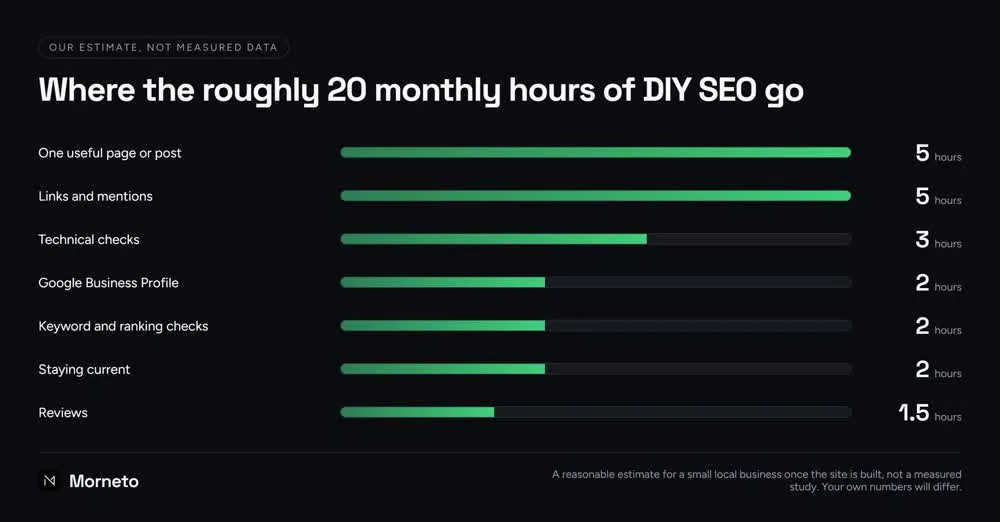
Half one is hours. Below is what ongoing search work costs a small local business per month, once the learning curve is behind you and the site is already built. Treat these as reasonable estimates from doing this work, not as measured data from a study. Your numbers will differ, and the exercise still works if you swap in your own.
- Google Business Profile upkeep. Posts, fresh photos, holiday hours, categories, answering questions people leave on the profile. About 2 hours a month. Our guide on what to put in Business Profile posts suggests posting about once a week.
- Reviews. Asking at the right moment, following up once, replying to every review that arrives. About 1.5 hours a month.
- One useful page or post. Research, draft, edit, images, publish, link it internally. About 5 hours for a single piece, and one piece a month is a slow pace, not a fast one.
- Keyword and ranking checks. Looking at what you rank for, what moved, and what people actually typed to find you. About 2 hours a month.
- Technical checks. Crawl errors, index coverage, page speed, broken links, structured data. About 3 hours a month once you know what you are looking at.
- Links and mentions. Suppliers, trade associations, the local chamber, a sponsorship page, a supplier directory. About 5 hours a month, for maybe one or two placements.
- Staying current. Reading what changed and deciding whether it applies to you. About 2 hours a month.
That adds up to roughly 20 hours a month. Not 20 hours once. Twenty hours in month one, month four, and month nine, which is the part that quietly decides the outcome.
Half two is the price of one of your hours. Pick whichever of these is true today.
- You bill by the hour and your calendar is full. Your rate is the number. At $85 an hour, 20 hours of search work costs you $1,700 in billable work you did not do.
- You do not bill hourly, but you are the one who sells. Estimate the profit you generate in an average working hour and use that.
- You have slack. New, quiet, or between seasons, and those 20 hours were not going to earn anything anyway. Then your hour is worth close to zero and doing it yourself is close to free.
Now the crossover. Divide a monthly plan by those 20 hours. The cheapest starting prices on the three pricing pages we read on September 3, 2026 ran from $799 to $999 a month, which works out at about $40 to $50 for each of those hours. That single number is the whole decision. Below roughly $40 an hour of genuine opportunity cost, doing it yourself is cheaper and you should. Above it, you are buying back time at a discount, assuming the work is actually done well.
Two warnings about that arithmetic. A published price is a starting price, and two plans at the same number can contain completely different work, so what a monthly package should actually include is worth reading before you treat any figure as comparable. And most providers publish nothing at all, which is why the comparison is harder than it should be.
Which search tasks should you always do yourself?
Some of this work is genuinely better in your hands, and that stays true after you hire anyone. You are the only person who knows what you actually sell and how customers describe it.
- Your Google Business Profile, week to week. Hours, holiday hours, service areas, categories, the description, new photos. Google keeps a plain guide to adding and editing your business information and it takes an afternoon to work through.
- Asking for reviews. Nobody can do this for you, because the ask works when it comes from the person who did the job, in the hour after it went well. Ten minutes a week beats any system.
- Replying to reviews. All of them, including the bad ones, in your own voice. A short and human reply to a two star review does more for a buyer reading it than the review itself.
- Photos. Real photos of real work, taken on your phone. Job sites, the shop, the van, the team, the finished result. This is free and almost nobody does it.
- Writing your service list in your own words. Not the keyword version. The version you would say out loud on the phone. That plain sentence is the single most useful raw material any writer can be handed.
- Keeping a list of the questions customers ask you. Just a note on your phone. Every one of them is a page that will earn traffic, and you hear them all day.
- Keeping your name, address and phone consistent. The same format everywhere it appears online.
If you do nothing else, do this list. It is maybe 4 hours a month out of the 20, it needs no tools, and for a business that serves one neighborhood it is the part that moves the phone soonest. The same holds in our neighborhood-level SEO for Brooklyn, where the Google Business Profile is the fastest return available for local businesses. Our guide to SEO for small dental offices turns the profile and review part into a weekly routine for the office manager.
Where does DIY SEO usually fall apart?
Four places, and only one of them is about intelligence.
- Technical work. Crawling, indexing, speed, structured data, duplicate pages competing with each other. It is learnable and it is also the fastest way to spend a weekend fixing something that was never broken. Rather than repeat it here, we keep the technical items worth checking in order as a standalone list you can work through.
- Diagnosis. Any tool will hand you a long list of issues. Only a handful of them matter this quarter, and knowing which ones is the actual skill. Our guide on what an honest audit should tell you covers how to tell a real diagnosis from a generated list, including when the report you are reading is only a sales document.
- Links and mentions. This is slow, social, and mostly rejection. Owners tend to stop after a few unanswered emails, which is a completely rational response to a low hit rate.
- Consistency. This is the real one. Month one and month two happen. Month five does not, because a big job landed. Search work compounds only if it keeps happening, and in our experience momentum is hard to pick back up after a gap.
Be honest about which of the four is your risk. If it is the last one, no tool subscription solves it, because the problem was never the tool.
When does DIY SEO stop being the cheaper option?
Watch for these. Any two together and the arithmetic has already flipped, whatever your gut says.
- Your own hour is worth more than about $50. At 20 hours a month you are spending more than $1,000 of your own time to avoid an $800 invoice.
- You skipped two months in a row. The most reliable signal in this whole post. It will happen again, because the reason it happened has not changed.
- Three months in and nothing moved. Not rankings, not calls, not form fills. Either the priorities were wrong or the technical base is holding everything down, and both are diagnosis problems.
- You are competing across boroughs, not one neighborhood. One profile and one service page is a job you can hold. A set of location pages that each need to earn their own visibility is not, and it is why a business chasing customers across Astoria, Flushing and Jamaica usually hands this over first.
- The site itself is the bottleneck. If pages load slowly or the structure fights you, content on top of it does not help.
- You want someone accountable in writing. The ongoing search work we run reports against enquiries rather than a rankings chart, and a monthly report you did not produce yourself is worth something on its own.
One caveat we will state plainly. Hiring badly is worse than doing it yourself badly, because you pay for both the invoice and the lost year. If you cannot tell whether a proposal is real work, the audit guide above is the cheaper first step. Our own monthly work starts with a free search visibility audit you can ask for in a short call, before anyone commits to a monthly figure, and that order is worth insisting on with whoever you talk to.
When should you skip both DIY SEO and an agency?
Sometimes the right answer is neither, and this is the section the tool vendors leave out because it sells nothing. Skip both, for now, if any of this is true.
- Almost nobody searches for what you sell in your area. If the monthly search volume for your service plus your neighborhood is in the single digits, ranking first wins you a handful of visitors. Check before you spend, not after.
- You need customers within 30 days. Search work does not deliver on that timeline. Our post on whether search work pays back for a small business works through the return and the waiting period in detail, and neither is short.
- Your site cannot convert the traffic it already has. If visitors arrive now and do not call, more visitors is the wrong purchase. Fix the page, the offer, or the phone first.
- You are about to rebrand or move domains. Wait. Do the move, then start.
- Cash is tight enough that six months is not certain. Three months of a monthly plan followed by a cancellation is close to money burned. If the runway is not there, do the free list in the section above and revisit in a quarter.
- You are still testing whether the business works. Nothing about search fixes an offer people are not buying.
None of these are permanent. They are reasons to wait, and waiting deliberately is a decision, not a failure.
Common questions
How many hours a month does DIY SEO actually take?
Roughly 20 hours a month for a small local business once the site is built and the setup is done. That is our reasonable estimate from doing the work, not a measured figure, and it splits into about 4 hours of profile and review upkeep, 5 hours of writing, and the rest across technical checks, links and reporting.
Can I keep the Google Business Profile myself and hire out the rest?
Yes, and it is a sensible split. Posting photos, updating hours and asking for reviews take a few minutes and land better coming from you. The technical work, the content schedule and the reporting are the parts that break down when they depend on a busy owner remembering.
At what hourly rate does hiring become cheaper than doing it myself?
Around $40 to $50 an hour, using 20 hours a month against the cheapest starting prices we read on September 3, 2026. If an hour of your time reliably earns more than that and those hours are already booked with paying work, hiring is the cheaper option. If you have slack in the calendar, it is not.
Is DIY SEO worth it if my time is currently free?
Yes, and this is the clearest case in the whole post. If the business is new or between seasons and those hours were not going to earn anything, your cost is close to zero. Start with the profile, the reviews and the photos, because those move the phone soonest and need no tools at all.
Can I start DIY and hand it over later without losing the work?
Yes, and it is a common path. Everything you build sits on assets you control: your own site, your own profile, your own reviews. Ask any provider before signing whether you keep the site, the code and the design files, because the answer is not the same everywhere. With us you do, and the content and rankings stay attached to your domain.