
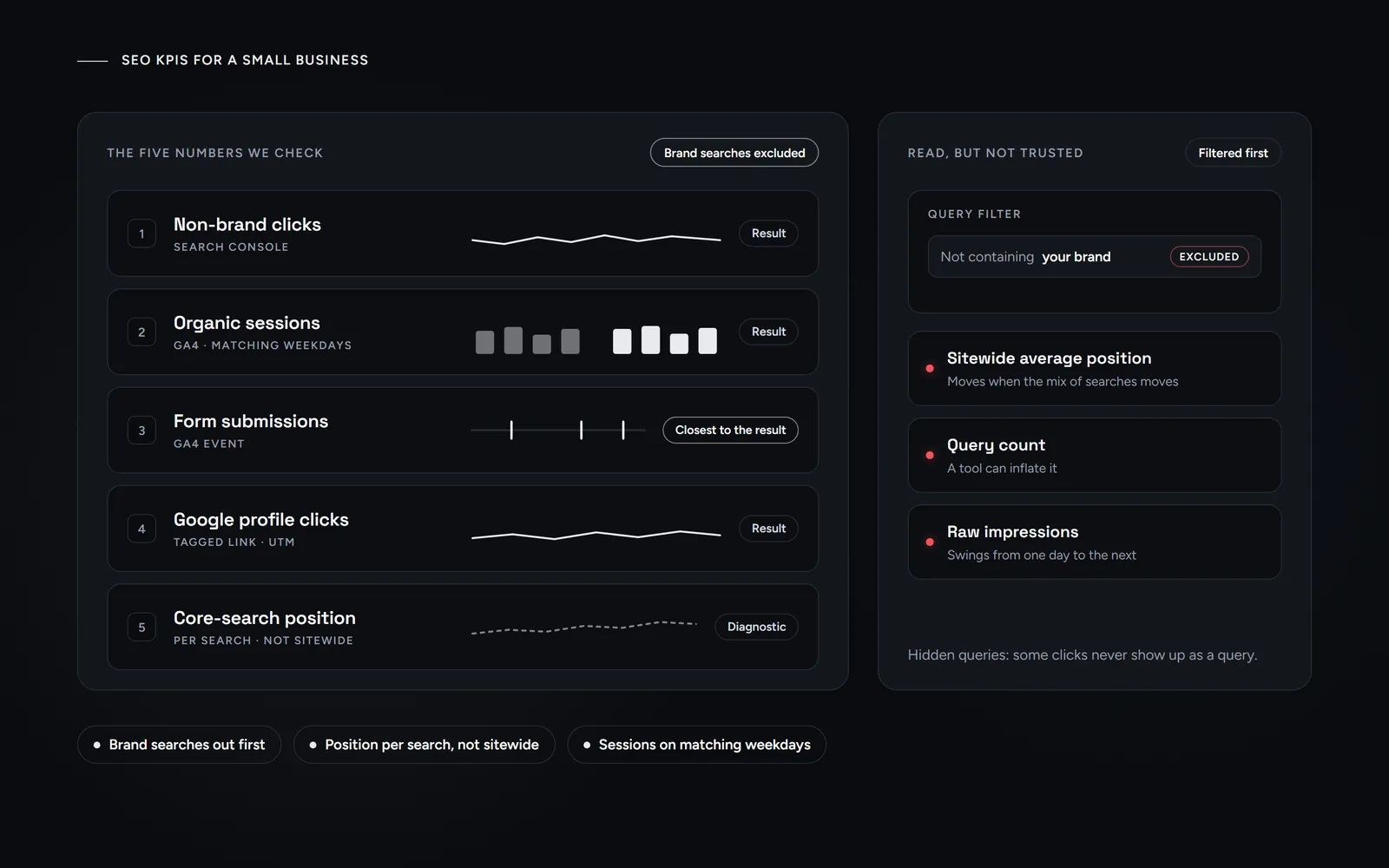
Short answer: the SEO KPIs that matter for a small business are the ones tied to inquiries. We check five: non-brand clicks, GA4 organic visits, form submissions, Google profile clicks and positions for a few core searches. On our own site, 97% of clicks with a visible query were brand searches, so we strip those out first.
Popular lists of SEO KPIs often name 10 or more numbers, and several come from companies that sell a reporting dashboard. Ours is shorter, and it comes from our own Search Console and Google Analytics 4 (GA4) data. Morneto is a web design, SEO and Google Ads studio in New York. Our site is young, with Search Console data from Aug 11, 2026. So our numbers are small, and we show them anyway. Unless we say otherwise, the Search Console figures below come from exports we made on Oct 10, 2026, covering Aug 11 to Oct 6. This post also opens a series we call Measured on our own site.
What are SEO KPIs, and which ones matter for a small business?
A metric is any number a tool reports. A KPI, short for key performance indicator, is a metric you would act on because it sits close to a business result. For a local business, that result is an inquiry: a form, a call or a booking. In analytics terms, that is what counts as a conversion, and every KPI should sit one or two steps away from it. So the test for any number is simple. If it moved, would you change what you do? Good SEO KPIs pass that test, while most dashboard totals do not.
Google splits the job between two free tools. Search Console covers what happens before someone reaches your site, such as impressions, clicks and position. GA4 covers what visitors do after they arrive. To see where on a page they hesitate, a free tool like Microsoft Clarity adds heatmaps and session recordings. The two will not match completely, as Google’s own guide to using Search Console and Analytics together points out, since a click and a session are different measurements. Therefore, do not expect 50 clicks to equal 50 sessions. Instead, let each tool speak for its own side of the click.
Search Console also shows health checks, such as indexing problems and structured data errors. Those are worth fixing, and a separate post covers the structured data we cleaned up on our own site. Still, a health check is not a KPI. A fix is a means, while the inquiry remains the end. The page for our month-to-month SEO service in New York puts it the same way: rankings are an input, and cost per inquiry decides whether the work pays off.
Which five numbers do we check on our own site?
With 233 clicks between Aug 11 and Oct 6, 2026, one misleading number can steer a small site wrong fast. These are the five SEO KPIs we kept:
- Non-brand clicks. These come from searches without our name in them. From Sep 9 to Oct 6, we had 3, one each for seo agency new york, web design company in new york and seo agency in new york. Small, but honest.
- Organic sessions in GA4, on matching weekdays. GA4 has run on our site since Aug 23, 2026. We compare the same weekdays across two periods, since a Saturday and a Monday rarely look alike.
- Contact-form submissions. Our setup sends a GA4 event when the contact form shows its confirmation message. This sits closest to the result we sell, so it outranks the rest. We do not publish the count.
- Google profile clicks. The website link on our Google Business Profile carries a UTM tag, a short tracking label. Search Console therefore lists it as its own URL. From Aug 11 to Oct 6, that line shows 69 clicks and 640 impressions at position 9.34, and the profile only went live on Sep 16. Without the tag, those clicks would sit inside the homepage line.
- Position for a few core searches. We read it per search, not as a sitewide average. From Sep 9 to Oct 6, ppc management nyc sat at position 9.7 with 31 impressions and 0 clicks. Page one is not the same as clicks.
Of these five, only the position checks are part of a weekly routine. We look up the other four as needed, so we call them numbers we check, not numbers we track.
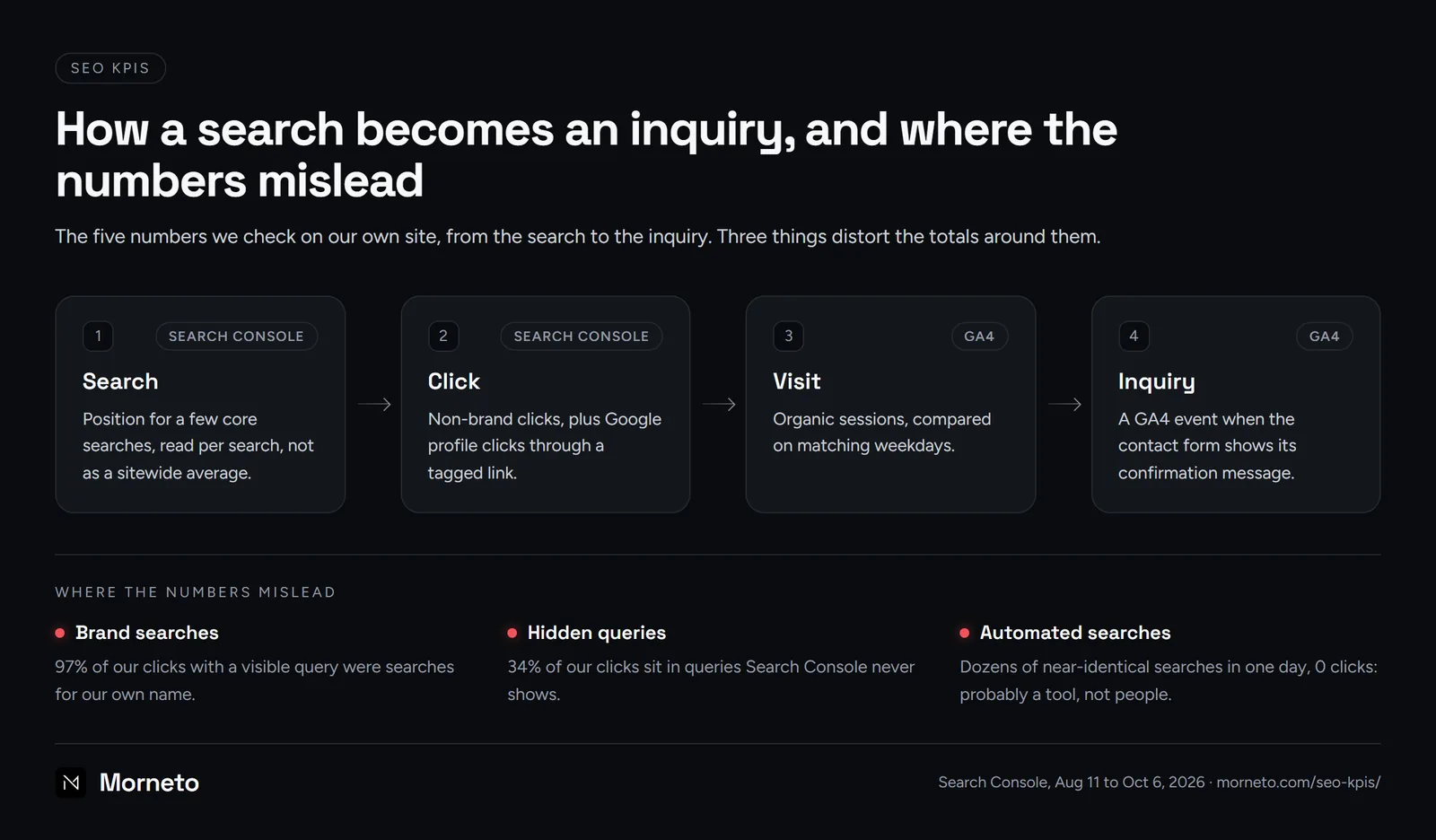
Which numbers looked like progress but were not?
Three numbers made our site look better than it was. We still read them, but they no longer decide anything.
- Sitewide average position. Google defines it as the average position of the topmost result from your site. Moreover, a link must get an impression before its position counts at all. So the average only covers searches where you appeared, and it shifts when that mix changes. On our site, the weekly average went from 66.7 in the week of Aug 24 to 31.4 in the week of Sep 21. We weighted each day by impressions: 1,100 and 1,571 in those weeks. On paper, that is a climb of 35 places. Yet non-brand clicks for the four weeks to Oct 6 still came to 3.
- Query count. The number of different searches you appear for sounds like reach. However, a tool can inflate it. In a later review of Sep 4, we found dozens of near-identical searches, mostly on web design in Queens and Brooklyn. They had 2 to 5 impressions each, no clicks and positions between 32 and 100. Two of them, website design brooklyn and web design brooklyn, had exactly 5 impressions at exactly position 80.2. That pattern points to a tool working through a keyword list, though we could not prove it.
- Raw impressions. Daily totals ran between 176 and 250 from Aug 30 to Sep 4, which looked like growth. Then 250 on Sep 4 became 15 on Sep 5. A number that drops 94% in one day cannot tell you whether customers found you. For that reason, we compare GA4 sessions on matching weekdays instead.
None of this means Search Console is wrong. It means a sitewide total mixes too many things to judge one business by.
How do we keep brand searches out of the picture?
Brand searches come from people who already know your name, you included. They matter, but they measure how well known you are rather than how easy you are to find. So they belong in a separate column from your SEO KPIs. On our site, they are nearly the whole picture:
| Search Console clicks | Aug 11 to Oct 6, 2026 | Sep 9 to Oct 6, 2026 |
|---|---|---|
| All clicks | 233 | 129 |
| Clicks with a visible query | 154 | 104 |
| Brand searches | 150 (97.4% of visible) | 101 (97.1% of visible) |
| Non-brand searches | 4 | 3 |
| Clicks in hidden queries | 79 (34% of all) | 25 (19% of all) |
The brand rows are morneto, morneto new york and morneto.com. Before we judge anything, we filter out every query that contains the brand name. In Search Console, that means a query filter that excludes the name. The table uses the Performance report, search type Web.
Then there is the gap: across the full period, 79 of 233 clicks sit in queries Search Console never shows. Google says its tables omit rare queries to protect user privacy, and they stop at 1,000 rows. Our export hit that cap. However, it lists queries by clicks, and every row after the seventh shows zero. So the gap comes from hidden queries, not from the row limit. Since those hidden clicks could be brand or non-brand, we treat the visible non-brand count as a floor.
Google also offers a Branded queries filter in Search Console. It relies on an internal, AI-assisted system instead of a word list. However, it only works for top-level properties with enough queries and impressions, so a young site may not get it. Until it appears for you, a plain filter on your name does the job.
How should SEO KPIs change between month one and month six?
Early on, most SEO KPIs are really diagnostics. A new site first needs pages in the index, its first non-brand impressions and a position for each core search. None of those pays a bill. Still, each one shows whether the next step is possible.
Later, the weight shifts to results: non-brand clicks, organic sessions on matching weekdays and form submissions. By month six, a monthly view should lead with inquiries and keep positions in the background. Our own count is still small. Three non-brand clicks from Sep 9 to Oct 6 is the figure in our Oct 10 export, and we would rather show that than a flattering average.
If you pay someone for SEO, ask for the report in the same order. For example, our pricing page spells out what the SEO plan from $799 a month includes, from tracked keywords to reporting against inquiries. When you compare offers, check what belongs in a small-business package and whether its report shows inquiries or only positions. Or, if you would rather have someone look at where you stand, ask for a free check of your search visibility.
Common questions about SEO KPIs
What is a KPI for SEO?
It is a search number that sits close to a business result and would change a decision if it moved. Non-brand clicks and contact-form submissions qualify. A sitewide total of impressions usually does not.
How many SEO KPIs should a small business check?
Five or fewer is enough for most small businesses. We check non-brand clicks, GA4 organic sessions on matching weekdays, form submissions, Google profile clicks and positions for a few core searches. More numbers rarely lead to better decisions.
Is average position a good SEO KPI?
Not as a sitewide number. Search Console only records a position when your page gets an impression, so the average shifts with the mix of searches. Per core search, it works well as a diagnostic.
Do you need both Search Console and GA4?
Yes, because they cover different sides of the click. Search Console shows searches, impressions and position before the visit. GA4 then shows sessions and events after it. Expect the two numbers to differ, since a click and a session are different measurements.
What should an SEO KPI dashboard include?
One line per KPI, each with the same date window and a note on brand searches. Google links a free Looker Studio template in its guide to using Search Console and Analytics together, which is a fair starting point before you pay for a tool.