Short answer: SEO for dentists comes down to an accurate Google Business Profile, review requests within the rules, and clear treatment, insurance and fee pages. The treating dentist should review clinical pages, forms should stay free of ad trackers, and replies should never confirm who is a patient. Most sites need three to six months to show measurable results.
Last updated September 28, 2026. Rules and enforcement cases below come from Google, the FTC, HHS and the ADA, checked that day.
This guide is for the owner or office manager of a practice with one or two dentists. Much of the advice on SEO for dentists that we have read stops at keywords and rankings. It rarely covers the parts that can hurt a practice: review replies that disclose patient information, tracking code on appointment forms, and specialty claims a general dentist should not make. We cover those too, in the order we would tackle them.
What does SEO for dentists include, and where do new patients find you?
It covers the three places a new patient might find you: map results, organic results and AI assistants’ answers. We think the same groundwork feeds all three.
Google’s local ranking factors are relevance, distance and prominence. For a dental office, prominence is where the work goes, in our view. Google says it rests partly on links and reviews, and that more reviews and positive ratings can help local ranking.
You can earn links and reviews legitimately, but you cannot change how far away the searcher is. On a Manhattan avenue with three practices on one block, distance barely separates them. There, local SEO for dentists comes down to what you can influence. The same is true for every business there: Manhattan search rewards relevance and reviews rather than distance.
We would budget paid search separately from this work. Our guide to Google Ads costs for small businesses covers how to size it.
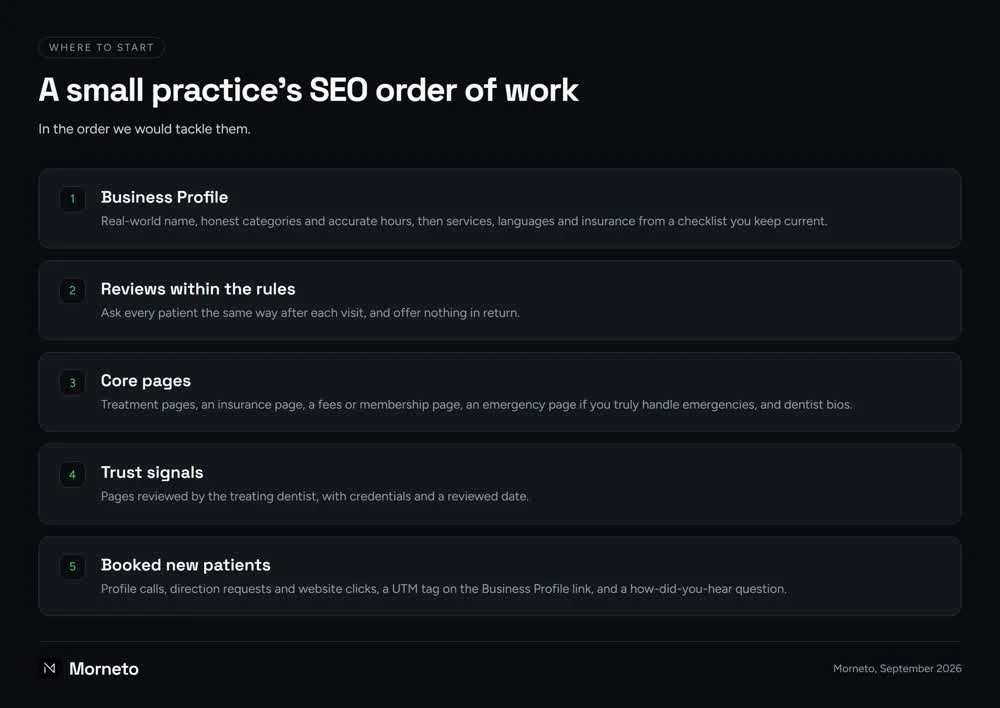
For a small practice, the order of work is short. Fix the Business Profile first, then build a review routine within the rules. Next come the core pages and trust signals, such as pages reviewed by the treating dentist. Finally, measure booked new patients instead of rankings.
How do you set up a Google Business Profile that fits a dental office?
In a dentist’s Google Business Profile, use the practice’s real-world name, honest categories and accurate hours. Then fill in services, languages and insurance from a checklist you keep current.
According to Google’s Business Profile guidelines, the name must reflect the business’s real-world name, as used consistently on signage, the website and stationery. Adding unnecessary information, such as service keywords, location descriptors or taglines, isn’t permitted and could lead to suspension. So adding “Best Dentist Astoria” to the name is a liability, not a tactic. Keyword-padded names are also among the first things we’d check when a New York profile fails verification.
Google suggests one format for a branded practice with a single public-facing dentist. In that case, it says it’s best to share one profile with the practice, named “[brand]: [practitioner name]”.
Choose categories honestly. A general practice that places implants or offers aligners is still a general practice. So use a specialty category only when a dentist there holds that specialty.
Hours should match when patients can come in and someone answers the phone, with holiday hours set in advance. Never list 24/7 unless a dentist can truly see patients around the clock. Then work through this checklist:
- Services. Only treatments you perform now, named the way patients say them.
- Languages. The ones your staff actually speak, such as Spanish, Mandarin or Russian. Most businesses leave it blank, and in Queens, where language shapes the search work, it frequently decides which of two similar options gets the call.
- Insurance. The networks you participate in today, matching your website’s list word for word.
- Booking link. One link to your appointment page, tagged so you can measure it.
Office photos, posts and the description aren’t dental-specific, so our guide to Business Profile optimization in New York handles them.
How can a practice get more Google reviews within the rules?
Ask every patient the same way after each visit, and offer nothing in return. We believe that routine avoids the incentives and selective asking that Google bars and the FTC warns about.
Google strictly prohibits incentives, such as free or discounted services or payment, in exchange for posting, changing or removing reviews. The ban applies whether or not the review has to be positive. Google’s Maps content policy also bars businesses from discouraging negative reviews or selectively asking for positive ones.
The FTC adds a second layer. Its Consumer Reviews and Testimonials Rule, in effect since October 21, 2024, prohibits incentives conditioned on a review expressing a particular sentiment, positive or negative. The FTC can seek civil penalties against knowing violators. The rule doesn’t specifically ban asking only happy customers, but the FTC warns that practice could violate the FTC Act.
A receptionist who hands the review card only to smiling patients is doing the selective asking Google bans. So take the choice out of staff hands:
- Same message, every patient. Have your reminder or scheduling system send it after every completed appointment.
- Neutral wording. “Tell us how your visit went,” not “If you loved your visit, leave us five stars.”
- No treatment details. Leave the procedure out of the message entirely.
- No rewards. No free whitening, fee credits or gift cards tied to a review, for any patient.
Our walkthrough of how to leave a Google review and ask for one covers the steps for first-time reviewers.
How should a dentist reply to reviews without breaking HIPAA?
Keep replies short, never confirm the reviewer is a patient, and move the conversation to the phone. HHS’s Office for Civil Rights (OCR) has acted against dental practices whose replies did the opposite.
- Elite Dental Associates, Dallas. In October 2019, OCR announced that the practice paid $10,000 and adopted a corrective action plan. Its reply to a patient’s Yelp review disclosed her last name, health condition, treatment plan, insurance and cost information. The settlement included no admission of liability.
- Dr. U. Phillip Igbinadolor, D.M.D. & Associates. In March 2022, OCR announced a $50,000 civil money penalty against this dental practice in Charlotte and Monroe, North Carolina. Its reply to a patient’s negative Google review disclosed the patient’s full name, symptoms and recommended treatment.
- New Vision Dental, California. In December 2022, OCR announced that the practice agreed to pay $23,000 and adopt a corrective action plan. Its responses to Yelp reviews disclosed patient names, treatment and insurance details the patients had not shared in their reviews.
The ADA goes further. It says a HIPAA-covered practice must keep protecting information a patient has already disclosed publicly. So a reviewer who mentions their own root canal does not free you to discuss it.
A cautious pattern for a complaint is below. For a kind review, its first sentence alone is enough.
“Thank you for taking the time to write. We don’t discuss anyone’s care online, and we can’t confirm whether someone is a patient. We’d like to hear more, so please call our office manager at [number].”
Add two house rules. First, one person, usually the owner or office manager, approves every reply before it posts. Second, nobody pastes review text or patient details into AI reply tools, because that can share them with another company. Confirm both rules and the wording with your compliance advisor.
Which pages should a dental website have?
Five kinds: treatment pages, an insurance page, a fees or membership page, an emergency page if you truly handle emergencies, and dentist bios. Together they cover what callers ask before booking. Do you offer this treatment and take my plan? What will it cost, how soon can you see me, and who is the dentist? For an Upper East or West Side dental practice, patients also want to know which subway or parking to use.
- Treatment pages. One per treatment you perform, in patients’ words: what happens, how many visits it takes and how payment works.
- Insurance page. List only the networks you participate in, with an “as of” date. Explain in plain words what in-network, out-of-network and “we file the claim for you” mean at your office.
- Fees or membership plan. Give uninsured patients a starting price or a plan cost. We put our published prices on one page for the same reason: it answers the first question before anyone calls. Check your state dental board’s advertising rules before publishing specials or discounts.
- Emergency page. Only if you really see emergency patients. Say which urgent visits you take, when same-day slots exist, and which number to call after hours.
- Dentist bios. Education, license, memberships and the languages each dentist speaks.
Avoid near-copies for each nearby neighborhood. We’d worry that identical Gowanus and Windsor Terrace pages from a Park Slope practice look like doorway pages. Instead, build one strong location page with cross streets and the nearest subway stops. We plan sites for Brooklyn businesses on the same principle: a page only for an area we can genuinely say something distinct about. In dental practice SEO, we would fix thin or duplicated pages before writing anything new.
How do you make dental content trustworthy for Google and AI assistants?
Put the treating dentist’s name, credentials and a reviewed date on every clinical page. Then make every claim match what the practice really does.
Google’s Search Central guidance says its systems give even more weight to content with strong E-E-A-T on topics that could significantly affect people’s health, financial stability or safety. Google calls these YMYL topics, and dental care plausibly falls under health. Google also notes that E-E-A-T is not itself a specific ranking factor.
In practice, one line does the job: “Reviewed by Dr. [Name], DMD, licensed in New York, on [date].” Mass-produced AI treatment posts do the opposite, in our view, because nobody at the practice has checked them.
ADA Code of Professional Conduct Section 5.I lets general dentists announce the services they offer. They must avoid implying specialization and state that general dentists provide them. Section 5.H limits announcements of a specialty to recognized specialties, for dentists who meet the educational requirements. So before any specialty title appears on the site or profile, check the dentist’s credentials against those sections. Read your state dental board’s advertising rules too.
Patient photos need the same care. The ADA notes even a photo or video of a patient in the waiting area may be protected health information. So get written authorization, on a form your compliance advisor has approved, before posting any identifiable smile or before-and-after photo.
No practice controls what AI assistants quote. Our working view is that matching facts leave less room for mistakes. So once a quarter, check that dentist names, credentials, languages and insurance networks match on the profile and website.
What should the website avoid for patient privacy?
Keep ad and analytics tracking off appointment and new-patient forms, and know where form entries and call recordings end up. Part of HHS’s guidance here was vacated in court, so treat the list below as questions for your compliance advisor.
On June 20, 2024, in AHA v. Becerra, the U.S. District Court for the Northern District of Texas declared unlawful and vacated a portion of HHS’s online tracking guidance. That portion treated a visitor’s IP address, combined with a visit to an unauthenticated public page about specific health conditions or providers, as triggering HIPAA. HHS’s own page describes the rest of the guidance as still posted.
So check these points with your developer and advisor:
- Forms. Ask your developer for a written list of every tag on the appointment page, new-patient form and thank-you page. Remove ad pixels there unless your advisor approves them, and check what analytics collects.
- Form delivery. Where does a submitted form go? If health history arrives in an ordinary email inbox, ask your advisor whether that setup is acceptable.
- Calls. If you use call tracking or recording, ask the vendor and your advisor what agreements it needs before launch.
If you also run ads, our overview of how search and ad work changes across six sectors covers dental practices.
How long does dental SEO take, what does it cost, and how do you measure it?
Most sites see measurable SEO results in three to six months, and competitive markets take six to twelve. At around 90 days, judge the direction: growing queries and impressions and the first calls, not page-one rankings. Our SEO timeline, measured on our own site, shows what the first weeks can look like.
Whoever does the work, get the plan in writing. For a small practice, it should cover profile upkeep, the review-request setup and reply drafts for your approval. It should also cover dentist-reviewed treatment and insurance pages, technical fixes and a monthly report with new-patient numbers.
For comparison, our monthly SEO and marketing service starts at $799 per month, month to month with 30 days notice. Our breakdown of what SEO costs a small business covers the wider market. Watch for these red flags in any contract:
- Long lock-ins. A contract you cannot leave removes the pressure to keep delivering.
- Agency ownership. The agency, not the practice, owns the Business Profile, the website or the domain.
- Guaranteed rankings. No agency decides where Google shows a practice, so a ranking promise is a sales line.
- Reports without patients. Keyword counts and traffic charts, but no new-patient numbers.
The day-to-day side of SEO for dentists fits a short weekly routine for the office manager:
- Requests. Confirm the review message went to every patient seen that week.
- Replies. Approve or rewrite pending replies using the pattern above.
- Profile check. Make hours, holiday closures and insurance match the website.
Each month, check the profile calls, direction requests and website clicks. Put a UTM tag on the Business Profile website link, so those visits show up separately in analytics. If you publish profile posts, our guide shows how to tell whether those posts are working. Then add a how-did-you-hear question to new-patient intake in your practice software, and review the answers monthly.
That last number, booked new patients by source, should decide whether any plan continues. Before you sign with anyone, ask how they would handle review replies and form tracking.
Common questions about SEO for dentists
Can a small practice compete with large group practices locally?
In our view, yes, for searches near the office. Distance is one of Google’s local ranking factors, and any practice can earn reviews and links. A complete profile and clear treatment pages cost time more than money.
Should we publish pages in the languages our staff speak?
If someone on staff can check them, we think so. One reviewed page per language, covering treatments, insurance and booking, beats machine-translated copies of every page. List the same languages on the Business Profile.
Should the office do dental SEO itself or hire someone?
An owner or office manager can usually run the weekly routine described above. Technical fixes, page writing and tracking setup take longer to learn, so consider handing those off. Keep every account in the practice’s name either way.
How is local SEO different from regular SEO for dentists?
Local work targets the map results: the Business Profile, reviews and consistent location details. Regular SEO covers the website pages that answer treatment, cost and insurance questions. A small practice needs both, we’d argue, because each one backs up what the other says.