Short answer: What a good SEO audit tells you is simple: exactly why customers cannot find your business. A genuinely useful audit shows you what search engines can and cannot reach, where your budget is leaking, and which competitors have earned more ground. It also tells you which gap is worth closing first. A fake audit is just an automated PDF: scary red scores that push you toward a package. The real one gives you a plan you can act on — even without hiring whoever wrote it.
Why should an audit come before an invoice?
You cannot fix what you have not measured. Guesswork only produces an expensive opinion. That is why any good agency reviews your site, your search visibility and your ad account before quoting a retainer. An audit turns the whole relationship from a leap of faith into a decision based on evidence. It is usually the cheapest money you will spend, because it stops you paying for the wrong fix. Not sure the problem is even your website? Our guide to why good small businesses stay invisible online is a useful companion read.
What a good SEO audit tells you
A real audit answers questions you can act on; it is a website SEO check done by a person rather than a scoring tool. It tells you what search engines can and cannot crawl on your site, what you rank for now, and what your competitors rank for that you do not. It also shows where your ad budget is going to waste and how complete your local listings are. Crucially, it ranks the findings by impact, so you know what to fix first instead of facing forty priorities at once. The test is simple: could you hand it to someone else and have them act on it? If yes, it is real. That, in short, is what a good SEO audit tells you.
What are the signs of a fake or automated audit?
Plenty of “free audits” take an automated tool’s report and dress it up to alarm you. Watch for a wall of red scores with no explanation of which ones matter. Generic issues that would apply to any website are another red flag. So is a report that never mentions your actual competitors or your specific market. A conclusion that always points to the same expensive package, no matter what the tool found, is the biggest tell. A fake audit exists to sell; a real one exists to inform. If a machine could have produced the same document about any business in thirty seconds, it probably did.
Which five things does a good SEO audit check?
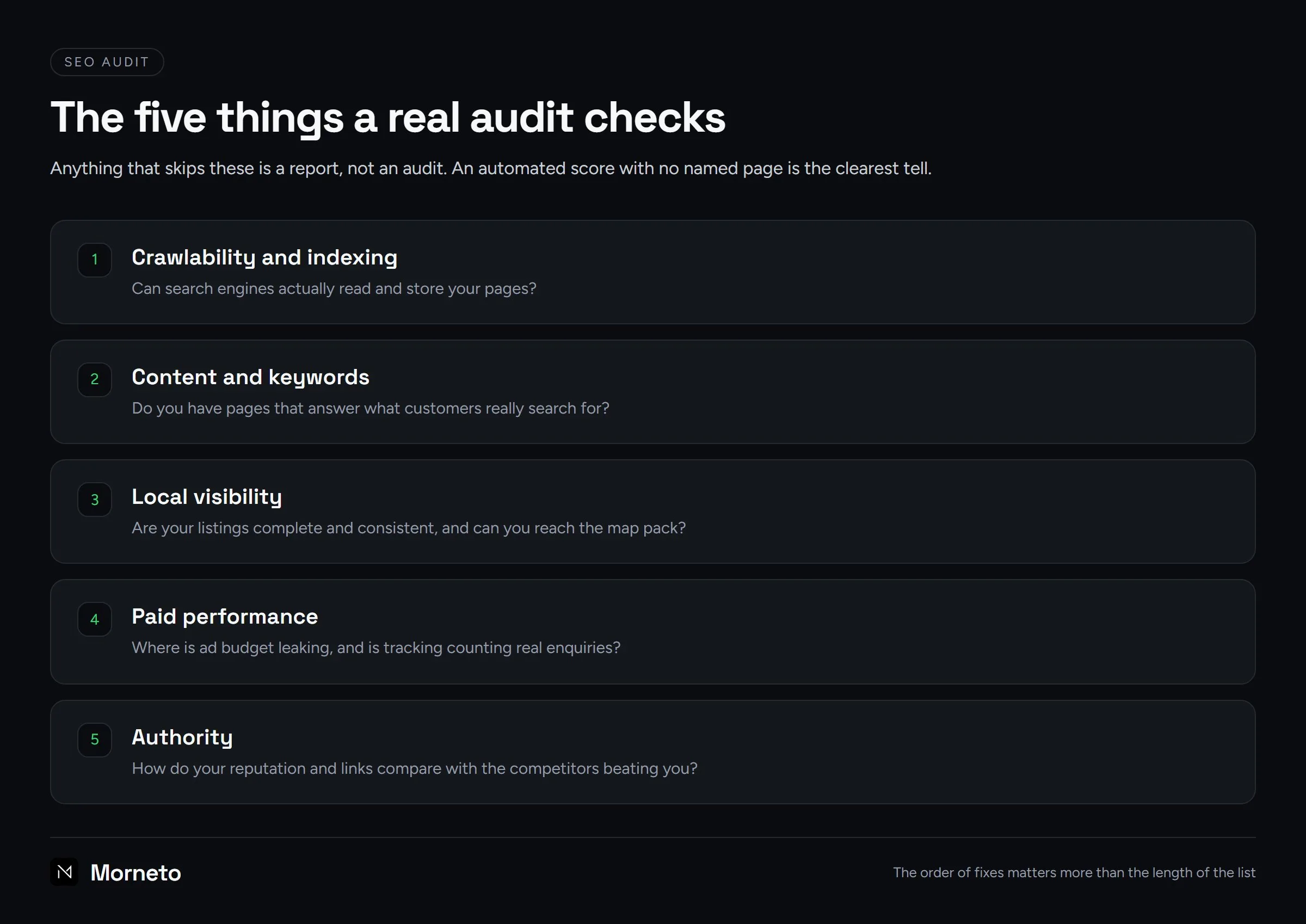
A thorough audit covers five areas, and explains each in plain language:
- Crawlability and indexing: can search engines actually read and store your pages?
- Content and keywords: do you have pages that answer what customers search for?
- Local visibility: are your listings complete and consistent, and can you reach the map pack?
- Paid performance: where is ad budget leaking, and is tracking counting real enquiries?
- Authority: how do your reputation and links compare with the competitors beating you?
Crawlability and indexing is usually where an audit finds the most, so if you want to run that check yourself first, our technical SEO checklist walks through crawl, index, speed and structure in the order that matters.
What should you do with the findings?
An audit is only useful if it ends in an ordered plan. The right response isn’t fixing all forty issues at once — start with the cheapest, highest-impact problem and work down. Often that means a technical fix or a neglected local listing — quick wins that drive calls fast. Slower work on content and authority can come after. A good SEO partner hands you this order of work as part of the audit, whether you continue with them or not. If you’re comparing providers yourself, our overview of the best SEO companies in New York lays out what separates a real audit from a sales pitch.
Free versus paid audits: which should you trust?
A free audit is not automatically worse than a paid one. What matters is whether it’s genuinely yours to keep and act on. A reputable agency often offers a free audit precisely because it proves they’re worth hiring. They’re happy for you to walk away with it. Be wary only when the “free” audit is a thin teaser that withholds the actual findings until you pay. The honest version is transparent about what it found and what it would take to fix. That is the plain-dealing principle Morneto was built on.
Which questions should a real audit answer for you?
Don’t judge an audit by how technical it looks — judge it by whether it answers the questions you actually care about. Can customers find me when they search for what I sell? If not, why not? Maybe search engines cannot read my site. Perhaps I have no page for that service. Or maybe my listing is incomplete, or a competitor is simply stronger. Where is my money leaking right now? And what is the single most valuable thing I could fix this month? A report full of jargon that never answers those questions isn’t helping you. It’s impressing you — and that’s a different thing. The best audits translate every technical finding into a plain business consequence. This issue costs you these customers, and fixing it wins them back.
Why does the order of fixes matter most?
The most valuable part of a good audit is not the list of problems — it is the order. Two businesses can have the exact same forty issues. The one that fixes them in the right sequence gets results months sooner, and for less money. Fixing content before the site is even crawlable is wasted effort. Chasing authority before your local listing is complete skips the fastest win on the board. And an audit that never opens your meta tags for SEO is skipping the cheapest fixes of all. A real audit sequences the work so each fix builds on the last, with the cheapest, highest-impact changes first. That ordering is where an experienced human still beats any automated tool. It depends on judgment about your specific market, not just a checklist of what’s technically imperfect.
In the end, a good SEO audit gives you something rare — certainty about where you stand and confidence about what’s next. You stop guessing, stop paying for the wrong fixes, and start spending on the changes that actually move enquiries. Whether or not you hire the person who ran it, that clarity is the whole point. It’s worth insisting on before any larger commitment.
If the audit points to a rebuild, read how to hire a web designer in New York without overpaying before you ask anybody for quotes.
If the audit points to a rebuild and you are in Brooklyn, start with the seven things to check before signing with a Brooklyn web design company.
The same logic applies to paid search: a good Google Ads consultant in NYC audits the account before asking for a contract.
One of the cheapest findings in any audit is the link structure itself: which posts support which pages, and which pages send nothing back. Our guide to internal links and why they matter for SEO shows how we measure it and what we found on our own site.
If the reason you want an audit is a decline rather than a launch, read why your website traffic is dropping first: it tells you in ten minutes which of the five causes you have.
Once the audit is done, the question becomes who does the work and at what price; SEO services in New York answers both.
For a worked example of turning audit findings into a plan, see our guide to running local SEO for a small Manhattan business, including a week-by-week starting sequence.
Common questions
How long should a proper audit take?
A meaningful audit takes a person time to run and interpret — usually days, not seconds. An instant PDF is a tool’s output, not an audit — the value lies in human judgment about what matters for your market.
Should a good SEO audit be free to keep?
Yes. A genuine audit is yours to keep and act on whether or not you continue. If a report hides its findings until you pay, that’s a sales teaser, not an audit.
What does a good SEO audit tell you first?
Often a technical or local-listing issue, because those are common, high-impact and quick to fix. But the point of an audit is that it tells you which problem is yours, rather than assuming. That is part of what a good SEO audit tells you before you spend on anything else.
Do I have to act on everything at once?
No. A good audit ranks the findings, so you fix the cheapest, highest-impact issue first and work down at your own pace.
Want a good SEO audit you can actually use?
We’ll tell you, in plain language, why customers can’t find you and what to fix first. The audit is yours to keep either way. Ask us for a free audit and see the difference between a real one and a sales pitch.