
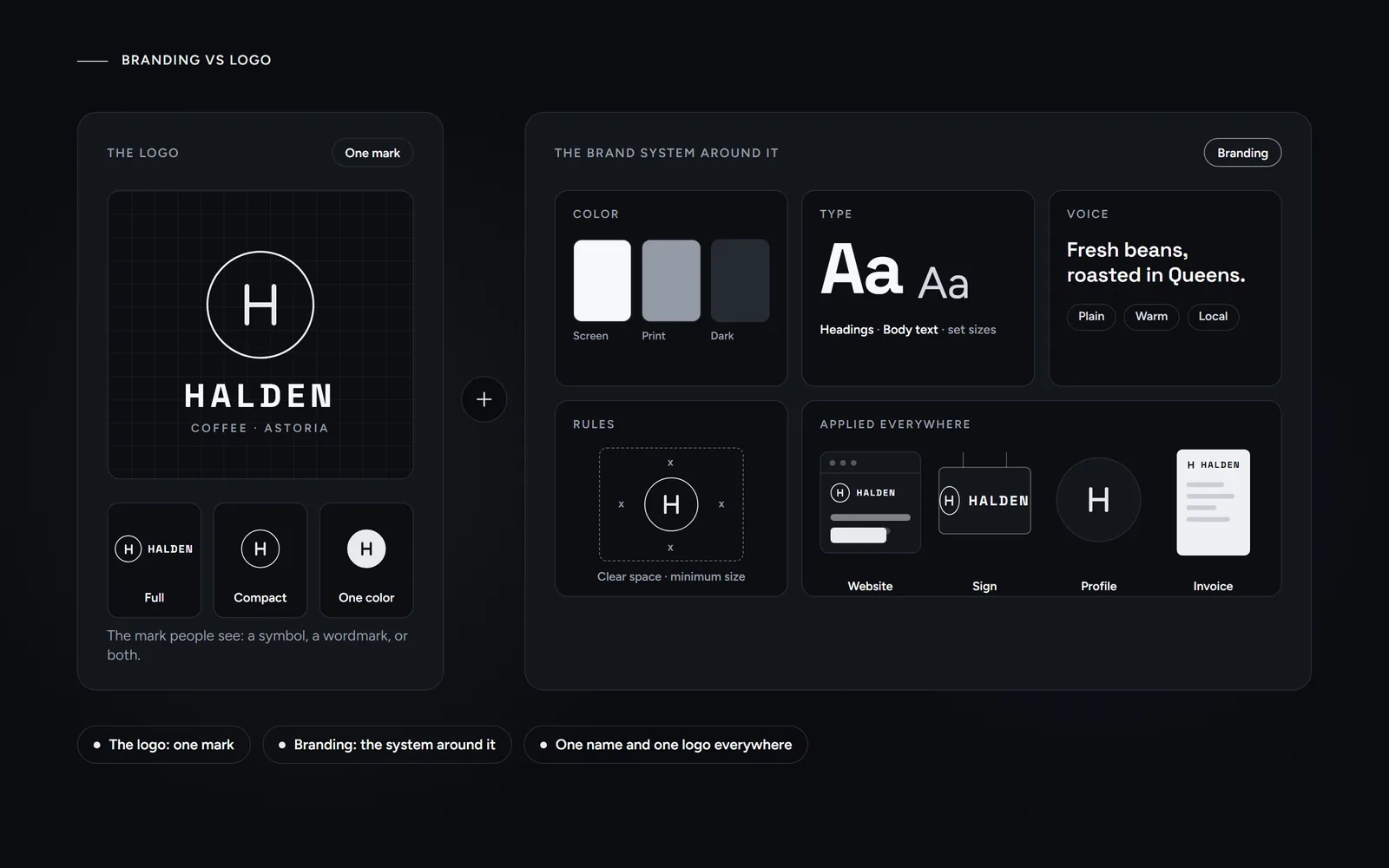
Short answer: in the branding vs logo question, the logo is one piece: the mark people see. Branding is everything that surrounds that mark, from colors, type and tone of voice to how every touchpoint looks, so customers recognize you before they read your name. Most small businesses need a usable logo first and a light brand system right after.
People often use the two words as if they mean the same thing, and then they buy the wrong one. For example, a business orders a new logo when the real problem is that nothing around it matches. People also ask it both ways. Checked in October 2026, DataWise keyword data puts branding vs logo and brand vs logo at about 110 US searches a month each, and logo vs brand at about 90. This branding vs logo guide explains the difference in plain terms and shows which one to fix first. It also covers a part many guides skip: how search engines and AI assistants connect your logo to your business.
Branding vs logo: are they the same thing?
No. A logo is a single mark, usually a symbol, a wordmark or both. Branding, by contrast, is everything that makes your business look, sound and feel the same each time someone meets it. Some guides split the words further: your brand is what people think and feel about you, branding is the work that shapes it, and brand identity is the visible kit of logo, colors and type.
Think of it this way. The logo is the name tag on the door. Branding is the whole shop: the colors on the walls, the way staff talk, the receipt you take home. So the branding vs logo difference is one of scale. The logo is part of the brand, and the brand is much bigger than the logo.
What does a logo do, and what can it not do on its own?
A good logo has three jobs:
- It identifies you. People link the mark to your name, so they can spot you on a sign, a van or a search result.
- It gets remembered. A simple, distinct shape is easier to remember after only a few glances.
- It fits small places. A browser tab, a social profile picture and a phone header all leave it very little room.
However, a logo cannot carry a business alone. It does not set the colors of your next flyer. It does not decide how your emails sound. It also cannot tell a stranger what you do or why they should trust you. If you are still choosing a style, our guide to the seven types of logos and where each one works is a good place to start.
What does branding add around the logo?
Branding turns one mark into a set of rules that everyone can follow. In practice, a small business brand usually covers these parts:
- Color. A small palette with exact codes: one set for screens and one for print.
- Type. One font for headings and one for body text, with set weights and sizes.
- Spacing. A fixed margin of empty space around the logo, and the smallest size it may appear at.
- Voice. How you write: casual or formal, playful or plain.
- Images. The kind of photos and graphics you use, and the ones you avoid.
- Application. The same look on the website, your profiles, the sign and the invoice.
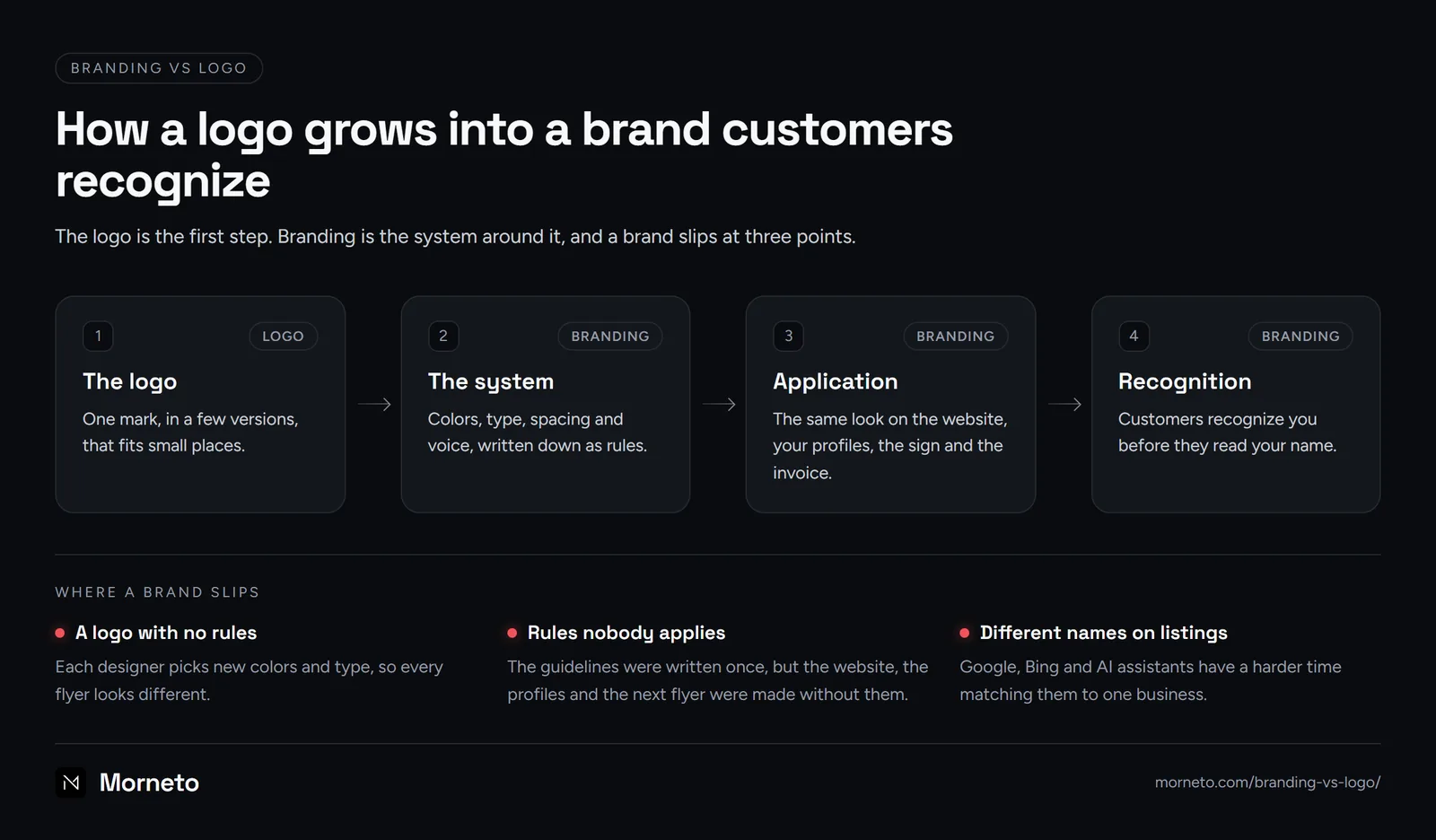
When the rules are missing or ignored, a brand slips in two predictable ways. First, there is a logo with no rules: each designer picks new colors and type, so every flyer looks different. Second, there are rules nobody applies: the guidelines were written once, but the website, the profiles and the next flyer were made without them. A third slip happens on your listings, which we cover further down. Either way, customers stop seeing one business, which is why the branding vs logo choice is rarely either-or.
A full identity of this kind is what a branding agency in New York delivers when a business has outgrown its logo. It includes written guidelines, the system and the rollout onto the places customers actually see.
Branding vs logo: how do they compare side by side?
The table below puts the two next to each other. It describes the work in general terms, not the scope of any one studio.
| Logo | Branding | |
|---|---|---|
| What it is | One mark, in a few versions | The rules and the look around the mark |
| Where it shows up | Sign, tab icon, profile picture, invoice header | Every page, post, email, package and conversation |
| What you receive | Logo files, ideally as editable vectors | A guideline document plus the applied pieces |
| How long it lasts | Often many years with small updates | Grows as the business adds new places to apply it |
| Main risk | A mark that fails at small sizes | Rules that exist on paper but not in use |
Which comes first for a small business: a new logo or a brand system?
For a small business, the branding vs logo decision depends on what you already have. Most businesses fit one of three situations:
- You are just starting. Before anyone draws, write a short brief: who you serve, what you promise and three words for how you want to come across. Then get a usable logo and write down a light system right away: two colors, two fonts and a few spacing rules. That is enough to launch a website that looks finished.
- Your logo is known, but everything around it is messy. Do not redraw it. Customers already know it, and that recognition took years to build. So spend the budget on the colors, type and spacing around it instead.
- The mark itself fails. If it turns to mush on a phone or in one color, a new logo is the right first step, and the system follows.
Budget usually settles the order, too. At Morneto, a logo starts from $250, and the final price is fixed in writing before work begins. You can compare that with what logo design costs in New York at other studios and platforms. A full identity is quoted per project instead. If you only need the mark for now, our page on logo design for New York City businesses explains what you receive and who owns the files. Finally, if a new website is part of the plan, the Full Growth package on our pricing page bundles brand work with the site.
How do Google, Bing and AI assistants connect your logo to your brand?
Search engines and AI assistants try to work out which website, listings and profiles belong to one business. Your business name is one of the clearest clues they have. Your logo matters too: it is what Google can show next to your name, and it tells people they found the right company.
- Your website. Schema markup can tell search engines which image is your official logo. Google’s documentation on Organization structured data describes the logo property for exactly this purpose.
- Your listings. Your Google Business Profile, Bing Places and Apple Maps each show a business name and let you add a logo.
- Your profiles. Social accounts and directories repeat the same mark and name once more. For a LinkedIn company page, for example, LinkedIn recommends a 400 x 400 pixel logo, as our step-by-step guide to a LinkedIn Page explains.
This is where branding vs logo stops being only a design question. When those clues match, the picture is simple: one business, one name, one logo. In contrast, when your listings use different names, Google, Bing and AI assistants have a harder time matching them to one business. Bing can even import your details from Google, as our Bing and Google listings comparison shows, so one clean profile carries over. A different logo on each one also makes customers wonder whether they found the right company.
We saw how strict the platforms are when we set up our own listings in the fall of 2026. Google turned down a longer version of our profile name because it named a service that was not on our sign. Apple’s business listing then turned down a descriptive version of the name, too. Both platforms want the name you actually trade under, and the same goes for the logo. So use one name and one logo file everywhere, and update them all at once when either one changes.
Common questions about branding vs logo
Is a logo considered branding?
A logo is part of branding, not all of it. Branding also covers your colors, type, voice, images and how all of them are applied, so the logo is one piece of a larger system.
Do all brands need a logo?
Nearly every business benefits from one, because people need a quick visual cue. Some brands use only a wordmark, which is their name in its own distinctive lettering, with no symbol. That still counts as a logo.
How do I brand my logo?
Write down the rules around it: exact colors, two fonts, clear space and a minimum size. Then apply the same files to your website, profiles, sign and invoices, and replace every old version at once.
Which should a new business pay for first?
Usually a usable logo plus a light set of rules, then a fuller system once the business grows. If your current logo is already recognized, keep it and invest in the system instead.