
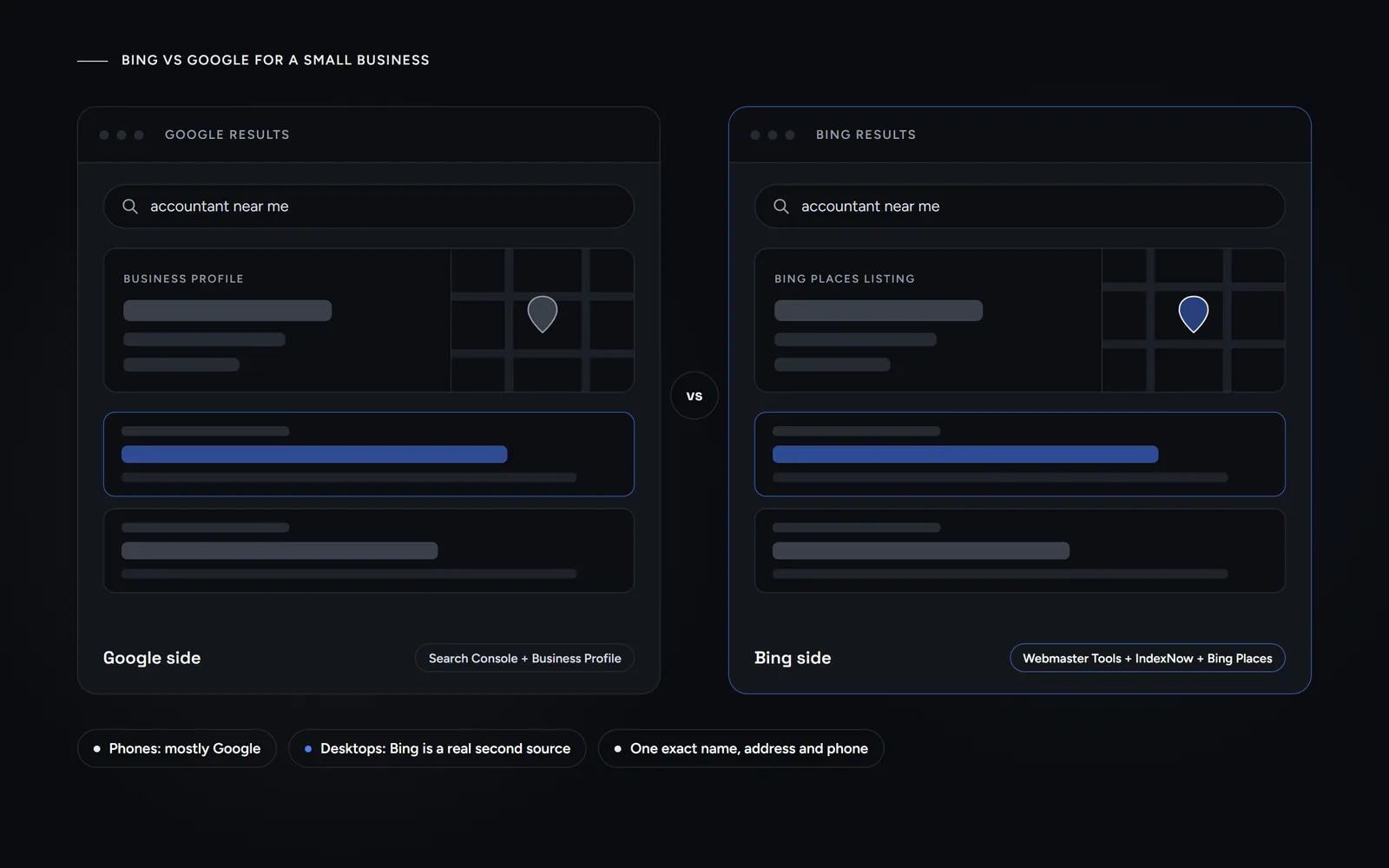
Short answer: Bing vs Google is not an either-or choice for a small business. Google sends most US search traffic, above all on phones. Bing is a real second source on desktops, where StatCounter credited it with 18.83% of US desktop search referrals in September 2026. It also feeds Yahoo and DuckDuckGo. So keep Google first, then give Bing one afternoon.
Most comparisons of the two engines are written for searchers: which one gives better answers, or which one has nicer images. This one looks at Bing vs Google from the owner’s side. Morneto is a web design, SEO and Google Ads studio in New York, and we keep our own business on both engines. For that reason, the questions here are practical. Where do your customers use Bing? Which other services rely on its results? And how much work does it take? Apart from our own Search Console data, we only use figures that StatCounter, Microsoft and the other services publish themselves, each with a date.
How big is Bing vs Google in the US in 2026?
StatCounter publishes free monthly figures by device, and they show a clear split. For September 2026, its US desktop search engine market share figures and the matching pages for all platforms and for mobile show this:
- All platforms. Google 85.19% and Bing 9.91%, followed by Yahoo at 2.63% and DuckDuckGo at 1.75%.
- Desktop. Google 74.7% and Bing 18.83%. StatCounter counts laptops as desktops too.
- Mobile. Google 94.14% and Bing 2.15%.
Two caveats keep these numbers honest. First, StatCounter does not count queries. Instead, it records a search engine referral when someone clicks a result and lands on a site that runs its code. Second, StatCounter says it may still correct a month’s figures for 45 days after first publication. So read them as a good picture of where search clicks come from, not as an exact count of searches.
For a local business, the Bing vs Google takeaway is therefore simple. On a phone, Google is almost the whole market. On a laptop or an office PC, however, almost one search click in five came from Bing that month.
Who uses Bing, and where does it reach them?
Market share hides the more useful question: in which situations does Bing show up at all? Microsoft’s own help pages point to three of them, so we start there.
- Windows PCs with Edge. Microsoft’s help page for Edge talks about keeping Bing as your default search engine, and it explains how to switch. Anyone who never changes that setting searches Bing from the address bar.
- Work accounts. The same page says Bing in Edge can show relevant suggestions from your organization when you sign in with a work or school account. In our view, that makes office PCs a natural home for Bing.
- Microsoft Copilot. Microsoft’s documentation for Copilot and Copilot Chat in Microsoft 365 says they may fetch information from the Bing search service when the web helps give a better, more grounded answer.
What we can’t give you is a reliable age or income profile. Plenty of blogs repeat one, but neither StatCounter nor Microsoft publishes it on the pages we checked, so we leave it out. For a New York business, the practical reading is simpler anyway. If your buyers decide at a desk, as an office does when it picks an accountant, a lawyer or a supplier, Bing deserves an afternoon. If they search on a phone during an emergency, then Google matters far more.
Which other services draw on Bing’s results?
Bing’s reach also goes beyond bing.com. Here is what each service says about its own sources, in its own documents:
- Yahoo. Yahoo’s help page on ranking says its search results are generated by an algorithm run by Microsoft Bing. It also says sites can advertise on Yahoo Search through Microsoft Advertising.
- DuckDuckGo. Its help page says it uses many sources, including its own crawler. It adds that it largely sources its traditional links and images from Bing.
- Microsoft Copilot. As noted above, Microsoft’s Copilot documentation says it may fetch information from the Bing search service for web answers.
- ChatGPT search. OpenAI says ChatGPT search sometimes partners with other search providers. Its help page links Microsoft’s privacy statement among those providers, but it does not say how often each one is used.
So a page that Bing indexes well can surface in more places than Bing alone. Still, be careful with bigger claims. None of these pages promises that a good Bing ranking puts you in an AI answer. Our guide on how ChatGPT search chooses the sites it cites covers that side in more depth.
How do listings and site tools compare, Bing vs Google?
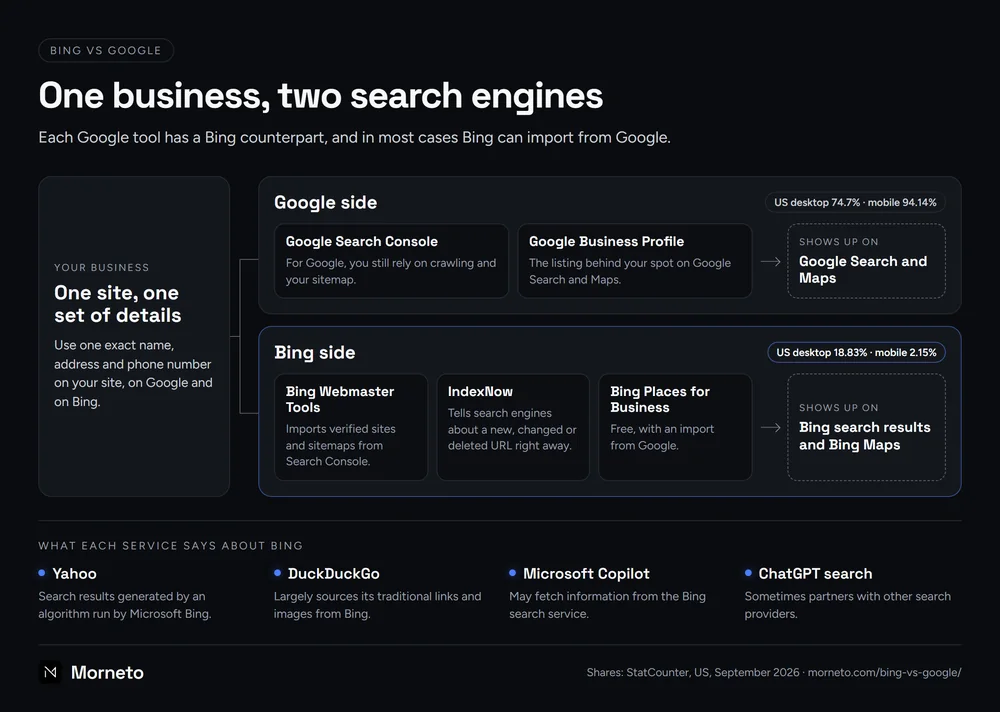
Each Google tool has a Bing counterpart, and in most cases Bing can import from Google. As a result, Bing is cheap to add.
| Area | Bing | |
|---|---|---|
| Business listing | Google Business Profile | Bing Places for Business, free, with an import from Google |
| Site owner tool | Google Search Console | Bing Webmaster Tools, which imports verified sites and sitemaps from Search Console |
| Instant URL alerts | Not listed as an IndexNow engine | Takes IndexNow submissions |
| US desktop share, Sep 2026 | 74.7% | 18.83% |
| US mobile share, Sep 2026 | 94.14% | 2.15% |
| Ads | Google Ads | Microsoft Advertising, also on Yahoo Search |
Start with listings. A Google Business Profile is the listing behind your spot on Google Search and Maps. Bing Places for Business is Microsoft’s free platform for listings in Bing search results and Bing Maps. In October 2025, Microsoft relaunched it under bing.com/forbusiness. It also said the new import from Google is faster and better at keeping the business name, hours and contact details. Our guide to claiming and syncing a Bing Places listing walks through it.
On the site side, Bing Webmaster Tools lets you import verified sites from Search Console, and Bing verifies the imported sites automatically. However, Bing notes that traffic data can take up to 48 hours to appear. Our Bing Webmaster Tools setup guide covers the reports worth reading.
Why does IndexNow matter in Bing vs Google indexing?
IndexNow is the clearest difference in how pages get found. It lets a site tell search engines about a new, changed or deleted URL right away. Bing is one of its participating endpoints, alongside Amazon, Naver, Seznam.cz, Yandex and Yep, and a submission is shared across all of them. Google is not on that list. So for Google, you still rely on crawling and your sitemap. Even then, IndexNow says each engine decides for itself whether to index a URL.
Ranking itself mostly overlaps. In practice, a fast, crawlable site with clear content does well on both engines. Our guide on getting found on Bing and the engines beyond Google explains the smaller differences.
What did our own Bing vs Google setup show?
Our own setup is small, so treat this as context, not a study. In the 90 days to October 28, 2026, Google Search Console showed 297 clicks and 15,625 impressions for morneto.com. Most of those clicks came from people who searched for our brand name. In other words, Google mainly sends people who already know us.
On the Bing side, two steps from the checklist below are in place. Since October 5, 2026, our Bing Places listing has been synced with our Google Business Profile. We also submit new URLs to Bing with IndexNow when we publish. Then, on October 31, 2026, a Bing search for Morneto showed our homepage and our New York page as the first two results.
For us, Bing vs Google was never a choice between the two. We are also not quoting a Bing traffic figure here, because our own Bing numbers are still too small to say anything useful. The honest lesson is a smaller one. The setup took little time, Bing knows who we are, and the same name and address now sit on both engines.
Should you add Microsoft Advertising next to Google Ads?
On the paid side, Bing vs Google follows the same pattern as organic search. Both platforms are keyword auctions, and Microsoft Advertising places ads on Bing and, according to Yahoo, on Yahoo Search as well. We set out costs, audiences and the import tool in our comparison of Microsoft Advertising and Google Ads, so we won’t repeat it here. In short, we run Google first and get it converting. Only then do we test Microsoft with a small share of the budget.
What can you do on Bing in one afternoon?
Here is the order we use for the Bing half of Bing vs Google. Most steps take minutes, because Bing borrows from the Google setup you already have.
- Import your site. Sign in to Bing Webmaster Tools, open My Sites, choose Import and connect Search Console. Your verified sites and sitemaps come across.
- Check the sitemap. Confirm that it shows up in Bing Webmaster Tools. If it doesn’t, submit it by hand.
- Turn on IndexNow. Your CMS, an SEO plugin or your CDN may offer it as a setting. If not, a developer can add the call. After that, each new or changed URL reaches Bing without waiting for a crawl.
- Claim Bing Places. Import from your Google Business Profile, then check the business name, hours and contact details.
- Match your details. Use one exact name, address and phone number on your site, on Google and on Bing.
- Search for yourself. Search your brand on Bing. Then try site:yourdomain.com to see roughly what Bing has indexed.
- Decide on ads later. Leave Microsoft Advertising until your Google Ads account converts.
Would you rather hand this over? Then look at our SEO plan for New York businesses, from $799 a month. It includes Google Business Profile work and AI answers in ChatGPT, Copilot and AI Overviews. Or, if you want a second opinion first, ask us for a free search visibility audit. We reply within one working day.
Common questions about Bing vs Google
Is Bing better than Google?
Not for reach. According to StatCounter, Google had 85.19% of US search referrals in September 2026. For a business, though, the real question is where your buyers search. Bing is stronger on desktops, so a small, cheap setup is worth it.
Who uses Bing the most?
Desktop users. StatCounter put Bing at 18.83% of US desktop search referrals in September 2026, against 2.15% on mobile. Also, Microsoft’s Edge help describes Bing as a default you can keep or change.
Does ranking on Google help on Bing?
Mostly, yes. The same fast, crawlable site and clear content work on both. What Bing adds is its own set of tools: Bing Webmaster Tools, Bing Places and IndexNow.
Does ChatGPT use Bing?
OpenAI says ChatGPT search sometimes partners with other search providers, and it links Microsoft’s privacy statement among them. However, it does not say how often it uses each one. Microsoft’s Copilot documentation, by contrast, says Copilot may fetch information from Bing.
Is Bing Places free?
Yes. Microsoft describes Bing Places for Business as a free platform for listings in Bing search results and Bing Maps. It can also import your details from Google.