SEO for lawyers and other sectors
SEO for lawyers, and what changes in five other sectors
Every sector here buys the same four things. A site that loads, an accurate Google profile, pages built around what people type, and reviews. What differs is which one decides whether the phone rings. The advertising policies differ too. We start with SEO for lawyers, because of the six it has the largest measured demand and the priciest clicks.
How we work
SEO for lawyers: what a firm is actually competing for
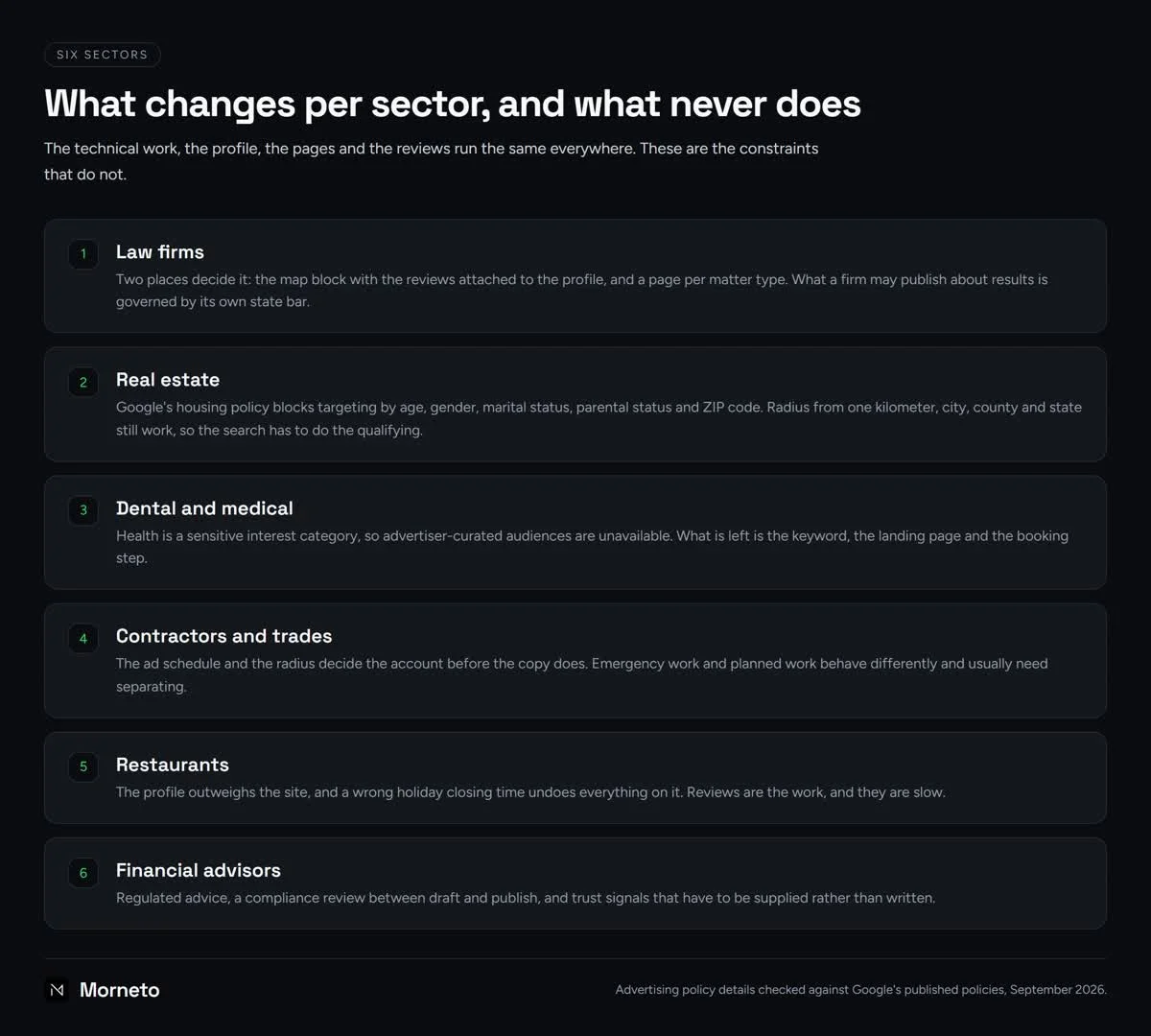
A law firm is not competing for a homepage. It is competing in two places. The first is the map block, where the profile and the reviews attached to it do the work. The second is the page that matches the matter somebody describes in their own words. That is what local SEO for lawyers is aimed at. Our local SEO service sets out the profile side in full.
The second half is the query layer. It is the half of SEO for lawyers that a services menu cannot carry. Personal injury, family, divorce, immigration, criminal defense, employment and estate planning are seven different searches. They are not seven entries on one list. Each needs a page of its own, in the client’s vocabulary rather than the statute’s. That is all SEO for personal injury lawyers is. One matter, one page, written to answer the questions the first phone call would. The same mapping is what law firm SEO means at every level below it. How those pages get built sits on our law firm web design guide, with the intake path behind them.
The prices around this category are easy to misread. In September 2026 data, the terms a partner types when shopping for help cost advertisers over $100 a click. SEO services for lawyers runs at $131.47, SEO company for lawyers at $147.68. That is the price of reaching lawyers, not the price of reaching their clients. PPC for law firms is worth planning against your own numbers rather than against those.
What a firm may publish about its own results is not ours to decide. Your state’s advertising rules govern it. New York rewrote its own in 2026, and the question belongs with your ethics counsel.
Real estate: the search has to do the qualifying
Real estate is the first of two sectors here where part of the targeting is taken off the table. Google’s housing policy for personalized advertising covers homes for sale or rental, and the services that enable them. Real estate agents are included. It blocks targeting by age, gender, marital status, parental status and ZIP code. Radius targeting still works, with a minimum of one kilometer, along with city, county and state targeting.
If you cannot select the buyer, you select the search. The property type, the transaction, the stage the person is at. Somebody typing a building type, a co-op board question or a closing problem has told you something. An audience segment would not. That is the case for SEO for real estate agents over a list buy. Ask anyone pitching you a housing campaign how they intend to target it. See whether the policy comes up before you raise it.
Dental and medical: you cannot follow the patient
Health is the other, and its restriction comes from a different direction. Google treats health as a sensitive interest category. An advertiser promoting a treatment or a procedure cannot use advertiser-curated audiences. Google’s own predefined audiences remain available. So you do not get to build a list of everyone who read the implant page. You cannot follow them for a month either.
Google Ads for dentists is won instead in the three places still open. The keyword, the landing page and the booking step. A medical practice has the same job with more paperwork. The procedure named, the insurers accepted, and how soon somebody can be seen. Then there is the part we cannot do for you. A new patient who calls at 8am and reaches voicemail calls the next practice. Our Google Ads management sets conversion tracking up before any bidding starts. At least then the failing half is visible. For the organic side, our guide to SEO for a small dental practice covers the Business Profile, review requests and HIPAA-aware replies.
Contractors and trades: two ad settings decide it
The search side of a trade business is already written up, so this section takes the half that is not. Google Ads for contractors fails on two settings long before it fails on copy. Both are easy to leave exactly as they came.
The first is the schedule. A burst pipe at 6am is not a considered purchase. An account that runs office hours misses those searches. The second is the radius. It has to match where the vans actually go. You pay for the click from an hour away exactly as you pay for the one next street over. Planned work behaves differently again, researched over weeks, so one account is usually doing two jobs. For the search half, our contractor SEO guide and the contractor web design page carry the checks worth running.
Restaurants: the rating decides more than the site
Hospitality is the sector where the website is the smaller half of the decision. People compare profiles first. Nothing on a site repairs a wrong closing time on a holiday weekend. It is also the sector with the clearest honest limit. A restaurant sitting at two stars does not have a search problem. No amount of SEO or ad spend will read as anything other than what it is. Reviews are the work there, and they are slow.
What a site does that a profile cannot is take the booking or the order directly. The margin stays in the room instead of going to a platform. That only pays once the profile and the regulars send people to it. The build itself, menu structure included, sits on our restaurant web design guide rather than here.
Financial advisors: the trust signals are not ours to invent
This is the sector where we start furthest back, and it is worth saying plainly. Advice about money is regulated. The buyer is choosing who to trust with a life’s savings. At many firms a compliance review sits between the draft and the publish button. A supplier with a shelf of financial clients can show work that has already cleared somebody’s compliance team. We cannot.
What we can do is the part that does not depend on that history. The technical work, the profile, the page structure. And pages built around the questions clients actually ask. That is where SEO for financial advisors is won. The signals that decide it are yours to supply and ours to present accurately. Credentials, registrations, a named person with a history. What we will not do is draft regulated claims. Nor will we promise that a page clears review.
Questions
Questions about SEO for lawyers and the other sectors
Is SEO for lawyers different from SEO for any other sector?
The order of work is not. What changes is the starting point and the constraints around it. Which part is actually holding you back. Which advertising policies narrow your targeting. Who inside the business has to approve a page before it goes live. The first engagement is a fixed-scope audit and fix in every sector, at the same published price.
Does a law firm need an agency that only does SEO for lawyers?
A client list is not the answer to that. A genuine specialist can tell you what it does differently. How it structures practice area pages, and how it handles what a firm publishes about results. Ask that of any agency, us included. If the reply is a list of firms and no method, it is a list. We do not call ourselves a legal specialist. We run the relationship and the strategy and bring in the specialists a project needs.
How much does SEO for lawyers cost?
The same as it costs anyone else on this page. SEO and marketing is from $799 per month, month to month with 30 days notice. There is no legal tier and no sector surcharge. Google Ads management is $497 per month up to $5,000 of spend, then 12% above that. A build is from $997 one-time. Your ad budget is separate, and in this category it deserves the longer conversation.
How long does this take?
Nobody can give you a date. A supplier who does is describing an advertisement. What we can say is the order. For a firm, the profile and the reviews attached to it move first. The matter pages and the links pointing at them build slowly behind that. The dates we do give are our own. When the audit lands, when each fix ships, when each page goes live.
Will you work with a competitor of a current client?
We do not publish an exclusivity clause. Inventing one on a web page would not make it binding, so treat a blanket promise from anybody with care. The genuine conflict is narrow. Two firms chasing the same map pack, in the same neighborhood, for the same matter type. Raise it before you sign, with us and with anyone else on your list. Get the answer into the contract rather than an email.
What if my sector is not on this list?
Then very little changes. These six are where the measured demand sits, not the only ones we work in. The audit looks at your market, your competitors and the terms people actually type. It comes back in the same shape whatever the industry label says. If your category carries an advertising restriction, as housing and health do, we name it before you spend anything.
Next step
Start with the audit
Send us your site and name the work you want more of: the matter type, the property, the job. Whether you came for SEO for lawyers or one of the other five sectors, the audit answers the same three things. Which part of the work is your constraint. Which advertising policy applies to you. What we would fix first. Send it in on the contact page, and the findings are yours either way.