Short answer: Skip ‘homes for sale’ searches, because the portals are hard for one agent to beat there. Instead, aim for your own name, a correctly set up Google Business Profile, and building, neighborhood and process questions. Follow New York’s website rules, collect reviews steadily, and judge progress at around 90 days.
Last updated September 28, 2026. Rules and policies below are quoted from the official pages linked in the text, checked that day.
The obvious target in real estate SEO is ‘homes for sale in [city]’. Search that phrase for your own borough and note who fills the first page. If it’s StreetEasy, Zillow, Realtor.com and the large brokerages, a one-agent website won’t move them.
So this guide starts from the other end. It covers what you can win, which New York rules apply to your site, and how to count clients.
Which searches can an individual agent win with real estate SEO?
Mostly the searches where a portal has little to add, plus your own name. As we see it, portals are built around inventory and say little about how one building runs.
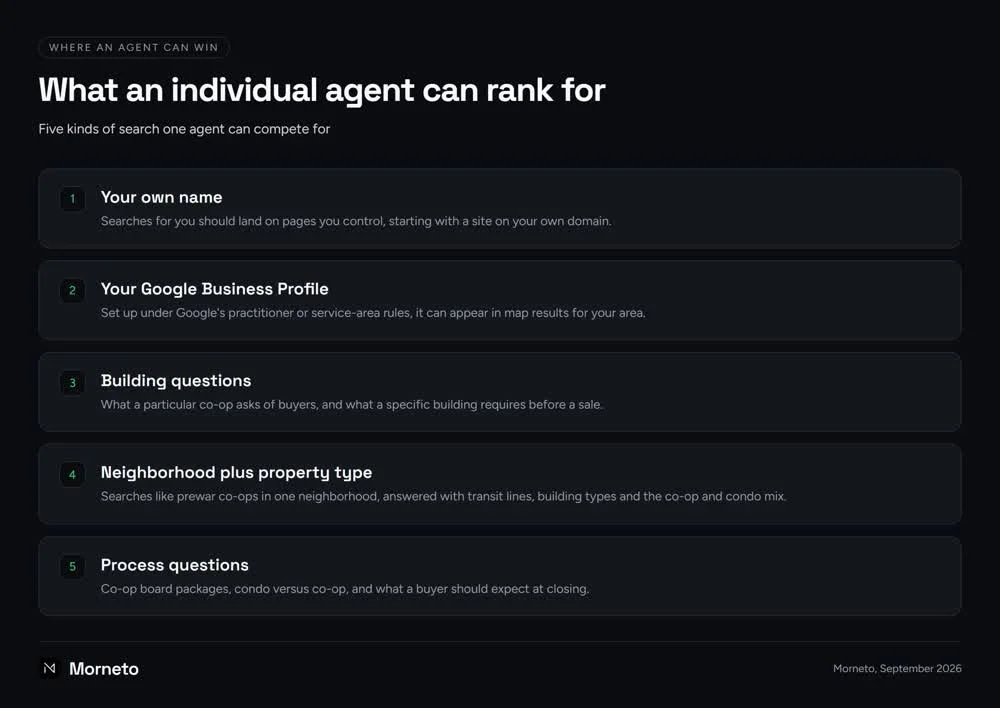
Five kinds of search are open to an agent. They are your own name, your Business Profile in map results, building questions, neighborhood plus property type, and process questions.
Building questions cover what a particular co-op asks of buyers. Neighborhood searches look like prewar co-ops in one neighborhood. Process questions include co-op board packages, condo versus co-op, and what a buyer should expect at closing.
Most of those need local knowledge that a listing feed doesn’t carry. In our view, SEO for real estate agents works best on exactly those searches. Check it yourself: search your name and your main building, then note who ranks.
Do you still need your own website if you have a brokerage page and a StreetEasy profile?
Yes, if you plan to stay in the business. A brokerage page and a portal profile are useful, but you rent both. Your own domain is the one web address you fully control, whichever firm you work for.
Ask your broker now what happens to your profile page, and the links pointing at it, if you ever leave. Either way, register the domain in your own name and keep the login yourself.
Your own site is also where real estate website SEO starts. Begin with a fast homepage that names you, your license type, your brokerage and your areas. Put your name, exactly as licensed, in the homepage title.
Then add your site’s URL to your brokerage and portal profiles wherever they allow a website link. If your site isn’t pulling its weight, start with what a useful SEO audit should show you, not a rebuild.
How should an agent set up a Google Business Profile without risking a suspension?
It depends on whether you’re public-facing at an office, the only agent at a branded office, or home-based. Google’s guidelines name real estate agents as individual practitioners, so local SEO for real estate agents starts with those rules.
- Public-facing at an office. Google’s Business Profile guidelines say you should have your own profile if you work in a public-facing role. That applies when clients can also reach you directly at the verified location during stated hours.
- The only agent at a branded office. If you’re the only public-facing practitioner there, Google says it’s best to share one profile with your brokerage. The name then follows the format Brand: Your Name.
- Working from home. If you meet clients in person elsewhere but not at home, you can qualify as a service-area business. Google says to hide the address in that case, so you don’t need a storefront.
- A rented mailbox or virtual office. Google says a rented mailing address you don’t operate from isn’t eligible. It also says a business shouldn’t create more than one profile for each location. No verification video can fix an ineligible address, as our guide to New York verification problems explains.
Before you create anything, ask your broker whether the office already has a profile. Ask too whether other agents there have their own, so you don’t create a duplicate.
Then limit the service area to neighborhoods where you show homes, and name the same ones on your site. After that, our field-by-field Business Profile guide for NYC covers categories, photos and hours.
Which pages bring clients: neighborhood pages, building pages or IDX listing pages?
In our view, building and neighborhood pages do more for an individual agent than IDX listing pages. That holds only when each one says something a feed can’t. In real estate SEO, test every page with one question. Would a buyer learn something here that a portal doesn’t tell them?
IDX listing pages
IDX puts the same listing text on many sites. Google says duplicate content on your own site doesn’t violate its spam policies. Still, it can be a poor experience and waste crawl resources, so Google recommends canonical tags or redirects. Republishing someone else’s feed without adding original value is a different case, because Google’s spam policies treat that as scraping.
So a listing page earns its place only when you add something of your own. Think notes on the building, how its board process works, or what the photos leave out. If your IDX tool creates several URLs for one listing, point them at one version with a canonical tag. Ask your IDX provider whether it already does.
Building and neighborhood pages
Here the risk is scale. Google’s spam policies treat pages created to rank for specific, similar queries as doorway abuse. Its examples include multiple region- or city-targeted pages that funnel people to one page. Generating many pages mainly to manipulate rankings, rather than to help people, counts as scaled content abuse.
So before you write a building or neighborhood page, answer three questions. Make the page only when all three answers are yes:
- Do you work there? You show or sell homes there and know the place firsthand, not from a listing feed.
- Is there something specific to say? For example, what a building’s board asks for, or how one block differs from the next.
- Is it different from your other pages? If swapping in another neighborhood name would make the page fit there too, it’s a template, not a page.
Start with the two or three buildings or neighborhoods where you do most of your business. The same logic shapes how we cover Manhattan, district by district: people there search by neighborhood, not by borough. Our overview of how SEO changes across six sectors shows where real estate differs from the rest.
Which New York rules does an agent’s website have to follow?
Check four items first: the fair housing link, broker details, your broker’s operating procedures and NYC rental ad rules. Federal fair housing law then covers the copy itself. Confirm each one with your broker, because these are regulatory requirements, not SEO tips.
- Fair housing notice. Every website a New York licensee or team creates and maintains must prominently link to the state’s fair housing notice. That rule, 19 NYCRR 175.29, has applied since June 20, 2020. Put the link on your homepage, where nobody has to hunt for it.
- Advertising information on every page. Under 19 NYCRR 175.25, a website counts as advertising. Every page of a salesperson’s, associate broker’s or team’s site, including search results pages, must carry the required advertising information. The homepage must link to the broker’s website unless the broker has none. Any ad that names a salesperson or team must also name the broker or brokerage.
- Standardized operating procedures. Real Property Law 442-h has applied since April 20, 2022. It requires brokers to date-stamp and notarize procedures for prospective homebuyers. Brokers must post them on any public website and mobile app they maintain. The procedures must cover at least whether ID, an exclusive broker agreement or mortgage pre-approval is required. Changes must be re-posted within 30 days. If you’re a salesperson, ask your broker how this applies to your own site.
- Rental ads in New York City. It is unlawful for landlords and brokers to publish ads that indicate a refusal to accept rental assistance. That covers programs such as Section 8, CityFHEPS or HASA. The same goes for ads that prefer non-voucher holders. The city also requires clear disclosure of tenant-paid fees in rental listings, in effect since June 11, 2025.
HUD’s regulation at 24 CFR 100.75 covers any ad or statement about selling or renting a home. It prohibits any such ad or statement that indicates a preference, limitation or discrimination based on a protected class. Words, photos and symbols all count.
HUD’s steering rule, 24 CFR 100.70, adds a second layer. It prohibits telling buyers they wouldn’t be comfortable with existing residents because of a protected characteristic. It also prohibits discouraging a purchase by exaggerating a neighborhood’s drawbacks for that reason. So neighborhood copy can amount to steering.
In our view, the safer habit is to describe places with facts anyone can check. Name the subway lines, the parks, the building types and the mix of co-ops and condos. Give the school district’s name if it helps, without judging it, and leave out who an area ‘suits’. Read the Department of State’s real estate advertising regulations yourself, then have your broker review your copy.
Do reviews and consistent profiles help Google and AI assistants name you?
For Google’s local results, they can. Reviews and links feed what Google calls prominence: how well known a business is. It is one of three factors local results mainly rest on, next to relevance and distance. Google also says there is no way to request or pay for a better local ranking.
So reviews are the part you can work on every week. Build the request into your closing checklist, so every client gets it, not only the happy ones. Offer nothing in return. Our guide to getting reviews without breaking Google’s rules covers the link, the timing and the wording. Ask for one review per client, on Google or on a portal profile that takes reviews.
Our guide on how clients leave a Google review has the steps. Before quoting reviews on your site, check with your broker, since New York treats a website as advertising.
Keep your name, brokerage, license type and areas identical everywhere you appear. That means your site, Business Profile, brokerage page and StreetEasy, Zillow and Realtor.com profiles. When you change firms, update every one of them the same week, so no profile still names your old brokerage.
We don’t know exactly how ChatGPT or Google’s AI answers choose an agent. Our working guess is that an agent described the same way in several places is easier to name. That includes reviews, a press or association mention, and a page that answers the exact question asked. Test it this week: ask an assistant who handles co-op purchases in your neighborhood, then note which sources it names.
How long does real estate SEO take, what does it cost, and how do you measure it?
Plan on months, not weeks. Our SEO timeline, measured on our own site, puts most sites at three to six months for measurable results. Competitive markets take six to twelve, and we’d count broad New York real estate terms as competitive.
At around 90 days, look for building names in your Search Console queries and the first calls from your profile. Don’t expect page-one rankings for borough-wide terms at that point.
The cost is your time or a fee. Doing it yourself costs mostly hours, plus the domain and hosting. Block a fixed slot each week for the profile, review requests and the occasional new page.
If you hire it out, our monthly SEO and marketing service starts at $799 per month. It runs month to month with 30 days notice.
Then measure clients, not traffic. Set these up before you judge anything:
- Key events in GA4. Count phone taps, form submissions and WhatsApp clicks as key events, so each online inquiry shows its source.
- Search Console queries. Filter by building, street and neighborhood names to see which pages gain ground.
- Business Profile calls. Track calls and direction requests from the profile month by month.
- Lead source in your CRM. Ask every new client how they found you, and record the answer. That stops a portal getting credit for a search lead.
- Cost per closed deal. Divide your SEO spend by the deals it produced. Compare that with the cost per closed deal from portal leads. That comparison shows whether SEO for realtors is worth it for you.
When should an agent run Google Ads next to SEO?
Run ads when you need inquiries now, while your real estate SEO builds. Ads also let you test which searches produce clients. The search terms your campaign pays for can show which building and neighborhood phrases deserve a page.
Google’s housing ads policy bars targeting by gender, age, parental status, marital status or ZIP code. It applies to real estate services in the US and Canada. City, county, state and a radius of at least 1 km remain available.
So send each ad group to the one building or neighborhood page it matches, not your homepage. Then check which of those pages turn clicks into inquiries. Our guide to Google Ads costs for small businesses covers real estate separately.
Start with the free steps this week. Search your own name and check your Business Profile against Google’s practitioner rules. Then confirm the fair housing link and broker details on your site. If you want help after that, our published price list sets out our rates.
Common questions about real estate SEO
Can a small agent rank above Zillow or StreetEasy?
Rarely for broad searches like homes for sale in a borough, in our view. A small agent has a fair chance on specific building and process questions, where a portal has little to add. Their own name is winnable too, since their own site can appear beside their portal profiles.
Should real estate agents blog?
Yes, if each post answers one question buyers or sellers actually ask you. Good seller-side topics are what to prepare before listing a co-op and how one building handles sublets. Skip market news you can’t add to, and open every post with a direct answer.
Is SEO better than buying portal leads?
They do different jobs. Portal leads depend on whatever program you pay into, while the pages and reviews you build stay yours. In our view, SEO is slower but keeps its value longer. Track cost per closed deal for both in your CRM, and let those numbers decide the split.
Does real estate SEO work for rental agents?
It can, with the same logic: building and neighborhood questions, a correct Business Profile and steady reviews. Rental listings in New York City carry extra rules on fee disclosure and on ads that signal refusing rental assistance. Have your broker check your listing copy before it goes live.