Short answer: restaurant web design in 2026 has to answer three questions on a phone screen in seconds, namely what you serve, when you are open, and how to book or order. So the menu belongs on a real web page rather than in a PDF, and the hours and address should match your Google Business Profile exactly. Our builds of 5 to 15 pages start from $997 one-time.
Last updated September 20, 2026. Every price below comes from our published pricing page, which lists our prices and the typical New York ranges.
Most guests meet a restaurant twice before they taste anything: once in Google Maps, comparing places a few blocks apart, and once on your website, on a sidewalk with one hand on the phone. So restaurant web design in 2026 is about winning those two moments.
What does restaurant web design have to do in 2026?
A restaurant site has a shorter job than most business websites, since people arrive already interested. So it either confirms the decision or loses it. Five things carry that weight.
- The menu, as a web page. Usually the first thing a guest looks for, so it belongs in text on your own site, not in a file to download.
- Hours, address and phone. Today’s hours, a tappable number, and an address that opens directions in one tap.
- Photos of the real room and real plates. Guests are deciding what the evening will feel like, not only what they will eat.
- One clear action. Book, order or call. Specifically, pick the one your business runs on and put it where a thumb lands.
- Speed on a phone. A page that stalls on a weak connection is a page nobody sees.
Everything else is optional. Our website design and build work for New York restaurants starts from that list, since a site doing those five things well beats a larger one that buries them.
Why should your menu be a web page instead of a PDF?
The PDF menu is a very common inherited mistake in restaurant web design: someone had a print file, so it went online. On a phone it costs you four ways.
- It is unreadable on a phone. A print layout does not reflow, so the guest pinches, zooms and drags around a page built for paper.
- It leaves your site. A PDF opens in a viewer or downloads, so the guest is now in a file rather than on a page with a Book button.
- Nobody can link to a section. Dish names, descriptions and dietary notes land in a downloadable file instead of on a page you can link to and update in a minute.
- It goes stale. Every price change means editing a design file, exporting it and reuploading it, so a PDF menu quietly falls behind the kitchen.
Google’s structured data documentation for local businesses treats the menu as an address on the web: for food establishments it recommends “the fully-qualified URL of the menu” as a property. So a page you can link to, section by section, beats a file you can only attach.
An HTML menu also answers the long tail nobody plans for: a dish name, a dietary need, a neighborhood plus a cuisine. That text is the practical side of getting a small business found by AI tools, since assistants read it when someone asks where to eat nearby.
Do your hours, address and phone match your Google Business Profile?
This is the cheapest fix in restaurant web design, and also the one most often left broken. Your site, your Google Business Profile and your delivery listings should carry the same address, number and hours, written the same way.
- Hours, including the exceptions. Holidays, a kitchen that closes before the bar, a brunch window. Otherwise guests arrive at a dark door.
- One phone number. Similarly, not a tracking number on the site and a different one on the profile.
- The address in one format. Likewise, the same suite or floor notation and the same abbreviations, every time.
- Service details. Delivery, takeout, outdoor seating and reservations should say the same thing in both places.
Of course, the point is not that a mismatch triggers a penalty. Rather, a guest who finds two different closing times stops trusting both.
Why does the Google Business Profile carry more first visits?
For a restaurant, the profile often is the storefront. People search a cuisine near them, scan the map, photos and reviews, and only then tap through. Some never tap through at all, since the profile already answered the question.
So the profile belongs in the build rather than after it. It is free to claim, and your site content should feed it: categories, hours, a link to the menu page, ordering links, and your own photos. Meanwhile, ordinary local SEO and Google Business Profile work keeps the two in step, though it never replaces a site you control.
What do photos add to restaurant web design?
Photography does more work on a restaurant site than copy does, so it deserves budget before anything decorative. In a walk-in neighborhood like Greenwich Village, people choose where to eat from photos, hours and a star rating.
- Shoot the actual room. Stock photography of somebody else’s dining room reads as a warning sign rather than as polish.
- Show the plates you serve. Specifically, signature dishes, at the portion size that arrives.
- Include the room at service. Light, crowd, tables set. That is what tells a guest whether the evening fits.
Photos are usually the heaviest files on a restaurant page, so size and compress them before they go up. A gallery of full-resolution images stalls a page on a phone, and because page speed reads as lost customers, the delay lands exactly while the guest is deciding.
Should you take orders and reservations yourself or through a marketplace?
There is a real trade-off here, though anyone who says one answer fits every restaurant is selling something.
- A marketplace buys reach. Delivery apps and booking platforms reach people who have never heard of you, and they handle payment, support and drivers.
- A marketplace charges per order. Commission comes off every order, including from regulars who would have ordered anyway, so the platform keeps that guest relationship.
- Your own ordering keeps the margin and the data. You know who ordered and how to reach them, and a repeat order carries no commission.
- Your own ordering needs demand. Nobody finds your order page by browsing. Instead, it works once your profile, your site and your regulars send people there.
Generally, restaurants end up running both and moving repeat guests toward the direct channel over time. Either way, a direct ordering flow is integration work rather than page design, so how an online store gets built and priced is the closer comparison. Before modeling either option, read the current merchant terms yourself, since rates change.
How fast does a restaurant website need to be on a phone?
Restaurant web design has to be fast enough for a street rather than for office Wi-Fi. So the real test conditions are a crowded sidewalk, one or two bars of signal, bright sun and one thumb.
- A heavy hero video. Usually the first thing to cut on a slow home page, and the least useful thing on it.
- Stacked third-party scripts. A booking widget, an ordering widget, a chat bubble, a popup and three trackers, all loading before the menu does.
- A menu behind an extra tap. Every step between the home page and the menu costs you guests who are still choosing.
The fixes are unglamorous and mostly free: compress the images, remove the scripts you cannot justify, and put the menu one tap from anywhere. Our guide to making a slow website faster lists them in order of effect. Meanwhile, we hold new builds to a performance budget from day one, which is what performance-first web design in New York means in practice.
What does restaurant web design cost?
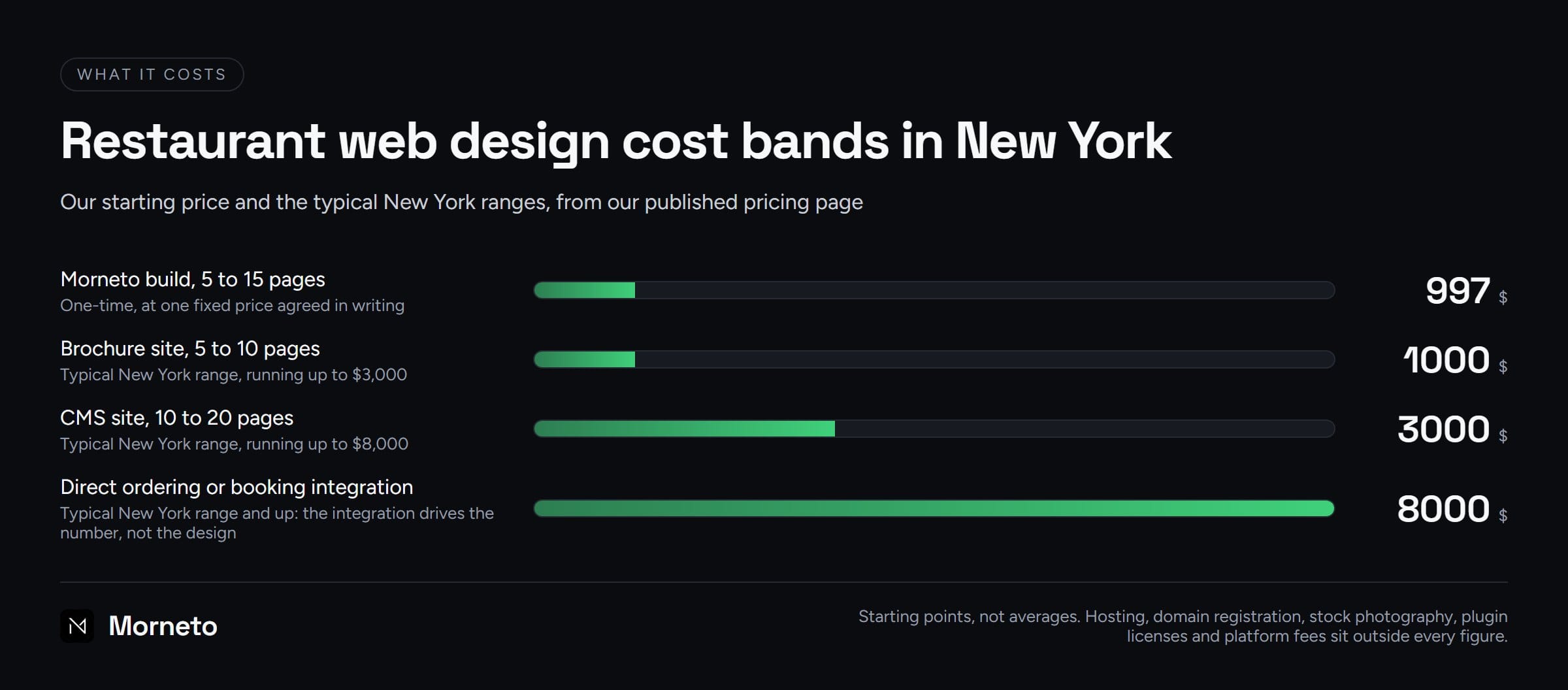
Restaurant web design cost follows scope, like any other build. So our published prices and the typical New York ranges give a straight answer:
- A Morneto build, 5 to 15 pages: from $997 one-time. Room for a home page, menu pages, an about page, a contact page and an events page, at one fixed price in writing.
- Brochure site, 5 to 10 pages: roughly $1,000 to $3,000. Specifically, the typical New York range for a site of that size.
- CMS site, 10 to 20 pages: roughly $3,000 to $8,000. The typical New York range once a site carries several menus, locations, a blog or events you update yourself.
- Direct ordering, payments or a booking integration: typically $8,000 and up in this market. The integration drives that number rather than the design, so we quote it per project against a written scope.
- Ongoing work: from $799 per month. Local SEO, Google Business Profile work, content and reporting, month to month with 30 days notice.
Outside all of those numbers: hosting, domain registration, paid stock photography, premium plugin licenses, and whatever your ordering platform charges. So a quote that leaves them out is not cheaper, only less complete. Side by side, the bands show that features move the price more than page count does.
Independent restaurants usually sit in the first two bands, so our guide to small business web design in New York covers the same territory. Trades with their own rulebook price differently again, which is why web design for a law firm carries constraints a restaurant never meets. Which of the four things decides the call is different again in every trade, and our breakdown by sector names the constraint for each one. Weighing a rebuild against a repair? Then the breakdown of what a redesign costs and what carries over is the better starting point, and our full published price list carries every figure above.
For a restaurant web design quote with a real number on it, send us your current site and your menu, and after one call you get a written scope with one fixed price and one launch date. The audit is free either way.
Common questions about restaurant web design
How much does a restaurant website cost?
Our builds of 5 to 15 pages start from $997 one-time. The typical New York ranges on our pricing page run roughly $1,000 to $3,000 for a 5 to 10 page brochure site and $3,000 to $8,000 for a CMS site of 10 to 20 pages. In this market, direct ordering or a booking integration starts around $8,000.
Does a restaurant need a website if it has Instagram and a Google profile?
Yes, for one practical reason: you do not own the other two. An account can be suspended, and neither hands you the guest list. Both are where people find you, though the website is where the menu lives, bookings happen, and the details stay correct.
Should a restaurant menu be a PDF or a web page?
A web page. A PDF does not reflow on a phone, pulls the guest into a file viewer, and is slow enough to edit that it falls out of date. Keep a PDF for printing, though guests should meet a page you can link to and change in a minute.
Should we use an online ordering platform or take orders on our own site?
Many restaurants end up with both. A marketplace reaches people who have never heard of you and takes a commission on every order, including repeat ones. Direct ordering keeps that margin and the guest data, though it only works once your profile, site and regulars send people to it.
What should a restaurant website include?
A menu as a real web page, today’s hours, a tappable phone number, an address that opens directions, photos of your own room and plates, and one obvious action such as book, order or call. Everything on that list should match what your Google Business Profile says.