Short answer: contractor web design is not about photographs of finished kitchens. It is about six things a homeowner checks in under a minute: what you do, where you work, whether you are licensed and insured, what it roughly costs, proof you have done it before, and a way to reach you with one thumb. Get those on one fast page and the site books jobs.
Last updated September 2, 2026. Licensing rules quoted below are New York City’s own published requirements. Prices are our own published rates. No invented case studies and no client numbers we cannot show.
Most contractor websites are built like a portfolio and used like a phone book. The homeowner is standing in a half-demolished bathroom at nine in the evening, on a phone, comparing three names a neighbor gave them. They are not admiring your gallery. They are checking whether you are real, whether you cover their block, and whether you will pick up. This guide is how to build for that person, whether you search for it as contractor web design, contractor website design or website design for contractors.
What contractor web design has to do
A contractor site has one job: turn a nervous stranger into a booked estimate. That is a narrower brief than most agencies work to, and it is why so many trade websites underperform. The brief barely changes by trade. A general contractor, a roofing or electrical outfit and a construction company all need the same answers. They were designed to look established. They needed to be designed to answer questions.
The difference shows in the first screen. A decorative site opens with a full-width photo and a slogan. A working site opens with the trade, the areas covered and a phone number that dials on tap. Consequently the working site wins even when the photography is worse, which is the same principle we set out in performance web design.
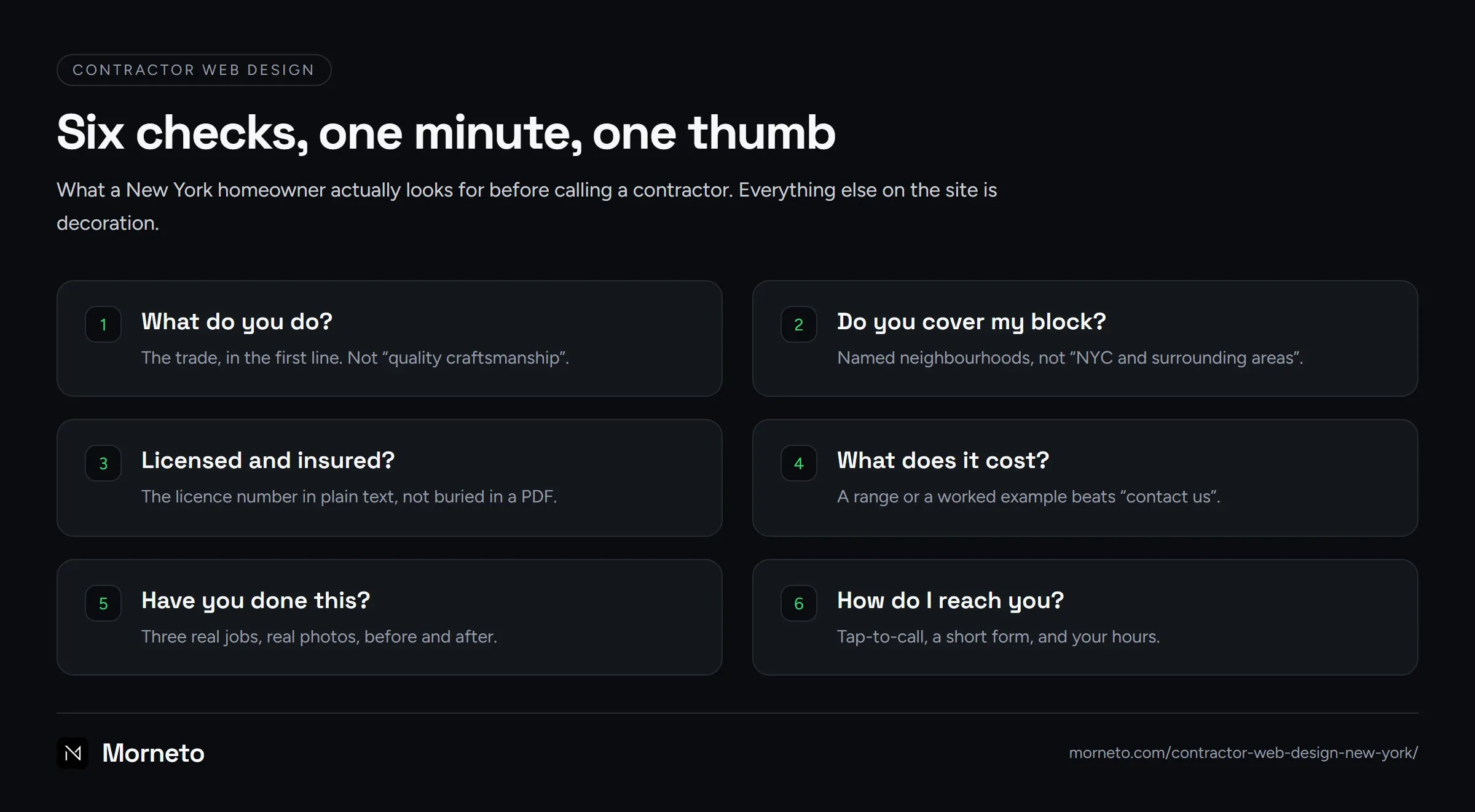
The six things a homeowner checks first
| The check | Where it belongs | What goes wrong |
|---|---|---|
| What do you actually do | First line of the home page | “Quality craftsmanship since 1998” says nothing |
| Do you cover my block | Named neighborhoods, not “NYC and surrounding areas” | A borough list reads as a call center |
| Are you licensed and insured | License number visible, not buried in a PDF | Claiming it without showing it |
| What does it roughly cost | A range, or a worked example | “Contact us for a quote” loses the cautious ones |
| Have you done this before | Three real jobs with real photos | Stock images of somebody else’s kitchen |
| How do I reach you | Tap-to-call, a short form, and your hours | A ten-field form and no phone number |
Notice how little of that is design in the decorative sense. It is information architecture with a deadline. Additionally, every one of those six answers is something an estimator already says on the phone twenty times a week, so the content already exists. It just is not written down yet.
Keep the page count small while you do it. Five pages, built properly, outperform twelve half-finished ones, and the argument is laid out in small business web design NYC.
Trust signals that are specific to New York
Anyone doing construction, repair or remodeling work on a home in New York City needs a Home Improvement Contractor license from the Department of Consumer and Worker Protection. The city publishes the license application checklist setting out exactly what that involves. It also gives homeowners a tool to check a license status before hiring. Therefore putting your number on the site, in plain text, is not a legal footnote. It is a conversion element.
Three more that matter locally. Buildings with a co-op or condo board will ask for a certificate of insurance, so saying you can produce one removes a real objection. Walk-up access, freight elevator hours and parking all affect a quote, so a sentence acknowledging them signals that you have worked here before. And a photograph of your van on a street somebody recognizes does more than any stock image ever will.
Above all, the address question needs handling honestly. Most contractors work from a yard or a home base rather than a shopfront, which makes them a service-area business in Google’s terms. That is a supported setup and it is explained in our glossary entry on a service area business. Inventing a closer address instead is the single fastest way to get a listing suspended.
How contractors get found on Bing and in AI answers
Trades are one of the categories where people genuinely ask an assistant rather than a search box. “Find me a licensed contractor in Astoria who does bathrooms” is now a normal request. Those answers get assembled from public, structured facts: your listing, your reviews, and pages that state plainly what you do and where. SEO for a construction company works the same way: the facts have to sit on the page in plain words before anything can quote them.
Two practical consequences follow. First, write in answers rather than adjectives, because a sentence like “We are licensed for home improvement work in all five boroughs and carry general liability insurance” can be quoted directly. A sentence like “Your trusted partner in home transformation” cannot. Second, do not ignore Bing. It is the engine behind Microsoft’s assistant, it takes minutes to claim a listing, and competition there is thinner. We cover the whole route in how to get found on Bing and the wider shift in how to get found by AI.
If your enquiries have been sliding without an obvious cause, this is often the reason, and why website traffic is dropping works through the five causes in order.
What contractor web design costs
Our builds start at $997 one-time, with the page list and the launch date agreed before work begins. Around the city, a freelancer will usually quote $500 to $2,500, a small studio $1,000 to $6,000, and a Manhattan agency $8,000 upward. For a contractor site, the upper end rarely buys anything the homeowner notices.
Spend the difference on being found instead. A complete Google Business Profile costs nothing but attention, and the method is in Google Business Profile optimization for NYC. Local SEO work from us starts at $799 a month. If you would rather buy the phone ringing immediately, Google Ads management starts at $497 a month, and a Google Ads budget for a small business sets a realistic starting figure.
Whichever route you pick, get the ownership question answered in writing first. The domain, the hosting, the site files and the ad account should all be in your name. Our web development agency in New York page sets out what we hand over, every price sits on the pricing page, and the free audit will tell you whether your current site is worth fixing or worth replacing.
A site is only half the job for a trade business. Once the pages exist, what actually gets a contractor found in New York search covers the order of work, from the profile through trade pages to the co-op and DOB content almost nobody in the trade writes.
Common questions about contractor web design
How much should a contractor website cost?
Between roughly $997 and $6,000 for a five to ten page site from a small studio, or $500 to $2,500 from a freelancer. What matters more is what is written down before you pay: the page list, the launch date, and who owns the domain, hosting and accounts at the end.
Do I need to show my license number on the website?
You are not obliged to put it on a web page, but you should. Homeowners in New York are told to verify a contractor’s license before hiring, so showing the number in plain text removes a step and a doubt at the same time. Put it in the footer and on the contact page.
Should I list prices if every job is different?
List ranges or a worked example rather than fixed prices. Something like “a typical full bathroom in a pre-war walk-up runs between X and Y, depending on plumbing” sets expectations without committing you. The alternative, a bare “contact us for a quote”, loses the people who are still deciding whether to call anyone at all.
How many photos of past work do I need?
Three complete jobs beat thirty scattered shots. For each one show a before, an after and a line about what the problem was. Real photographs from a phone work better than stock images, because homeowners recognize the difference immediately.
Is a website even worth it if most of my work comes from referrals?
Yes, because referrals check you online before calling. The site is not replacing word of mouth; it is confirming it. A referred homeowner who finds nothing, or finds a broken site from 2014, often quietly moves on to the next name on the list.
How long does a contractor website take to build?
Two to six weeks once the text and photos exist. Content is nearly always the delay rather than the build. So collect ten job photographs and write a paragraph per service before you sign anything, and the whole project shortens by weeks.