Short answer: Google Ads for small business has three costs, not one. There is the ad budget you pay Google, the fee you pay whoever runs the account, and the page the click lands on. The budget is whatever you set, and you can change it any day. Our Google Ads management is $497 per month for accounts spending up to $5,000 per month, then 12 percent of ad spend above that.
Last updated September 20, 2026. Prices are the ones published on our pricing page that day.
Look at what people actually type about Google Ads for small business, and almost all of it is about money. Is ten dollars a day enough? What about twenty, or five hundred a month? Then come the follow-ups: what a click costs, and what an agency charges on top. This guide answers each of those. It also covers what has to work before you spend anything.
What do Google Ads for small business actually cost?
Most quotes name one number when there are three. The three also behave very differently.
- The ad budget. Paid to Google directly, from your own card, in an account in your own name. You set it, you see it daily, and you can pause it in a minute.
- The management fee. What you pay whoever builds the campaigns, writes the ads and reads the results. It is charged monthly, whether or not the ads worked.
- The destination. A click has to land somewhere that answers the search. If the page is slow, vague or missing a phone number, you paid for the visit and got nothing back.
The third is the one people forget. It is also the only one that keeps working after you stop paying. A page that converts helps your ads and your organic results at once. That is why our Google Ads work for New York businesses starts with a free audit of the account, before any bidding.
Is $20 a day enough for Google Ads?
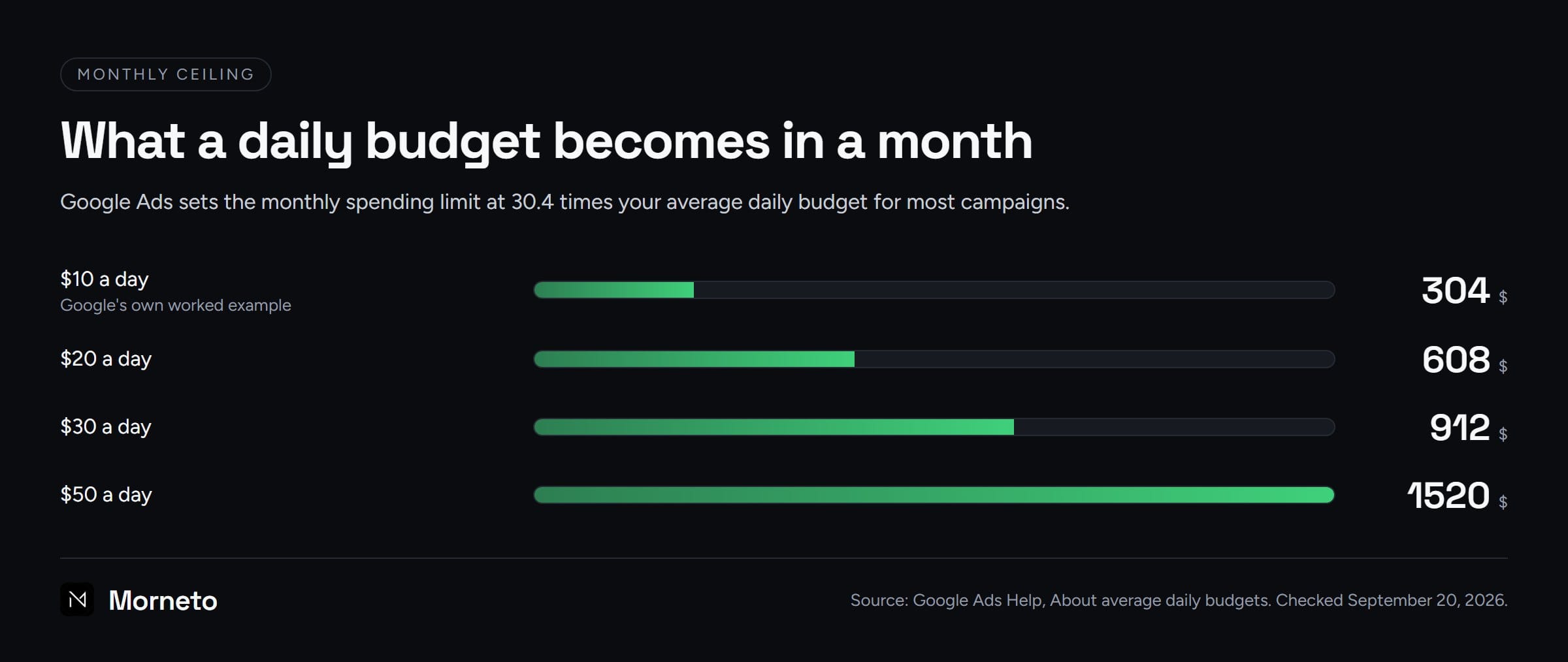
Twenty dollars a day is a real starting point for one service in one area. First, though, it helps to know what Google does with that number. A daily budget is an average, not a cap. Google Ads Help puts the monthly spending limit at 30.4 times your average daily budget for most campaigns, and the daily limit at two times that average.
So $20 a day is up to roughly $608 in a month. Meanwhile, a single busy Tuesday can cost $40 without anything being wrong. Google’s own example runs the other way: divide $304 by 30.4 and you get a $10 average daily budget. The same multiplication works at any level. Thirty dollars a day is about $912 a month, and fifty dollars is about $1,520.
Whether that is enough is arithmetic you can do before you spend. Suppose a click costs $8, and one click in twenty becomes an inquiry. Then $608 buys about 76 clicks, or three to four inquiries a month. If a customer is worth $3,000, that works. If a customer is worth $150, it does not, and no campaign tuning fixes it.
Is $500 a month enough for Google Ads?
Five hundred dollars a month is about $16 a day. That is enough to learn something. It is not enough to do everything at once.
- It works when the target is narrow. One service, one borough or a short list of zip codes. Five to fifteen keywords that a buyer would type. Ads running during the hours you can answer the phone.
- It runs out fast when the target is wide. Five services across all five boroughs, running around the clock on broad terms, spends the month in a week.
- It rarely survives expensive categories. Legal, medical, insurance and emergency trades bid high, so a small budget buys very few clicks there.
In short, a small budget buys focus rather than reach. Location changes the math too: Google Ads accounts in Brooklyn pay less per click than Manhattan ones, so a smaller budget goes further there. Our separate walkthrough of how to set a Google Ads budget in New York works those numbers through in more detail.
What does a click cost for a small business?
There is no price list for Google Ads for small business. Anyone quoting one figure for your industry is repeating an average from somewhere else. Every click is an auction, and three things move the result.
- How many others want that search. Competition sets the floor, and in New York there are usually more bidders chasing the same search.
- What a customer is worth to them. Bidders who make thousands from one job can pay far more per click than bidders who make forty dollars.
- How relevant your ad and page are. The auction takes relevance into account, so a tighter page can lower what you pay for the same position.
This is also why Google Ads for contractors varies so much from one trade to the next. An emergency plumbing search and a search for kitchen remodeling ideas behave nothing alike. One is a customer in trouble, the other is browsing. Sending both to the same page wastes the expensive click. A contractor website with a page per service gives each search a page that matches it. Our breakdown of what Google Ads for plumbers cost per booked job puts numbers on the plumbing side.
For a figure grounded in your own market, open Keyword Planner in your own account. Ask for your keywords in your area, then read the bid estimates it returns. It is free, and it uses your own targeting. If someone is pushing you straight into Performance Max, read what Performance Max actually does before you agree to it.
How much does Google Ads management cost?
Management is usually priced one of three ways. The structure tells you more than the number.
- A flat monthly fee. Predictable, and it does not reward anyone for talking you into a bigger budget.
- A percentage of spend. Common above a certain size, but it ties someone’s income to how much of your money they spend.
- A hybrid. A flat fee up to a spend threshold, then a percentage above it, which is what we do.
Ours is $497 per month for accounts spending up to $5,000 per month, and 12 percent of ad spend above that. It covers campaign setup, Search, Performance Max and remarketing, plus negative keywords and conversion tracking setup. A free account audit comes first. The ad budget is paid to Google directly, and the account stays in your name. Our pricing page carries the rest of the numbers in writing.
Our studio runs the strategy and the account, and we bring in specialists per project for the build work around it. So you always know who owns your account and who to call. If you are comparing studios, our notes on what to ask before you hire someone to run ads are the place to start. Our piece on working with a Google Ads consultant in New York separates a manager from a reseller. Three answers should end a conversation. The account will not be in your name. Conversion tracking costs extra. Reporting is a dashboard nobody will explain.
What has to be in place before you spend anything?
Ads expose whatever is already there. These four things belong in place before the first click, while they are still cheap to fix.
- Conversion tracking. Decide what counts as a result: a form, a phone call over thirty seconds, a booking or a directions request. Then have it recorded in the account. Without it you are buying traffic and guessing.
- A page that answers the search. Name the service the ad promised, the area you cover, proof, and one obvious next step. Speed belongs here too, because a heavy page on mobile data quietly erases the click you paid for. Our piece on what a slow site costs you in lost customers puts money against that.
- Call tracking basics. Turn on call reporting and call assets, so calls from ads are counted. Use a number that rings someone who can quote. Then decide who answers in the evening. For most service businesses the phone is the conversion.
- A negative keyword list from day one. Words like jobs, salary, free and DIY stop you paying for people who were never going to buy.
When are Google Ads for small business worth starting?
Ads buy attention that already exists. They do not create demand. So the honest test is whether people already search for what you sell.
Google Ads for small business are worth starting when four things are true. People search for your service by name. You can say roughly what one customer is worth. An inquiry gets answered the same day. Your margin leaves room for the cost of winning the job. Ads also make sense when you need work this month, because they are one of the few channels that turn on that fast.
They are not worth starting when the searches do not exist. The same goes when the whole budget buys a handful of clicks a week, when the page cannot take a booking, or when nobody answers the phone. Then the money belongs in the site first. Our comparison of whether a new website or better SEO comes first is the faster read. That logic also holds if you want traffic that compounds rather than traffic you rent. Building it is what our SEO and marketing work in New York is for, from $799 per month.
We will not promise a ranking, a cost per lead or a timeline before an account has data. What we will do is look at what you already have. Send us the account, and we will say whether ads are the right move, including when the answer is no. That audit is free. In the end, Google Ads for small business is worth starting the day the math works, and not before.
What should a dental practice expect to pay?
Google Ads for dentists splits sharply between two kinds of search. Somebody typing “emergency dentist” on a Sunday evening is worth a high bid. Somebody reading about implant types is months away from a chair and will eat the budget first. So the early work is negative keywords and match types, not a bigger daily number.
There is also a rule that catches practices out. Google’s advertising policies treat health as a sensitive interest category, and advertisers in that category cannot use advertiser-curated audiences, which is the remarketing you would normally build from your own visitors. Google’s predefined audiences stay available, but you cannot lean on following everyone who read the implant page. The first click therefore has to do more of the work, and that weight lands on the destination: one procedure per page, the phone number visible without scrolling, and a booking that works on a phone. That booking step is where uptown practices on both sides of Central Park lose the most inquiries. Our SEO guide for small dental practices covers the unpaid side of the same search, from the Business Profile to treatment pages.
What is different for a real estate agent?
Google Ads for real estate agents runs into a rule before it runs into a budget. Real estate advertising falls under Google’s housing policy in the United States, and that policy removes the levers most agents reach for first. Age, gender, marital status and parental status cannot be used to target housing ads, and ZIP code targeting is not available either. Radius targeting is allowed, with a minimum of one kilometer around a location, and so is targeting by city, county or state.
That changes the plan rather than ending it. The geography gets drawn as a radius or a city, and the qualifying moves into the ad text and the page instead: the price band, the neighborhood, the type of property. An ad that says plainly what it is about gets skipped by the wrong reader, which is the point. Our guide to real estate SEO for individual agents covers the building and neighborhood pages those ads should land on.
The other difference is the clock. A buyer or a seller takes months, so clicks are a poor measure and calls, forms and saved searches are the ones worth counting. Set that up before the first ad runs, or the account has nothing to learn from.
Common questions about Google Ads for small business
Are Google Ads worth it for small businesses?
Google Ads for small business are worth it when people already search for what you sell, you know roughly what a customer is worth, and you answer inquiries quickly. They are not when the searches do not exist, the page cannot take a booking, or the budget buys a few clicks a week. Nobody can promise a result before the account has data.
Can I run Google Ads myself?
Yes. The account is free to open and the platform is learnable. Plan for the parts that decide the result: conversion tracking, a tight keyword list, negative keywords and a page that answers the search. If nobody has time to read the search terms each week, the budget leaks quietly.
Do I pay Google directly for Google Ads?
You pay Google directly for the ad budget, from your own card, in an account in your own name. Management is separate, and it goes to whoever runs the account. For us that is $497 per month up to $5,000 in monthly spend, then 12 percent above that.
What is a negative keyword?
A negative keyword stops your ad from showing for a search you do not want. Words like jobs, salary, free and DIY are the usual first entries. Adding them from day one keeps the budget on people who might actually buy.
What is a good daily budget for Google Ads?
Work backward instead of picking a round number. Take what a customer is worth, estimate how many clicks it takes to win one, and check your click cost in Keyword Planner. Set the daily budget that buys enough clicks to learn something within a month, then adjust once real numbers arrive.