Short answer: Google Ads for plumbers can pay off for a small shop when someone answers every call and ads only run where your trucks go. The number that decides it is what each booked job costs you in ads. Also set job types and areas tightly, because Google no longer credits Local Services Ads leads flagged as a job type or area you don’t serve.
Last updated September 28, 2026. Google rules below come from Google's own help pages, checked that day; benchmark figures carry their source.
Most advice on Google Ads for plumbers stops at getting more calls. The harder part is paying only for calls you can turn into jobs. This guide covers the math, settings and checks for a shop with one to five trucks.
Where a point comes from Google or a third-party study, we name the source. Where it is our own advice, we say so.
Are Google Ads for plumbers worth it for a small shop?
Yes, when two conditions hold. Someone answers every call while the ads run, and the ads only show where a truck can reach in time. Miss either one and you pay for calls that go nowhere.
Plumbing searches are often urgent. Our view: with water on the floor, few homeowners leave a voicemail and wait. So treat every unanswered ad call as a likely lost job. Watch for these three problems:
- The area is too wide. In New York City, a job two boroughs away can mean a long drive through traffic while the next call waits.
- The searches are wrong. People looking for plumbing jobs, repair videos or parts click too.
- Nobody counts jobs. The account reports calls, but nobody knows which calls became invoices.
Treat ads as one part of plumbing marketing, not all of it. Alongside them, start on the trade pages described in our guide to SEO for contractors and trades in New York.
What do Google Ads for plumbers cost per click, per lead and per booked job?
One third-party benchmark gives a reference point. LocaliQ’s 2025 study covered 3,211 US home-services search campaigns from April 2024 to March 2025. Plumbing search ads averaged a $10.49 cost per click and a $129.02 cost per lead. These are LocaliQ’s averages for regular search ads, not Google figures and not Local Services Ads lead prices.
Even so, cost per lead isn’t the number that matters. Plumbing PPC only pays when a lead becomes a booked job. On Search you pay per click, and a lead is a call or a form. Divide cost per lead by your booking rate to get cost per booked job, then compare that with your average ticket and margin.
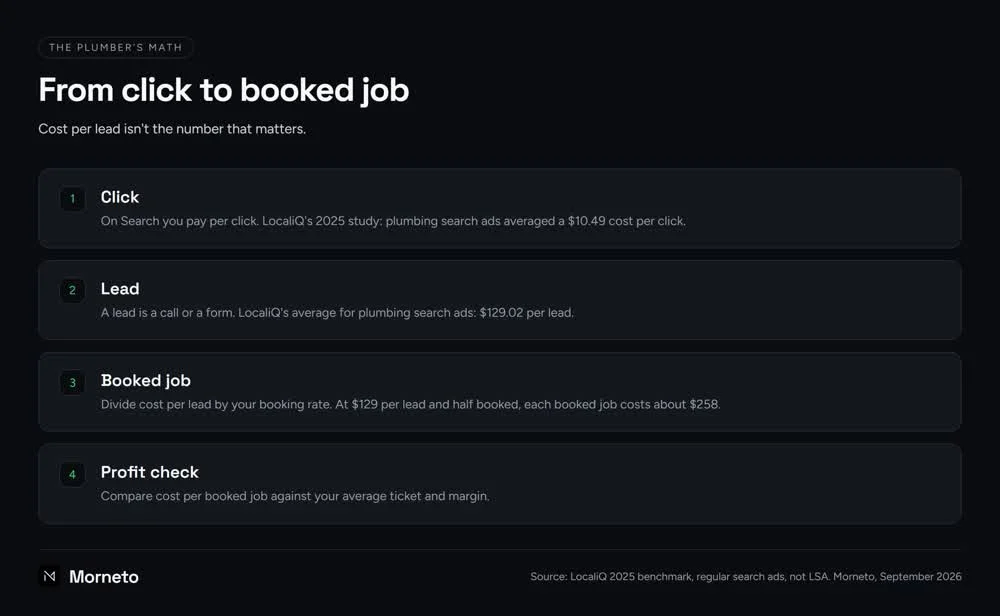
At the benchmark’s $129 cost per lead, if you book half your leads, each booked job costs about $258 in ads. On a small drain call, check what is left after parts, labor and that $258. On a large water heater job, the same $258 is a smaller share of the invoice.
To find your ceiling per booked job, multiply the average ticket for a job type by your gross margin. If that comes to less than $258, the job loses money in that example. Get your booking rate from last month’s dispatch log: booked jobs divided by calls and forms.
So point the budget at job types where cost per booked job stays under that ceiling. For a monthly figure, work through our guide to setting a Google Ads budget for a small New York business.
Local Services Ads or Search ads: which should a plumber run first?
For a shop with one to three trucks, our advice is to run both at a small scale. Start a narrow Search campaign on your best-paying jobs while you go through Local Services Ads screening. Once you pass, switch those ads on too. After 30 days, compare cost per booked job for each and move budget toward the cheaper one.
With Google Local Services Ads (LSA), you’re charged for each valid lead, not for each click. Leads include customer messages, answered calls and booking requests, and Google defines which contacts count as valid. Google’s Local Services Ads help page explains the program.
Google also doesn’t publish one fixed price per lead. It says prices can vary by location, job type, lead type and bidding mode.
Google now reassesses charged leads with its own models. It may credit low-quality ones automatically, in most cases within 30 days.
Industry reports say a ‘Rate this lead’ survey replaced the manual Dispute button in 2024, and that feedback can sometimes earn a bonus credit. If your account shows it, our advice is to rate every junk lead, from robocalls to lead sellers.
Search ads charge per click instead, and you set the keywords, match types and ad groups yourself. That control matters in plumbing, where wrong search terms cost real money. A narrow campaign might hold two ad groups, water heater replacement and drain cleaning. Each ad group’s keywords pair the job type with the boroughs or towns you serve.
Google is bringing Local Services Ads into Google Ads as Performance Max campaigns with pay-per-lead goals. The first phase started in August 2026 for select US home and storefront service advertisers. Plumbing is one of the categories Google names.
Service-area businesses without a physical storefront, which includes many plumbers, are scheduled for late 2026. For how that campaign type spends a budget, see our plain-English guide to Performance Max.
What replaced Google Guaranteed, and what does Google Verified require?
On August 20, 2025, Google announced that one Google Verified badge would replace the Google Guaranteed, Google Screened and License Verified by Google badges. It also said the Money Back Guarantee would end, with the change starting in October 2025.
That has two practical consequences for plumber advertising:
- Stop promising the guarantee. If your website, ads or truck lettering still mention a Google money-back guarantee, take it out.
- Don’t expect a ranking bump. Google said LSA ranking wouldn’t be affected by the switch to the new badge. Completed verification checks are still one of the inputs Google lists for profile quality, so finish them.
Google treats plumbing as an urgent category, so plumbers face an extra level of screening that includes service professional background checks. For US plumbers, Google’s requirements list general liability and professional liability insurance. They also list state-level business and owner licenses where local law requires them, so confirm yours with your state or city.
Our practical advice: gather insurance certificates and license numbers before you apply. Then use one exact business name on your license, insurance, LSA profile and Business Profile. For the rest of the Business Profile, see our guide to Google Business Profile optimization in NYC.
How do you set service areas and hours so you only pay for calls you can take?
Build your area from the ZIP codes your trucks actually reach, and run ads only while someone answers. To build the list, pull last year’s paid invoices and note the ZIP code on each.
Keep the ones you can reach within the drive time you’d accept for an emergency call. A shop in Queens may reach eastern Brooklyn faster than lower Manhattan at rush hour. Use the same list in LSA and in Search. Within one borough, areas can differ too: our Google Ads work for Brooklyn trades treats Bay Ridge, Bushwick and Park Slope as three different markets.
In Local Services Ads, Google no longer gives credits for leads flagged as ‘job type not serviced’ or ‘geo not serviced’. So if a job type or area you don’t cover stays switched on, don’t expect a credit for those leads. Go through your job types and areas line by line and turn off anything you won’t take.
In Search campaigns, Google’s default and recommended location option is ‘Presence or interest’. It can reach people in or regularly in your area, plus people who have shown interest in it.
Choosing ‘Presence’ limits ads to people likely located, or regularly located, in your target area. For a local plumber, our advice is to choose ‘Presence’. For more detail, read Google’s help page on location targeting.
An ad schedule sets the days and hours your ads can run. It uses your account’s time zone, so adjust it if your customers are in a different one.
A call asset can add your number or a call button to a Search ad, and you can limit it to hours you take calls. Like other assets, it won’t show every time, so keep the number on the landing page. On Staten Island, where almost everybody drives, searches happen in a parked car more often than at a desk, so that number matters even more.
Run emergency hours only if a person answers: you, a tech on call, or an answering service that can book. Our advice is a separate emergency campaign with its own budget and schedule, so night calls show their true cost. If calls already ring out, read why ads get clicks but no calls.
Which negative keywords should a plumbing account start with?
Start with six groups of negatives, then read the search terms report weekly and add whatever slipped through. Negative keywords don’t match close variants, so add singular and plural forms as separate entries, such as both job and jobs. Here is a starting list for a residential shop:
- Jobs and careers. job, jobs, career, careers, salary, salaries, hiring, apprentice, apprentices, apprenticeship, license exam, school, schools, training.
- DIY and how-to. diy, how to, yourself, video, videos, tutorial, tutorials, youtube.
- Parts and big-box stores. part, parts, supply, supplies, wholesale, home depot, lowes, amazon.
- Free. free, but only if you don’t offer free estimates, since people asking for one may be ready to book. Add coupon and coupons if you don’t run offers.
- Services you don’t offer. septic, well pump, well pumps, sprinkler, sprinklers, pool, pools, and commercial if you only work in homes.
- Places you don’t serve. town and borough names outside your area, such as staten island for a Queens-only shop.
Leave cost and price alone, since people comparing quotes use them too. Using broad match or an automated campaign type? Then read search terms more often, because you picked fewer searches yourself.
How do you track which ads turn into booked jobs, not just calls?
Count a call as a conversion only past a minimum length you choose, then tell the account which calls became booked jobs. Google Ads can count calls from your ads and calls to a Google forwarding number on your website.
Our advice is to leave the main number on your Business Profile alone. Customers already know it, and it should match your other listings. Use tracking numbers only on the website and in ads.
For calls from ads, you set the minimum call length yourself, so check the value in your own conversion action. Pick one that drops wrong numbers and quick hang-ups but keeps short booking calls. Then compare a month of counted calls against your dispatch log.
The stronger signal is the booked job. If your job software records which call each customer came from, import the calls that became booked jobs as call conversions. Google Ads can import those from another system, such as a CRM. Keep LSA leads on their own report line, since one blended cost per lead hides which channel earns its budget.
What should you check after 7, 30 and 90 days, and what does it all cost?
Check calls at day 7, booking rate at day 30 and cost per booked job at day 90. The total cost of Google Ads for plumbers is ad spend plus the fee for whoever manages the account.
- Day 7. Calls are coming in, tracking records them, and search terms look clean. Add negatives, but don’t judge cost yet.
- Day 30. Work out cost per lead and booking rate. If bookings are low, check who answers, how you quote and where calls come from first. In rental buildings, the caller may not be the person who approves the work. Our advice: ask whether a landlord or super has to sign off before you send a truck.
- Day 90. If cost per booked job sits below the ceiling from your ticket and margin, add budget to the jobs and ZIPs that pay. If not, fix the leaks before you spend more.
Let the budget follow your own demand. Pull last year’s job log by month to see when your calls actually peak. Then raise the budget ahead of those weeks and trim it when they pass.
Once the Google side is clean, we’d treat Microsoft Ads, with the same keywords and negatives, as a cheap extra test. Before you run it, read our comparison of Microsoft Advertising and Google Ads.
If you’d rather not run the account yourself, compare this checklist with what our Google Ads management service covers. Management is $497 per month for accounts spending up to $5,000 per month, then 12 percent of spend above that. The ad account stays in your name, and the ad budget is paid directly to Google.
At $3,000 of monthly ad spend, the monthly total is $3,497: $3,000 to Google plus $497 management. You can check that fee against our published pricing page.
Common questions about Google Ads for plumbers
How much should a plumbing company spend on Google Ads each month?
Base it on cost per booked job. If you don’t have your own numbers yet, start from the benchmark math in this guide. After 30 days, swap in your own figure. Multiply that cost by the extra jobs you want each month, then add the management fee.
How much does a plumbing lead cost on Google?
Google doesn’t publish a fixed Local Services Ads lead price. It says prices can vary by location, job type, lead type and bidding mode. For regular search ads, LocaliQ’s 2025 benchmark put plumbing at $129.02 per lead on average.
Can a plumber still get the Google Guaranteed badge?
No. Google announced that one Google Verified badge would replace Google Guaranteed, Google Screened and License Verified by Google from October 2025. It also said the Money Back Guarantee would end. Plumbers still face extra screening, including service professional background checks. For US plumbers, Google’s requirements list liability insurance plus licenses where local law requires them.
What keywords should a plumber bid on first?
Start with the jobs that pay best and searches that show clear intent, such as a job type plus your borough or town. Keep match types tight at first, add negatives weekly, and widen only when cost per booked job holds.
Is PPC or SEO better for plumbers?
The choice turns on timing. PPC for plumbers suits urgent repairs because you choose where and when ads run. SEO takes longer: most sites see measurable results in 3 to 6 months, and competitive markets take 6 to 12 months. In our view, a small shop can run both and judge SEO direction at about 90 days.