Short answer: To get found by AI search, your business needs three things: content that AI can crawl, content that is easy to quote, and a clear, consistent identity across the web. AI answers in ChatGPT, Copilot and Google’s AI Overviews pull from sources they can read and trust. The same clarity that helps you rank also helps you get found by AI.
Why do you need to get found by AI, not only by Google?
More and more people no longer scroll a page of blue links; they ask ChatGPT, Copilot or Google’s AI a question and read the answer. If that answer names your business, you are the recommendation. If it does not, you are invisible in a way that does not even show up in your rankings. Showing up in AI answers has quietly become part of showing up at all. It is the same principle we built Morneto on, applied to a new front page.
You will hear three labels for this work. AEO (answer engine optimization) is about being the direct answer in featured snippets, voice assistants and Google’s AI Overviews (sometimes called AIO). GEO (generative engine optimization) covers how generative engines such as ChatGPT, Perplexity, Copilot and Gemini decide whom to cite. Both sit on top of classic SEO rather than replacing it, and both reward the same three things this guide covers; Google’s own page on AI features and your website says as much. If you are choosing an agency for this, our NYC web design agency shortlist for SEO, AEO and GEO lists the questions to ask.
How does AI decide who gets found by AI answers?
AI does not rank the way Google does. On the paid side, Microsoft Advertising or Google Ads explains why Bing’s index, not ChatGPT’s algorithm, decides who shows up in Copilot and ChatGPT search. It assembles an answer from sources it can read, understands as being about a clear topic, and considers trustworthy. In practice that rewards three things: being crawlable, being quotable, and being a recognizable entity. Miss any one, and AI is unlikely to cite you, however good your service is.
LLM SEO, GEO and AEO: three names for getting found by AI
In under two years the industry has produced three labels for this work, and the confusion sells a lot of packages. The llms.txt file arrived on the same wave, and our guide to llms.txt covers what it can and cannot do. The honest translation:
- LLM SEO — optimizing so large language models such as ChatGPT, Gemini, Claude and Perplexity can read, understand and cite your pages.
- GEO (generative engine optimization) — the same idea, named after the engine rather than the model.
- AEO (answer engine optimization) — the same idea again, named after the output: an answer instead of a list of links.
All three describe one job: being the source the machine quotes. Anyone selling you three separate services is selling you the same work three times.
What matters more than the label is where these systems get their facts. The search mode in ChatGPT and Microsoft Copilot both read Bing’s index; Google’s AI Overviews read Google’s. That single detail decides most of the strategy — if your pages are not in those indexes, no amount of clever wording puts you in the answer. It is also why our first move is making sure both engines have the site, rather than writing “AI-optimized” copy.
The practical difference between LLM SEO and classic SEO is smaller than the marketing suggests. Roughly four fifths is the same work: a crawlable site, pages that answer one question properly, clean structured data, consistent business details. The remaining fifth is specific — short self-contained passages a model can lift without losing meaning, plain definitions near the top of the page, and mentions on sites the model already trusts.
Which is why we include it in the SEO plan rather than pricing it separately. Some agencies now sell “LLM SEO” as its own line item at its own rate; the work behind that invoice is largely the work in this guide.
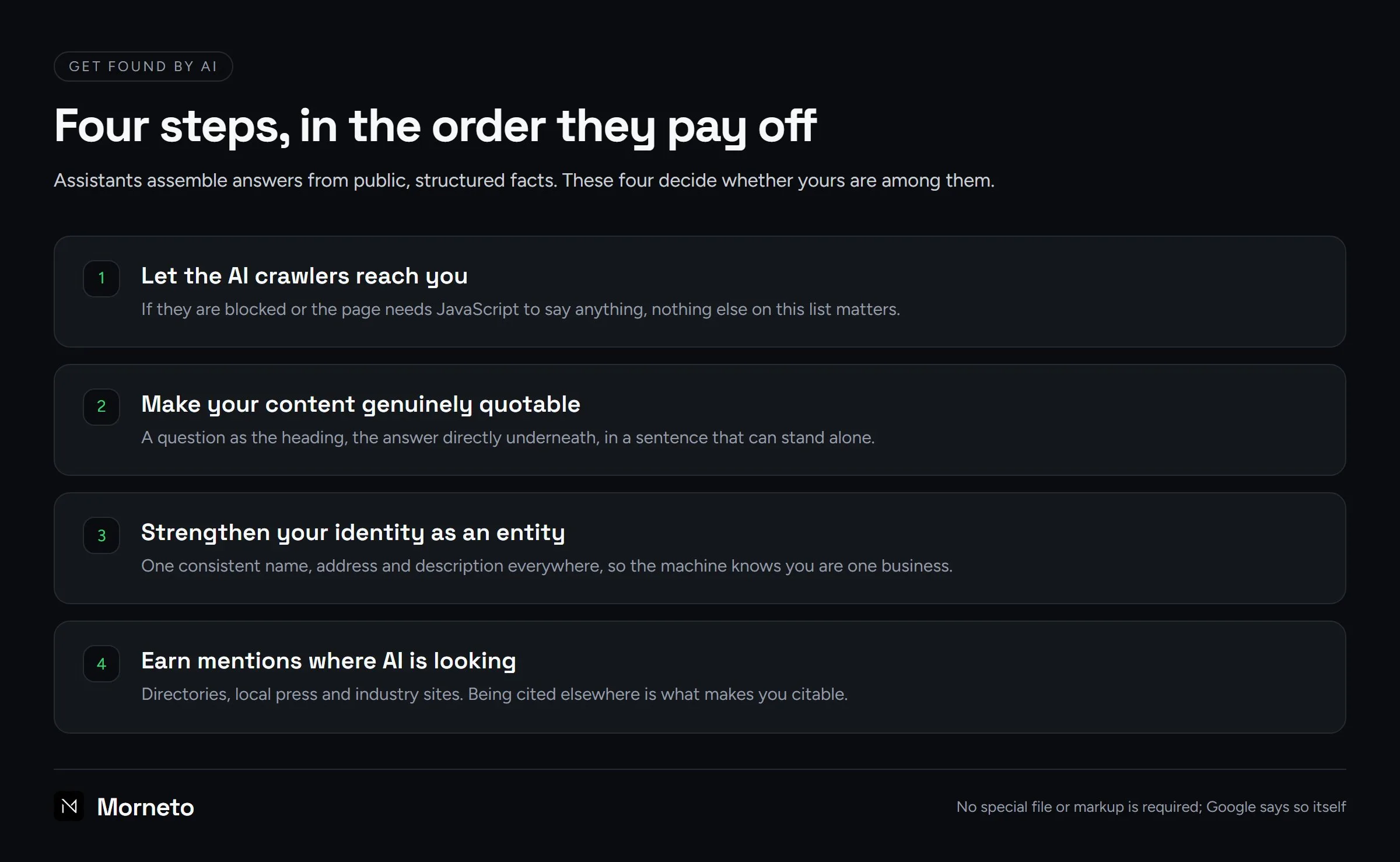
Step 1: how do you let the AI crawlers reach you?
The AI engines use their own crawlers — and they can only cite what they can read. Your robots.txt should welcome them, your content should not hide behind heavy scripts, and your pages should load quickly. Much of this overlaps with ordinary search hygiene. We cover the indexing side in how to get found on Bing and the engines beyond Google — which matters doubly here, because Copilot and ChatGPT lean on Bing’s index.
Step 2: how do you make your content genuinely quotable?
AI builds its answers from short, clear passages. Pages that open with a direct answer, use plain headings shaped like real questions, and include a focused FAQ are far easier to lift into an answer than a wall of marketing copy. Write the one-sentence answer first, then explain it. This is the same groundwork that our AI search optimization covers, and it helps human readers too — AI simply rewards it more strictly.
Step 3: how do you strengthen your identity as an entity?
AI is far more likely to mention a business it can pin down. That means a clear name, a consistent address and phone number everywhere, and structured data that spells out who you are. It also means an About page that states plainly what you do and who runs it. Inconsistent details across your site, your Google Business Profile and other listings make you harder to trust and easier to skip.
Step 4: how do you earn mentions where AI is looking?
AI models weigh what the wider web says about you. Reviews, mentions on reputable local sites, and useful content that others reference all build the reputation an AI reads before it decides to name you. This is slow, honest work. It is also, increasingly, how you choose an agency that understands search across every engine rather than just chasing Google rankings.
How can you test whether you get found by AI today?
You do not need special software to see where you stand. Open ChatGPT or Copilot and ask a question a good customer would ask — something like “who does affordable web design for small businesses in [your area]?” Then check whether it mentions you, whether it mentions a competitor, and what it seems to know about you. Then ask it directly what it knows about your business by name. If the answer is thin, vague, or wrong, that is your to-do list. The AI is telling you exactly where your crawlability, clarity or reputation falls short. Repeat the test every few weeks as you make changes, and you will watch your presence in those answers improve.
Why is this not a passing fad?
It is tempting to wait and see whether AI search sticks, but the direction is already clear. The major search engines are putting AI answers above the traditional results, and a growing share of people never look past them. The reassuring part is that you do not have to gamble on it. Everything that makes you visible to AI is exactly what has always made you visible to Google and to human beings. That means a fast, readable site, clear answers, consistent listings, and an honest reputation. You are not building a separate AI strategy. You are doing good fundamentals slightly more deliberately — and getting a second, fast-growing channel for free.
Which mistake stops businesses getting found by AI?
If there is a single reason AI skips good businesses, it is ambiguity. When your name, address and phone number differ across your website, your Google listing and a directory or two, an AI cannot be sure you are one business rather than three. So it plays safe and mentions a competitor it can pin down instead. The same goes for what you actually do: a homepage full of slogans but light on plain statements leaves the AI guessing. The fix is unglamorous but powerful. Say who you are, where you are and what you do in clear language. Use the exact same business details everywhere, and back it with structured data. Certainty is what earns the mention.
Where do you start this week to get found by AI?
You do not need to do everything at once. A sensible first week looks like this:
- Run the AI test above and write down what ChatGPT and Copilot get wrong or miss about you.
- Fix your details so your name, address and phone number match exactly across your site and every listing.
- Rewrite one key page to open with a direct, one-sentence answer and a short FAQ.
- Check your crawlability — make sure nothing blocks the AI bots and the page loads fast.
None of these steps is expensive, and together they move you from “invisible to AI” to “quotable” faster than any clever trick could. From there it becomes maintenance: keep the details consistent, keep answering real questions, and keep earning honest mentions.
It also helps to remember who is on the other side of the answer: a real person, in a hurry, asking a machine for a recommendation they can trust. The businesses that win in AI search are simply the ones that make themselves the easiest to recommend — clear about what they do, consistent about who they are, and genuinely useful to the person asking. Get those right and the technology takes care of itself.
If you are starting from scratch, how to build a website in New York puts these AI-readiness steps in the right order.
Answer engines follow the same paths Google does, so the clear internal links between a question page and the page that answers it are part of being quotable, not an afterthought.
If your numbers are already sliding rather than merely flat, start with the diagnosis instead: why your website traffic is dropping shows how to tell an AI-answer loss from a ranking loss in Search Console.
Assistants answer local questions from map data, which makes your Apple Maps business listing and its Bing equivalent part of the same job.
Common questions
How do I get my business mentioned by ChatGPT or Copilot?
Be crawlable, be quotable, and be a consistent, recognizable entity. Those tools draw on Bing’s index, so Bing is far more likely to cite a site it knows and trusts.
Is getting found by AI different from normal SEO?
It shares most of the foundations, but it rewards clarity even more: direct answers, clean structure, structured data and consistent business details.
Do I need a special tool or plugin for AI search?
No. There is no shortcut plugin. It is good technical SEO, quotable content and a consistent identity — the same fundamentals, done well.
Will this help me on Google too?
Yes. Google’s AI Overviews use the same signals, so optimizing to be quotable helps you across classic search and AI answers at once.
What is the difference between SEO, AEO and GEO?
SEO ranks your pages in classic search results. AEO turns them into the direct answer in featured snippets, voice search and Google’s AI Overviews. GEO puts your business into the answers that generative engines such as ChatGPT and Perplexity give. One crawlable, quotable, consistent site serves all three, as our GEO and SEO comparison shows.
What is LLM SEO?
LLM SEO is optimizing so large language models can read, understand and cite your pages. Same work as GEO and AEO under another name: be crawlable, answer one question per page, earn trusted mentions.
Is SEO dead now that AI answers the question?
No. AI answers are built from search indexes, so the pages that get cited are the pages that rank. What changes is the payoff: an answer can quote you without sending a click.
How do I rank in ChatGPT?
Get into Bing’s index first, because the search mode in ChatGPT reads it. After that the levers are ordinary: clear passages a model can quote, consistent business details, and mentions on trusted sites.
Want to be the answer, not the afterthought?
If you would like to know whether AI can currently find and quote your business, ask us for a free audit — we will show you where you stand and what to fix first.