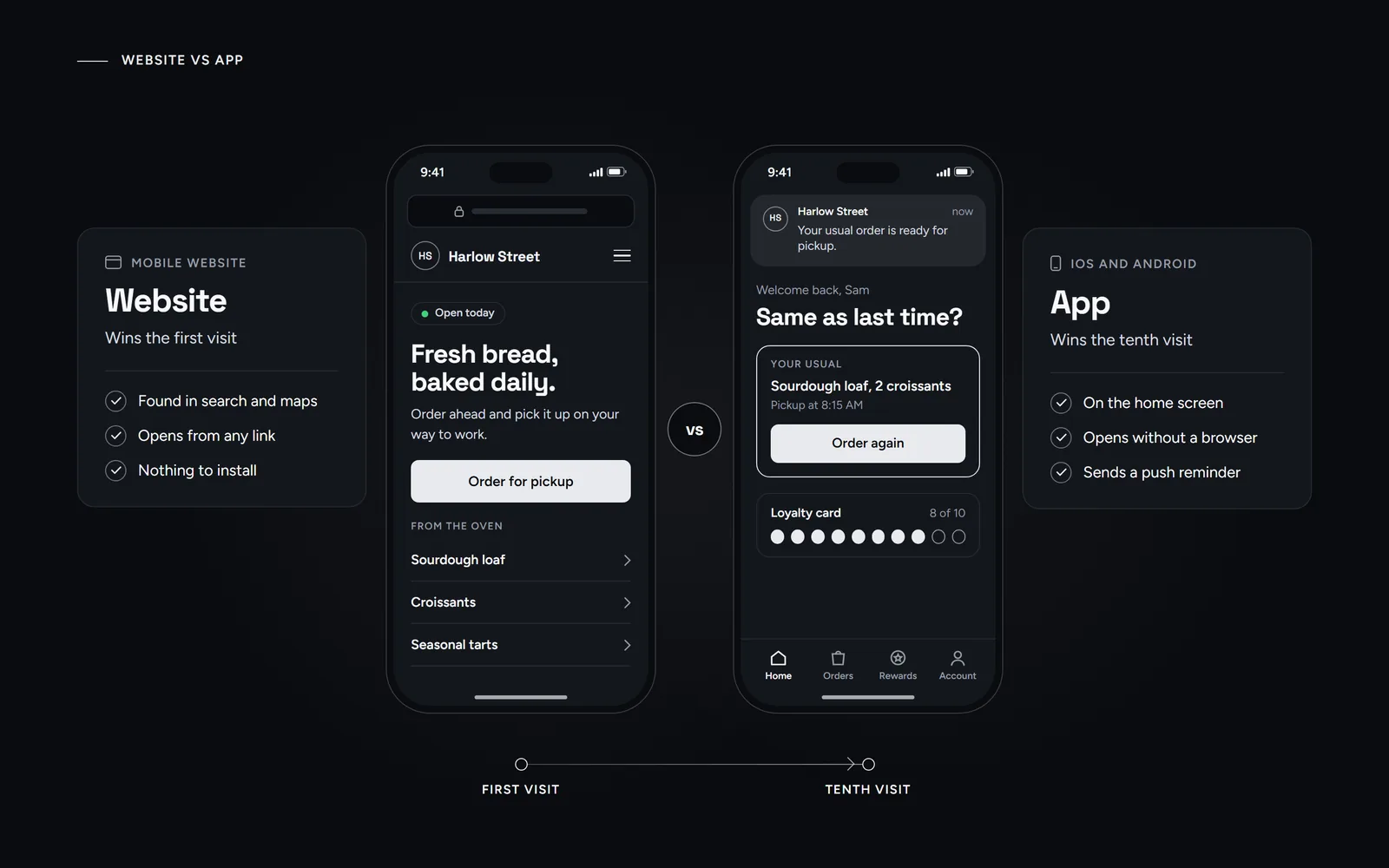
Short answer: in the website vs app decision, most small businesses should build the website first. A website is found in search and opens from any link, with nothing to install. An app earns its place later, when the same customers come back every week to book, order or check a status. At Morneto, a mobile-first website starts from $997 and a simple app from $9,997.
Search for website vs app, and most of the top guides come from software vendors and app agencies. As a small business, your question is narrower: which one brings in customers for the money you have? So this guide compares the two on reach, cost and upkeep. It uses our own published prices, checked on October 4, 2026.
Website vs app: what is the actual difference?
A website lives on the open web. Anyone can reach it from a search, a map listing, a shared link or an AI answer, in any browser. A mobile app lives on the phone itself. People download it from the App Store or Google Play, and it opens from an icon on the home screen.
That one difference drives most of the others:
- How people find it. Search engines show web pages, so strangers can find your website. An app is mostly found by people who already know your name.
- The first step. A website opens in the browser right away. An app asks for a download first, and often for an account.
- Updates. A change to a website is live for everyone at once. A new app version goes through store review, and then each phone has to install it.
- What it can do. An installed app sits on the home screen, opens without a browser and can send push notifications.
Side by side, the trade-off looks like this:
| Question | Website | App |
|---|---|---|
| How new customers find it | Search, maps, shared links and AI answers | The App Store, Google Play or your own website |
| What a visitor does first | Nothing. It opens in the browser. | Downloads it, and often signs up |
| How updates reach people | Live for everyone at once | Store review, then each phone installs it |
| Best at | Turning a first visit into an inquiry | Bringing the same customers back |
| Morneto price | From $997 one-time, mobile-first included | From $9,997 for a simple app |
When is a website the better choice?
For most small businesses, the website comes first, because new customers start with a search. A plumber, a law firm or a bakery needs to be found, read and contacted. A website does all three, and it works on every phone without an install.
In addition, a website is the better choice when:
- Most customers visit once or twice a year. Few people install an app for a business they need twice a year.
- Your budget covers one project. A mobile-first site costs a fraction of an app, and it can start bringing in search traffic.
- You will keep changing what it does. A website change is live in minutes, while each new app version waits for store review.
However, a website only wins if it works well on a phone, since many visitors arrive on one. Every site we build is mobile-first, which our mobile website design service explains step by step. Speed matters just as much, and our guide on how to make your website faster covers the fixes that count most.
When does an app earn its place?
An app pays off when the same customers come back often. Think of a gym member who books classes every week, or a regular who reorders lunch. A client who checks the status of a job fits too. For these people, an icon on the home screen and a saved login cut steps from every visit. A website can do much of this too, but the customer has to open a browser and find it each time.
In practice, three signs point toward an app:
- Repeat use. Customers act weekly or even daily, not once a season.
- Frequent accounts. People sign in every week to see their bookings, orders, loyalty points or documents.
- Phone features. The service depends on location in the background, Bluetooth or push reminders that reach every phone.
If two or three of these fit, an app is worth pricing. As an app development company in New York, we build for iOS and Android. A written scope sets the exact price before any work starts.
Website vs app: what does each one cost?
Cost is where the website vs app gap is widest. At Morneto, a website of five to fifteen pages starts from $997 one-time, and the mobile version is included. A simple app starts from $9,997. In other words, the app starts at roughly ten times the website price.
Both need upkeep after launch, and an app adds costs a website does not have:
- Store accounts. Apple charges $99 a year for its developer program, and Google Play charges a one-time $25 registration fee.
- App updates. New iOS and Android versions arrive every year, so an app needs testing and occasional fixes to keep working.
- Website upkeep. Our Website Care plan costs $97 per month for WordPress, plugin and theme updates, daily backups, uptime monitoring and malware scanning. Content changes are not part of it.
For the full picture on app budgets, see our breakdown of what mobile app development costs in 2026, with published price ranges from studios in New York and beyond. On the website side, our published website and marketing prices list every package.
Where does a web app or PWA fit in?
Between a website and a store app sits a third option: the web app. It runs in the browser like a website, but it behaves like software: people sign in, enter data and get work done. A client portal, an online booking system and an order dashboard are all web apps.
A progressive web app, or PWA, goes one step further. According to Google’s web.dev guide to progressive web apps, a PWA reaches any device with a single codebase. People can install it to the home screen, and it can keep working on a weak connection.
- The upside. One build serves phones and computers, so nobody has to visit a store to start.
- The downside. There is no App Store or Google Play listing by default, and some phone features are still out of the web’s reach.
A web app suits customers who mostly sit at a computer, and it works well as a tool for your own staff. If your project leans toward custom software, our guide to choosing a web development company or a design agency explains who builds what.
Do you need a website if you have an app?
Yes, in almost every case. Someone who has never heard of you is unlikely to find your app, and a store listing says little about your service area or prices. Also, both stores ask every app for a privacy policy link, and that policy usually lives on your website.
For that reason, the website vs app question is really about order for most businesses: website first, app second. The website brings in new customers, while the app serves the ones who come back.
How do you decide on website vs app for your business?
Start with one question: how often does the same customer come back? Then match your answer to one of these three paths:
- Once or twice a year. Build a fast, mobile-first website, and put the rest of the budget into being found.
- About once a month. Start with the website, and add online booking or an account area to it.
- Weekly or daily. Price an app, and keep the website as the front door for new customers.
Put simply, a website wins the first visit and an app wins the tenth. The diagram shows where each one does the work, and three places where customers get lost.
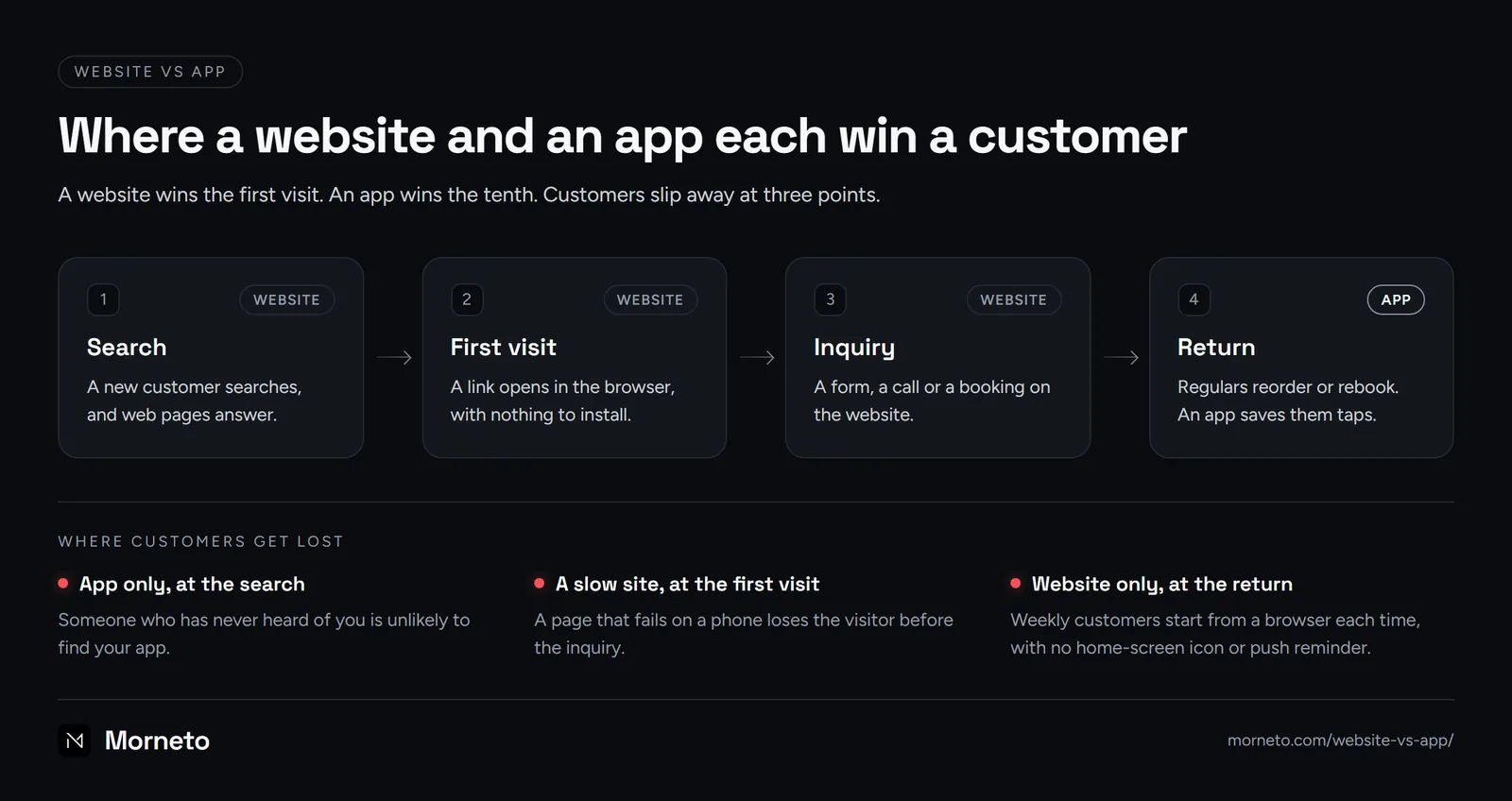
Still unsure? You can tell us how often your customers come back, and we will say plainly which one to build first. If the answer is a website, we will not sell you an app.
Common questions
Is it better to make an app or a website?
In the website vs app choice, a website comes first for most small businesses. It can be found in search, works on every device and costs far less. An app makes sense later, when the same customers return weekly to book, order or sign in.
Is an app basically a website?
No. A website opens in a browser from a link or a search. A mobile app is installed from the App Store or Google Play and runs on the phone itself. A web app sits in between: it runs in the browser but works like software.
Which is easier to make, an app or a website?
A website is usually easier and faster to build. One version serves every screen, and no store has to approve it. An app needs testing on iOS and Android, plus approval from Apple and Google before launch.
Do you still need a website in 2026?
Yes. Search engines, map listings and AI assistants point people to web pages. Without a website, a business is harder to find, and an app store listing cannot replace your pages on services, prices and location.
Can I turn my website into an app?
Sometimes. A progressive web app can make your site installable on a phone. A store app is a different matter, because Apple expects an app to offer more than a repackaged website. So a store app needs real app features of its own.