Short answer: how web design agency pricing works comes down to four agency pricing models — a fixed project price, monthly retainer pricing, a percentage of ad spend, or hourly billing. For a small business, a fixed price for defined projects and a clear flat retainer for ongoing work are usually the safest. They tie the cost to the outcome rather than to how long someone takes. The model matters as much as the number.
Why does the agency pricing model matter more than the number?
Two agencies can quote the same amount and still be completely different deals. The model behind the number decides who carries the risk. A price based on a written scope means the agency has thought the work through, and you can hold them to it — what a web design agency in NYC charges shows how the tiers compare. A price based on hours means the risk of slow or padded work quietly shifts to you. Before comparing figures, understand how each model works and what it rewards — that tells you more than the total ever will. If you want a sense of realistic numbers first, our breakdown of what a website should cost a small business is a good anchor.
When is a fixed project price the right model?
A fixed price covers a clearly defined project — a website build, a specific campaign setup — for one agreed figure against a written scope. Its great strength is certainty: you know exactly what you will pay and exactly what you get. Any overrun is the agency’s problem, not yours. It only works when the scope is genuinely clear, which is why a good agency spends time defining that scope before quoting. We publish our own pricing on this basis for exactly that reason.
What does fixed price SEO actually mean?
Fixed price SEO is the monthly version of the same promise: you agree one set fee in writing for a defined scope of search work. No hourly tracking, no invoice that grows because a problem took longer than expected. You know in January what December will cost.
Read the words defined scope carefully. Fixed covers the fee and the deliverables: how many pieces of content go live, how many links are pursued, what technical work is covered, and what the monthly report shows. The outcome, on the other hand, is never part of the deal. Rankings depend on competitors, on Google, and on your own site, so a fixed fee is not a ranking guarantee, and anyone who sells it as one belongs in the red flags section below.
When does it beat a traditional retainer? When you want predictability and the work is steady month to month, which is true for most small businesses doing local search. A classic retainer earns its keep when the work genuinely shifts shape every month, on larger accounts with campaigns, launches and seasonal pushes. If an agency cannot tell you which of the two it is selling you, that is your first question answered.
Our own version is straightforward: search and content work from $799 per month, fixed, month to month with 30 days notice. If you are comparing fixed price SEO packages from several providers, what belongs inside such a package line by line is the checklist to hold every quote against, because two identical fees can buy very different work.
Fixed price SEO vs. an agency retainer: which costs less over 12 months?
Run the math over a year and the models separate fast. Our fixed plan is $799 a month, month to month, which is $9,588 over twelve months — and you can stop at month four if the work disappoints. The retainers we checked in September 2026 published starting prices of $950 and $999 a month, or $11,400 to $11,988 a year, and one provider recommends a six-month commitment before you judge results.
The gap is not the headline number. It is what happens when you want out. A month-to-month fee prices the agency’s confidence into the contract; a commitment prices your patience into it. Over twelve months the fixed plan costs 16 to 20 percent less on the sticker and carries none of the exit cost, which is the part no quote shows. The full SEO cost breakdown sets out what those monthly numbers should buy at each level, and our fixed-price SEO plan is the version of this we actually sell.
What does a monthly retainer actually pay for?
SEO, content and ongoing management are never “finished.” For what that ongoing work looks like on the ads side, see what Google Ads management in NYC includes. So agencies usually bill them as a monthly retainer — a flat fee for an agreed scope of work each month. Across the industry the label barely changes — an ad agency retainer, an advertising agency retainer fee, branding agency retainer rates — and the mechanics are the same everywhere.
The strength is a predictable budget and a team that keeps improving things over time. The risk of the retainer model is vagueness: a retainer with no clear deliverables can become a bill for very little. Insist on knowing what the retainer buys each month. What the numbers themselves look like across the whole market, from hourly rates to $5,000 retainers, is mapped in our honest guide to what SEO costs in 2026. Treat a short, clear notice period as a sign of confidence, rather than a fixed annual lock-in.
How do agency retainer fee structures compare?
Four retainer fee structures cover almost every proposal you will read, and what separates them is what the fee is attached to: an agreed scope, a pool of hours, a list of deliverables, or a share of your ad spend.
| Structure | How the fee is set | What it is good for | What to watch |
|---|---|---|---|
| Flat scope retainer | One monthly price for an agreed scope of work | Ongoing SEO, content and maintenance, where the workload is steady | Vagueness in both directions, so keep the monthly list explicit |
| Hours-bank retainer | A block of hours each month, drawn down as you use them | Mixed work you cannot predict a month ahead | Unused hours expiring, and admin time billed as work |
| Deliverables retainer | A fixed number of outputs per month | Content and technical fixes, where volume is the point | Volume arriving without a quality standard attached |
| Percentage above a spend level | Flat fee up to a ceiling, a percentage on spend above it | Ad accounts that outgrow one manager | The percentage applying from the first dollar instead of the ceiling |
Retainer versus project is the easier half of the question: a project has a finish line and a retainer does not. Pay a project price for anything you can write down with an end date, and a retainer for work that only compounds, such as rankings, content and campaign management. That is how our own work is split, with SEO and marketing from $799 per month on month-to-month terms with 30 days notice, while a build is quoted once and finished. Every one of those numbers sits on the page where we publish prices in full rather than behind a call.
The retainer half of this comparison has enough moving parts to need its own guide, so we set out what an agency retainer actually buys month to month and what the agreement behind it should say separately.
How much do marketing agency retainers cost in 2026?
Most agencies still publish nothing, which is why this question fills search results with guesses. Here is what pages with actual prices said when we checked in September 2026: entry SEO retainers in New York started at $950 and $999 a month, mid tiers sat around $2,200, and enterprise tiers reached $5,400. Branding and advertising retainers are quoted publicly even less often, but the structure is the same: a monthly fee, a scope document somewhere behind it, and a commitment period that decides how expensive a wrong choice becomes.
Read any retainer rate against three questions rather than against an average. What is in the defined scope? How long are you committed before you can fairly judge the work? And does the fee buy named deliverables or outcome-shaped promises? An average hides exactly the terms that cost money, which is why we publish our own prices in full rather than quoting a range on a call.
Why is percentage of ad spend the model to watch?
For Google Ads management, many agencies charge a percentage of what you spend. It sounds fair, but it contains a quiet conflict of interest. The more you spend, the more the agency earns — even if a smaller, tighter budget would serve you better. A flat fee — or a percentage that only kicks in above a sensible threshold — keeps the agency focused on results, not on growing your spend. If you are unsure what to budget in the first place, how much a small business should spend on Google Ads is a useful starting point.
Why do we avoid hourly billing?
Hourly billing charges you for time rather than outcome, which rewards slow work and turns every question into a metered event. You never quite know what a task will cost until the invoice arrives. There is no incentive to work efficiently. It can suit genuinely open-ended consulting, but for defined small-business work it usually transfers risk onto the client. A fixed price or a clear retainer almost always serves you better.
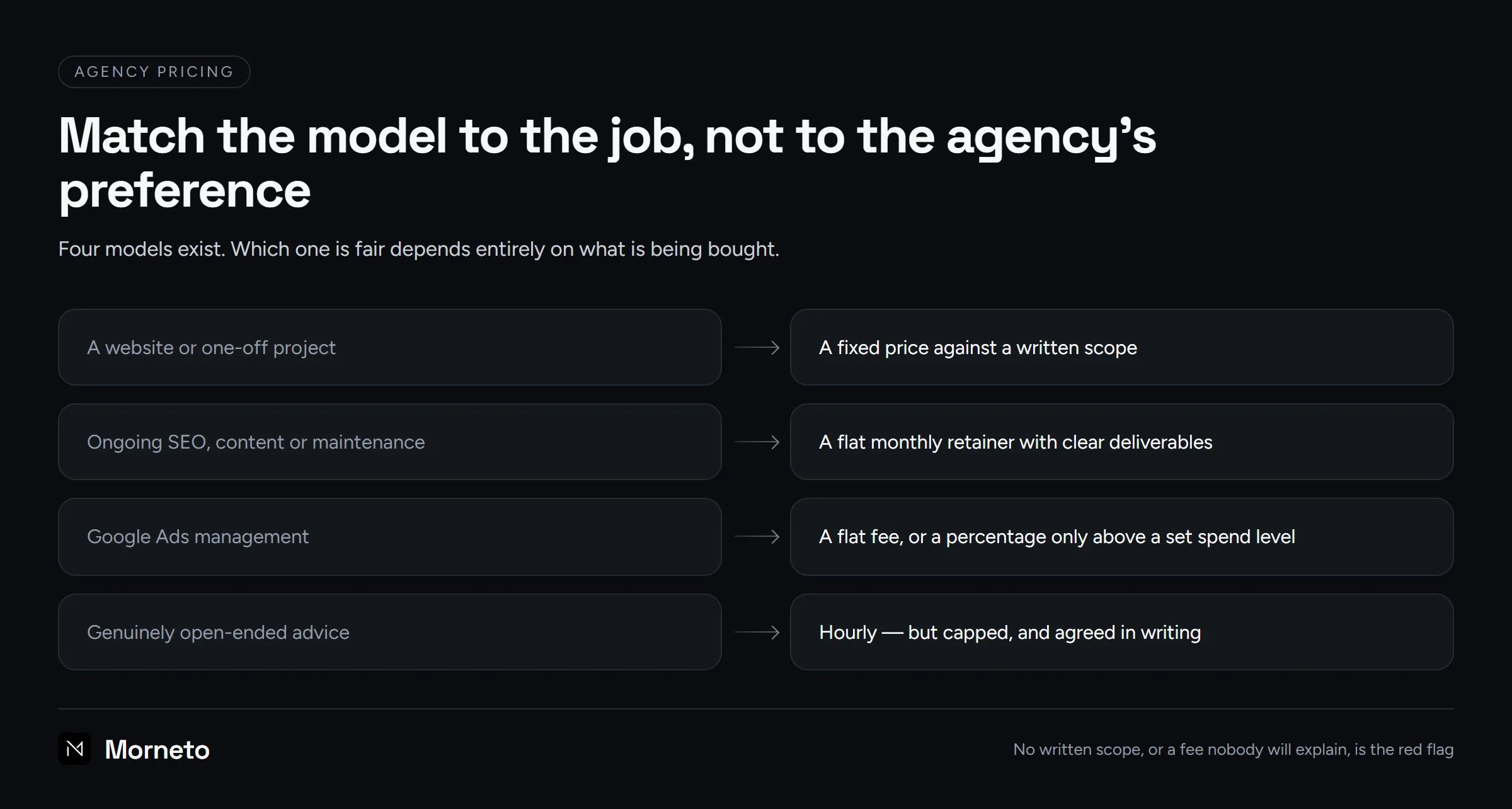
Which agency pricing model fits which job?
Match the model to the type of work, not to the agency’s preference:
- A website or one-off project: a fixed price against a written scope.
- Ongoing SEO, content or maintenance: a flat monthly retainer with clear deliverables.
- Google Ads management: a flat fee, or a percentage only above a set spend level.
- Genuinely open-ended advice: hourly can be fair — but cap it and agree it in writing.
What are the red flags in an agency pricing conversation?
Whatever the model, a few warning signs cut across all of them. Be cautious of a quote with no written scope. Watch for a long mandatory contract that exists to keep you, not to protect the work. Watch too for hidden setup or “management” fees that appear later, and any refusal to explain what you are actually paying for. Transparent pricing is not just fairer — it is a signal that the agency is confident in its work. Google’s own guidance on hiring an SEO lists the same warning signs, which makes it a useful cross-check on any agency pricing proposal. This is part of the wider question of how to choose an agency that actually works with you. It reflects the plain-dealing principle Morneto was built on.
How do you compare two agency quotes fairly?
The mistake most small businesses make is comparing headline totals. A cheaper quote can hide a vague scope, hourly overruns and a percentage-of-spend ad fee. Over a year, that can easily cost more than a higher fixed price with everything defined. To compare fairly, put both quotes on the same footing. Ask each agency what it includes, what triggers an extra charge, how it bills ongoing work, and what the total looks like across twelve months — not just at kickoff. When you do that, the “expensive” transparent quote often turns out to be the cheaper one. It has no surprises hiding inside it. Price certainty has a real value, even if it does not appear on the invoice.
How does web design agency pricing work in a real example?
Say two agencies both quote around the same monthly figure for managing your ads. Agency A charges a flat management fee; Agency B charges fifteen percent of your ad spend. At a small budget they look identical. But as your campaigns grow and your spend doubles, Agency B’s fee doubles too, for work that has not necessarily doubled. Agency A’s fee stays flat. Worse, Agency B now has a quiet incentive to encourage more spending rather than tighter, more efficient campaigns. The models that looked equal on day one point in opposite directions six months later. This is exactly why the structure matters more than the starting number. It is worth reading the fine print before you sign.
The reassuring takeaway is that you do not need to become a pricing expert. You only need to insist on two things. Put everything in writing, and choose a model whose incentives point the same way as your results. Get those right, and whichever agency you choose, you have already removed the ways small businesses usually get caught out.
It is also cheaper to avoid three margins — see the case for one roof.
Before you pay for anything, insist on a genuine audit.
If the job is a website build, we have applied these models to that decision in how to hire a web designer in New York without overpaying.
For a borough-level version with a checklist, see how to compare Brooklyn web design companies.
For the buyer-side view of what each price tier should include, read what a fair price for a website looks like in New York.
For the ads-specific version, including percentage-of-spend traps, read what a Google Ads consultant in NYC should cost.
Common questions
Is a fixed price always better than a retainer?
No — they suit different work. Fixed price is best for a defined project. A retainer is right for ongoing work that is never finished, like SEO. The key is that both stay tied to a clear scope.
Why is percentage of ad spend risky?
Because it rewards the agency for you spending more, even when a leaner budget would perform better. A flat fee, or a percentage only above a threshold, keeps the focus on your results.
Should I ever agree to a long contract?
Be cautious. Good work retains clients on its own. Long contracts mainly protect agencies whose work would otherwise not. Look for a short, clear notice period instead.
What should always be in writing?
The scope, the deliverables, the price, the payment schedule and the notice period. If any of these is only spoken, ask for it in writing before you commit.
How much is a typical marketing agency retainer fee?
Advertised retainers for small-business marketing run $1,000 to $5,000+ per month in this market, and the fee only makes sense when the monthly deliverables are named in writing. For comparison, our SEO plan is $799 per month fixed, published on the pricing page.
Retainer or project: which fee structure should a small business ask for?
Ask for a project price whenever the work has an end point, such as a new website, and a flat retainer for work that never finishes, such as SEO or ad management. Avoid hours-bank retainers unless the month is genuinely unpredictable. Whichever you sign, insist the monthly deliverables are written down and the notice period is short.
Want pricing you can actually understand?
We quote fixed prices against a written scope, with no hidden fees and no long lock-in. Get in touch for a free audit and a clear quote. You will know exactly what you are paying for before anything starts.