Short answer: An agency retainer is a fixed monthly fee that buys you an agreed amount of ongoing work rather than a finished deliverable. You are paying for capacity and continuity, not for a project with an end date. It suits work that only compounds when it happens every month, like SEO, content and ad management. Ours start at $799 per month and run month to month with 30 days notice.
What is an agency retainer, exactly?
A retainer is an agreement to pay a set amount every month in exchange for an agreed scope of ongoing work. The word comes from professional services, where you retained a lawyer so their time was available to you. In marketing it means roughly the same thing: the agency reserves capacity for your account, and you get a defined amount of work each month whether or not you have an emergency that month.
That is the real difference from a project. A project has a finish line, a fixed deliverable and a handover. A retainer has a rhythm. Nothing is ever finished, because the work is a response to something that keeps moving, whether that is a competitor, a search algorithm or your own ad costs.
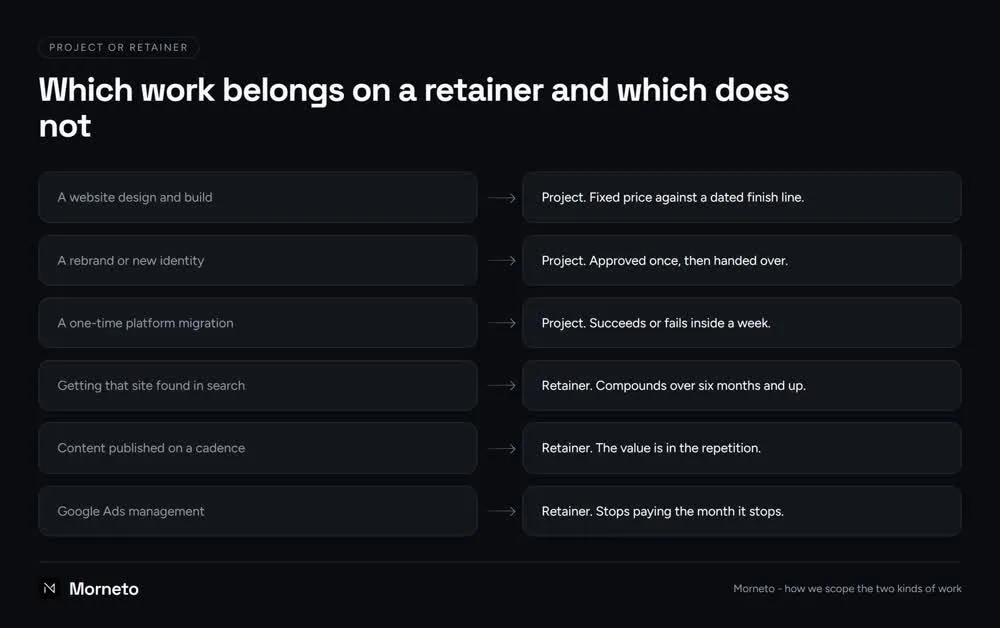
The confusion in most agency retainer conversations comes from mixing the two. A site build is a project. Getting that site found is a retainer. When one contract tries to be both, the project half gets finished and the retainer half quietly stops happening.
What do you actually get for an agency retainer?
This is the question to press hardest on, because the answer varies wildly between agencies charging the same number. Our monthly search work is written down as a specific list, which is the format worth insisting on wherever you buy it. Our website maintenance plans are written the same way, down to what falls outside them.
- A tracked keyword set. Ours covers 10 to 30 keywords, so both sides know what is being measured before the work starts.
- Content on a cadence. Two to six posts a month in our case. The number matters less than the fact that it is a number and not a promise to publish when there is time.
- Link building. Three to eight referring links a month. This is the slowest-moving part of any retainer and the first thing that disappears from a vague one.
- Google Business Profile work. Posts, categories, service lists, review handling. Small and relentless rather than difficult.
- Technical maintenance. Crawl issues, speed, structured data. Sites decay, and nobody notices until rankings move.
- Monthly reporting against enquiries. Not rankings alone. A report that never mentions leads is a report designed to survive a bad month.
If a proposal cannot produce a list like that, you are not buying a retainer. You are buying access to someone who will decide later what your money was for. The full breakdown of what sits at each of our tiers is on our pricing page, deliberately in public.
How do agency retainer hours work?
Two models exist and they behave very differently when a month goes wrong.
Hour-based retainers sell you a block of time, say twenty hours a month, drawn down against tasks. They are transparent in principle. In practice they turn every conversation into a negotiation about whether a call was billable, and they reward the agency for the work taking longer.
Scope-based retainers sell you an agreed set of outputs, and how long those take is the agency’s problem. This is the model we use, for the plain reason that it puts the incentive in the right place. If we get faster at something, you keep the same output for the same price and we keep the efficiency. Nobody has to argue about a timesheet.
Ask which one you are being sold, and if it is hour-based, ask what happens to unused hours. Rollover, forfeit and pooling across quarters are all normal answers. No answer at all is not.
What does an agency retainer cost?
Across the market, small business marketing retainers commonly run from a few hundred dollars a month at the low end into five figures for national campaigns with large teams. That range is so wide because the label covers everything from one freelancer doing two hours a week to a full team with a strategist, writer and developer.
Ours are published. Search and marketing work starts at $799 per month. Google Ads management starts at $497 per month covering up to $5,000 in monthly ad spend, then 12 percent of spend above that, so the fee stays predictable as the account grows. The combined option is $3,497 one time and then from $799 per month.
Two structural points matter more than the number itself. First, monthly work should not require a year-long commitment: ours runs month to month with 30 days notice. Second, a retainer priced as a percentage of your ad spend rewards the agency for spending more of your money, which is worth understanding before you sign. We wrote up how the three common models compare in our breakdown of fixed price, retainer and percentage of ad spend.
When is a retainer the wrong model?
Often, and any agency that says otherwise is selling rather than advising. A retainer is the wrong shape for work with a natural end: a website build, a rebrand, a one-time migration, a single campaign for a single event. Those are projects, and paying for them monthly just spreads the cost while blurring the finish line.
It is also wrong when you do not yet have the thing the retainer would promote. Starting a search retainer against a site with one page for eight services means the first months go to fixing the build. Get the structure right first, through a properly scoped build, then start the monthly work against something that can actually rank.
And it is wrong if you cannot sustain it. Search work compounds over months, so three months of retainer followed by a cancellation is close to the worst possible use of the money. If the budget only covers a quarter, spend it on ads, where the traffic stops when the money does but at least arrives while it is running.
What are the warning signs in an agency retainer?
Five things, in rough order of how much they should worry you.
- No written scope. A monthly number with no list of what it buys is the single most common way retainers go bad. Everything else on this list is a variation of it.
- A twelve-month lock-in with no exit. Long terms are sometimes justified by genuine setup costs. A long term plus a vague scope is a trap.
- Reporting that only shows rankings. Rankings are an input. Enquiries are the output. An agency that never mentions the second is choosing which numbers you see.
- Ownership left unstated. If the contract does not say you own the site, the code, the ad account and the analytics, assume you do not.
- The person selling is the only person you meet. Ask who does the work, by name, before you sign rather than after.
Google publishes its own version of this list, and it is worth reading before any search retainer conversation: their guidance on whether you need an SEO and what to ask one makes the same point about vague promises, from the one party with no commercial interest in the answer.
How do you make an agency retainer pay for itself?
The clients who get the most out of a monthly arrangement do three unglamorous things. They decide who signs off, so approvals do not sit for a week. They share what actually happens in the business, so the content is about real jobs rather than generic advice. And they judge the arrangement on a quarter rather than a month, because a single month of search data is mostly noise.
On our side the equivalent discipline is to report against enquiries and to say plainly when something is not working. Both sides having an honest read on the same numbers is what turns a retainer from a subscription into a working relationship. If you want to see how we structure that before committing to anything, a first conversation and audit costs nothing and produces a written scope either way.
All of this only binds anyone if it is written down, so once you have agreed what a month looks like, what belongs in the agency retainer agreement itself is the next thing to read before you sign.
Common questions
What is a typical agency retainer fee?
The range is genuinely wide, from a few hundred dollars a month for a freelancer to five figures for national campaigns. Ours start at $799 per month for search and marketing work, and $497 per month for Google Ads management up to $5,000 in ad spend.
How long should an agency retainer last?
Long enough for the work to compound, which for search means six months or more before you judge it fairly. That is different from being locked in. Ours run month to month with 30 days notice, so the commitment is to the work rather than to the contract.
Is a retainer better than paying per project?
Neither is better in the abstract. Projects fit work with a finish line, like a build or a rebrand. Retainers fit work that only pays off through repetition, like SEO, content and ad management. Problems start when one contract tries to cover both.
Can I pause an agency retainer?
Ask before you sign, because policies vary. Some agencies allow a pause, others treat it as a cancellation and require a new setup fee to restart. Pausing search work also means the compounding stops, so it is rarely as cheap as it looks.
What is the difference between a retainer and a subscription?
Mostly the amount of judgment involved. A subscription delivers the same thing every month. A retainer reserves capacity that gets pointed at whatever matters most this month, within an agreed scope. If your retainer feels identical every month, it may be a subscription with a better name.