Short answer: An agency retainer agreement should state exactly what work you get each month, what it costs, how much notice either side needs to end it, and who owns the website, code, ad accounts and analytics afterwards. If those four things are not written down, the number in the contract is the only thing you can actually rely on. This is a practical checklist from the agency side, not legal advice.
What is an agency retainer agreement for?
It exists to settle arguments before they happen. Almost every dispute between a business and its marketing agency comes down to a difference in what both sides assumed was included, and a good agreement makes those assumptions explicit while everyone is still friendly.
The document has a second job that matters more than most people realize: it decides what happens on the way out. Agencies end. Someone moves, budgets change, results disappoint. The clauses that look like boilerplate when you sign are the ones that determine whether leaving costs you a week or a rebuild.
Worth saying plainly at the start: we write and sign these from the agency side and this guide reflects that experience. It is not legal advice, and for anything with unusual risk you want an attorney reading the actual document.
What should an agency retainer agreement include?
Four of them carry almost all of the practical risk, so read those twice even if you skim the rest.
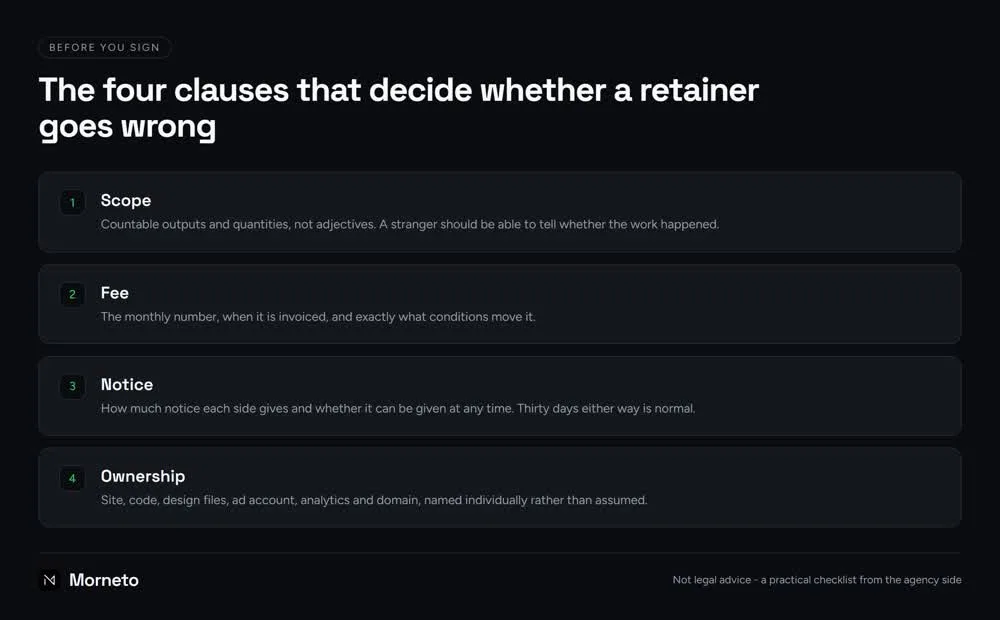
Eight sections in total. If one is missing, ask why before you ask for a discount.
- Scope of work, as a list. Specific outputs and quantities, not adjectives. Ours names a tracked keyword count, a monthly content number, a link-building range, profile work, technical maintenance and a monthly report. The same test applies to website maintenance services, where the phrase “as needed” hides the most.
- Fee and what triggers a change. The monthly number, when it is invoiced, and the conditions under which it moves. Ad management priced partly on spend should say exactly where the threshold sits.
- Term and notice. How long the initial period runs and how much notice ends it. Ours is month to month with 30 days notice.
- Ownership of work and accounts. Site, code, design files, ad accounts, analytics, domain. Named individually, because they are often held in different places.
- Reporting commitment. What you receive, how often, and against which metrics.
- Approvals and turnaround. Who signs off on your side and how long the agency waits before moving on. This protects both parties.
- Confidentiality and data handling. Access to your analytics and customer enquiries is access to real data about real people.
- Termination and handover. What the agency must hand over, in what format, within how many days.
How should scope be written in an agency retainer agreement?
In countable nouns. The test is whether a stranger reading the contract in six months could tell whether the work happened. Compare these two versions of the same clause:
Weak: ongoing SEO optimization, content creation and link acquisition as required to improve search visibility.
Strong: 10 to 30 tracked keywords, 2 to 6 published articles per month, 3 to 8 new referring domains per month, monthly technical crawl and fixes, Google Business Profile management, one report per month against enquiry volume.
The second version is harder to sell and much harder to argue about. It also protects the agency, because it defines what is out of scope and therefore chargeable. An agency resisting countable scope is usually protecting its flexibility at the direct expense of yours.
One nuance worth allowing: ranges rather than exact numbers are reasonable in search work, because the right action in a given month genuinely varies. A range is still countable. An adjective is not.
What do the notice and termination clauses need to say?
Three things. How much notice each side gives, whether notice can be given at any point or only at a renewal date, and what is owed at the end.
Thirty days either way is the common and fair shape for monthly marketing work. Longer initial terms can be legitimate when the agency carries real setup cost, but the tell is whether that setup is itemized. A twelve-month minimum with no stated setup work is a retention device rather than a commercial necessity.
Watch for automatic renewal into a fresh long term, which turns a single missed email into another year. Renewal into a rolling monthly arrangement is normal and reasonable. Renewal into another twelve months is a clause worth negotiating out before you sign, and most agencies will if you ask.
Who owns the work when the agency retainer agreement ends?
You should, and the agreement has to say so item by item, because ownership is not one thing. Six separate assets typically sit in different accounts:
- The website and its code. Including any custom development done during the retainer.
- Design files. The working files, not just exported images.
- The Google Ads account. With its conversion history, which is genuinely valuable and does not transfer if the account was the agency’s.
- Analytics and Tag Manager. Your historical data lives here. Losing it means starting measurement from zero.
- The Google Business Profile. Ownership, not just management access.
- The domain. Registered to you, in an account you control.
The pattern that causes the most damage is an agency running your ads inside their own manager account. It looks like a technical detail and functions as a hostage. Ask for your own account with the agency granted access, which is how our Google Ads work is set up as standard, and confirm it in writing rather than on a call.
We put the same principle in our own agreements: you own the site, the code and the design files, and every published price sits openly on our pricing page. It is a low bar, and a surprising number of contracts do not clear it.
Which clauses in an agency retainer agreement should worry you?
Five, and none of them are automatically dealbreakers. They are all things to ask about.
- Results guarantees. Nobody controls Google’s rankings. A guaranteed position clause means either meaningless small print or a plan to chase worthless keywords.
- Unilateral scope changes. A clause letting the agency adjust deliverables at its discretion cancels out the scope section above it.
- Fees payable after termination. Sometimes fair for work already done. Not fair as a penalty for leaving.
- Broad non-solicitation. Reasonable in narrow form. Unreasonable if it stops you hiring in your own industry.
- Silence on data and privacy. An agency touching your enquiry data should say how it handles it. Silence is not the same as safety.
The reason to read these carefully is that they are the clauses least likely to be discussed on the sales call. Contract terms in the United States are largely a matter of what both parties agreed to, so the written document is the protection, and the Small Business Administration’s guidance on managing a business is a reasonable starting point before you get to a lawyer.
Do you need a lawyer for an agency retainer agreement?
For a standard monthly marketing arrangement at a few hundred to a few thousand dollars, most small businesses reasonably sign without one, provided the four essentials are clear: scope, fee, notice and ownership. Read those four sections twice and you have covered most of the practical risk.
Get an attorney involved when the numbers get larger, when the term runs past a year, when the agency asks for anything unusual around intellectual property, or when you would struggle to replace what you would lose by leaving badly. That last test is the useful one, and it has nothing to do with the size of the fee.
If you want a comparison point, the models behind these agreements are worth understanding first, and we set them out in how agency pricing actually works alongside what a retainer buys month to month.
Common questions
How long should an agency retainer agreement be?
Short enough to read in one sitting. Most good ones run three to eight pages. Length is not the signal, though. A two-page agreement with a countable scope protects you better than a twenty-page one full of adjectives.
Can I use a template for an agency retainer agreement?
A template is a reasonable starting point for structure, but the scope section is the part that has to be written for your specific arrangement, and that is the part templates leave blank. Whatever you start from, make sure scope, fee, notice and ownership are filled in with real detail.
What notice period is normal in an agency retainer agreement?
Thirty days either way is common and fair for monthly marketing work. Ours is 30 days. Longer initial terms can be legitimate when setup costs are itemized, but a long term with a vague scope is worth negotiating before signing.
Should the agreement guarantee results?
No, and be wary of one that does. No agency controls search rankings. What an agreement can and should commit to is the work: specific outputs, on a stated cadence, reported against enquiries.
What happens to my ad account if I leave?
That depends entirely on whose account it is. If the campaigns run inside the agency’s manager account, the conversion history can leave with them. Insist on your own Google Ads account with the agency granted access, and get it in writing.