Short answer: Contractor SEO in New York is won on two things most generic plans skip: a separate page for each trade you actually sell, and content that proves you have dealt with co-op boards, DOB filings and landmark rules before. Homeowners here are not only choosing a builder, they are checking whether you will survive their building’s approval process. Ongoing search work starts at $799 per month.
Why is contractor SEO different in New York?
Because the job does not start when the client says yes. It starts when the building says yes.
A kitchen renovation in a Manhattan co-op runs through a board that wants insurance certificates, a schedule of work and often an alteration agreement before a single cabinet comes out. A facade repair in a landmark district answers to the Landmarks Preservation Commission. Most meaningful work needs a filing with the Department of Buildings, and the homeowner has usually already been told a horror story by a neighbor about a contractor who could not get one through.
That changes what your website has to prove. Elsewhere a contractor site sells craft and price. Here it also has to answer an unspoken question: will this firm get me through my building’s process without stalling. A gallery of finished kitchens does not answer that. A page explaining how you handle a board package does.
This is also why generic contractor SEO advice underperforms in the five boroughs. Claim your profile, gather reviews and add city names is true everywhere and decisive nowhere. The differentiator here is procedural competence, and almost nobody writes about it.
What are people actually typing when they need a contractor?
Three kinds of search, and they want completely different pages.
- Trade plus place. Bathroom remodel Park Slope, general contractor Astoria, roofer Staten Island. High intent, ready to call, and the search that map results decide.
- Problem first. Water coming through ceiling from upstairs apartment, cracked stucco facade, radiator not heating whole apartment. The person does not yet know which trade they need. These searches are cheap to rank for and they arrive before your competitors are even in the conversation.
- Process questions. Do I need a permit to remove a wall, what does a co-op alteration agreement cover, how long does a DOB permit take. Nobody in the trade writes these, which is exactly why they are available.
The second and third groups are where a small firm can realistically win. The first group is a knife fight with every established contractor in the borough, and you need reviews and profile strength before you compete there. The pattern is the same one we described for local search across Brooklyn and Queens: earn the easier searches first, then use that traffic to build the authority the harder ones require.
Which pages does a contractor SEO plan need?
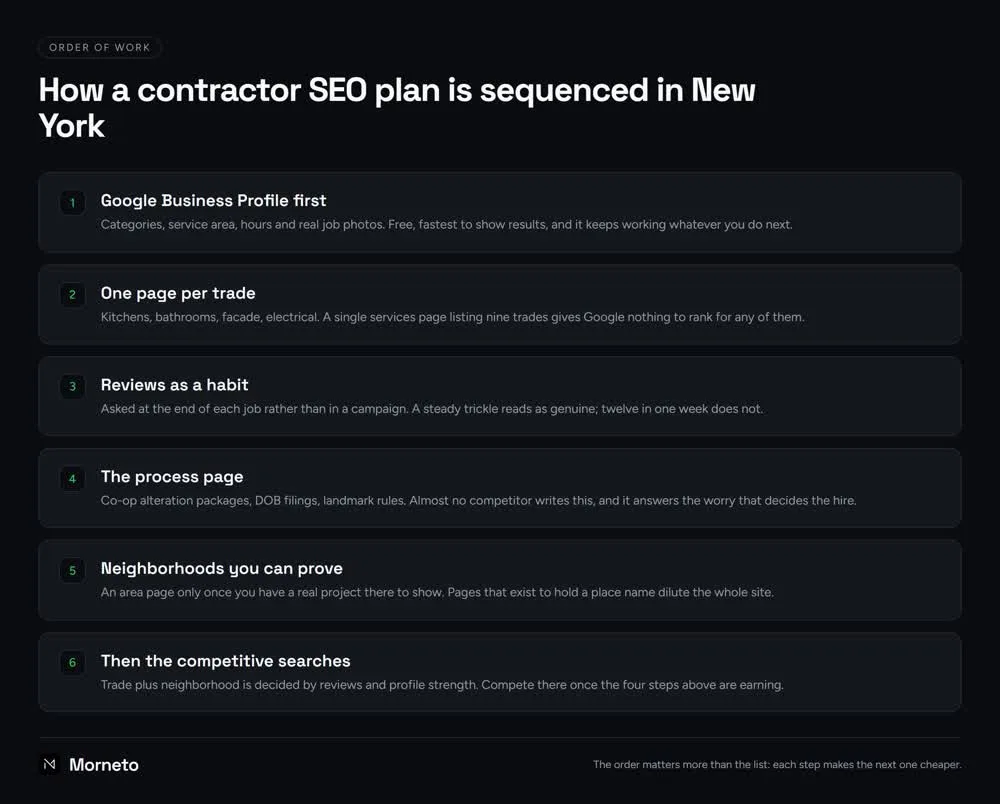
One page per thing you sell. That single rule fixes more contractor sites than anything else, because the standard build is a homepage, a services page listing nine trades, and a contact form. Google has nothing to rank for any of the nine.
A workable structure looks like this:
- A page per trade. Kitchens, bathrooms, facade work, electrical, whatever you genuinely do. Each with real photos of your work, a realistic timeline and what is included.
- A page for the approval process you handle most. Co-op alterations, DOB filings, landmark work. This is the page that separates you from every competitor selling on price.
- Project pages with the constraint named. Not just the finished bathroom, but the fact that the building allowed work between nine and four, that the elevator had to be padded, and that you finished inside the window anyway.
- Answers to the process questions. Short, plain pages about permits, timelines and what goes wrong. These earn traffic long before somebody is ready to hire.
The build itself matters here too, because these pages need to load on a phone from a basement or a job site. We wrote separately about what that means for a contractor website in New York, and the structure above assumes that groundwork exists.
How should contractor SEO handle a service area?
Honestly, and narrowly. The temptation is to claim all five boroughs and every neighborhood in them. That produces dozens of near-identical pages with a swapped place name, which Google has treated as doorway pages for years, and it makes you look like a lead broker rather than a builder.
What works is naming the areas you genuinely serve and proving it with jobs. Three neighborhoods with real projects, real photos and a note about the building types you have worked in beats thirty pages of filler. If you do not have a job in an area yet, do not build the page yet.
If you run a service area business with no storefront, your profile can hide the address and still show up in local results. That mechanism, and what it costs you in ranking strength, is the same for contractors as for anyone else, and our search work for Brooklyn businesses is built around exactly that constraint. How the same question lands in other trades and professions is set out on our page on what changes per sector, which names the advertising rules that apply to each.
What should contractor SEO cost a small firm?
Our ongoing search work starts at $799 per month, month to month with 30 days notice. That covers technical work, on-page optimization, Google Business Profile, content and reporting tied to enquiries rather than to a rankings chart. If the site itself is the problem rather than the marketing, a build is a separate one-time project from $997, and every figure sits openly on the page where we publish what we charge rather than behind a discovery call.
Two things are worth saying plainly. First, a contractor with a strong profile, steady reviews and one good trade page can get a long way without paying anyone; the free work is genuinely free and we say so in our piece on doing search work yourself versus hiring. Second, quotes in this market vary enormously for the same brief, so compare what is included line by line rather than comparing headline numbers, which is the exercise we set out in what a monthly package should actually contain.
What we would not do is spend on search before the phone is answered properly. If calls go to voicemail during working hours, more visibility just produces more missed calls. Paid ads are no different: our guide to running Google Ads for a plumbing shop starts with who answers every call.
Which contractor SEO mistakes cost the most?
Five, in rough order of how much they cost.
- No page per trade. Everything funneled through one services page. Nothing can rank because nothing is about one thing.
- Photos that are not yours. Stock kitchens read as stock instantly, and in a trade sold on trust that is expensive. Phone photos of real jobs outperform them every time.
- Reviews in bursts. Twelve reviews in one week after eighteen months of silence looks exactly like what it is. A steady trickle is worth more than a campaign. The fix is asking every customer right after each job, month after month, as our guide to a steady Google review flow explains.
- Silence about process. The board package, the permit, the building rules. This is the single most underused content opportunity in New York contracting.
- Chasing every borough at once. Thin location pages dilute the site and rank for nothing. Google has been clear about what it considers helpful content, and a page that exists only to hold a place name is not it.
None of these need a big budget to fix. They need decisions about what you actually sell and where you actually work.
Borough matters for a trade business, and Staten Island is the clearest example: it is the only one where lower density means the nearest credible name still has a real advantage, which is why web design and SEO for Staten Island leans harder on the map pack than the same work in Manhattan does. Around University Heights and the west Bronx, lighter competition means a complete profile and a decent site can often reach the map pack in weeks.
Common questions
How long does contractor SEO take to produce calls?
Expect early movement in one to three months and meaningful enquiries in three to six. Problem-first and process questions tend to land soonest because competition for them is thin. Trade plus neighborhood searches take longer because reviews and profile strength carry more weight there.
Do I need a separate page for every neighborhood I work in?
No, and doing it is usually harmful. Build a page for an area once you have real projects there to show. Pages that exist only to hold a place name are the classic doorway pattern and they dilute the rest of the site.
Is Google Business Profile enough on its own for a contractor?
It is the highest-value single thing you can maintain, and for a small firm serving one neighborhood it can carry a lot. It stops being enough when you want to compete for searches outside your immediate radius, because that is decided by the website rather than the profile.
What should a contractor write about if they hate writing?
The questions clients ask on site. Keep a note on your phone for a fortnight and you will have a year of pages. Permits, timelines, what goes wrong in prewar buildings, what a board wants to see. Plain sentences beat polished marketing copy in this trade.
Does contractor SEO work if I only do high-end renovations?
Yes, and the process content matters more rather than less. Higher budgets mean longer research, more scrutiny and usually a co-op or condo board in the middle of it. Those clients read before they call, so the pages that answer their procedural worries do the selling.