Short answer: website maintenance services are a monthly arrangement to keep a site updated, backed up, monitored and fixed, so problems are caught before a customer meets them. A real plan names what is checked, how often, how fast someone answers and what falls outside it. Ours start at $97 a month, and the boundary is written down rather than negotiated after something breaks.
Most owners discover their maintenance arrangement on the day it fails: the contact form has been silently dropping messages for a month, or the checkout stops on a Friday afternoon.
A website is software. It sits on somebody else’s server, runs somebody else’s platform, and depends on a dozen plugins written by different people who each ship changes on their own schedule. Left alone, it does not stay the way you left it. That is the problem website maintenance services exist to solve, and it is why the interesting question is not whether you need them but what has to be inside the arrangement.
What are website maintenance services?
Website maintenance services are the recurring work that keeps a live site healthy: applying updates, taking backups that have actually been restored, watching whether the site is up, scanning for malware, and fixing what breaks. Some plans add a small allowance of hands-on work each month for the edits every business needs.
Notably, this is not the same as hosting. Your host rents you the machine and keeps it powered; it does not care whether your booking form still sends email. It is also not web design. Design changes how the site looks and works, while maintenance keeps whatever you have got running as intended.
Because the label is unregulated, two quotes at the same price can mean entirely different things. One provider means updates and a backup. Another means updates, backups, monitoring, security scanning, a monthly report and an hour of work. So the comparison has to happen at the level of the deliverables, not the number at the bottom.
What does a plan include each month?
Strip away the marketing and a credible plan does six things:
- Updates. WordPress core, plugins and themes, applied on a schedule rather than whenever somebody remembers, with a check afterwards that nothing visible broke.
- Backups you can restore. A backup nobody has ever restored is a hope, not a backup. The restore has to be tested, and the copy has to live somewhere other than the server it protects.
- Uptime monitoring. Automated checks, so the provider learns the site is down before your customers tell you.
- Security scanning. Malware scans and a plan for what happens if something is found. The WordPress project’s own guidance on hardening WordPress treats current software as the foundation of site security, which is exactly why lapsed updates are the common thread in compromised sites.
- A monthly report. What was updated, what was found, what was fixed, and how long the site was unavailable.
- A named route in. One address that reaches a person, and a stated response time.
Everything beyond that list is an add-on, and add-ons are where quotes diverge. Content changes, new pages, speed work and redesigns are project work, which is why our WordPress development work is quoted separately.
Do websites need monthly maintenance?
A brochure site on a managed platform with no forms and no plugins can survive on a quarterly look. However, that describes almost nobody. The moment a site takes bookings, sells anything, or runs more than a handful of plugins, the update cycle stops being optional, because plugin authors patch security holes and those patches only protect you once they are applied.
There is a second reason that has nothing to do with security. Things degrade quietly. Links to pages you deleted turn into dead ends, images pile up until pages crawl, and a form that worked in January stops delivering in June when a mail provider tightens its rules. Nobody reports this. They just leave, which is the expensive version of a problem that a slow site quietly costs you describes in more detail.
In short: monthly for anything transactional, and at minimum a scheduled review twice a year for a site that genuinely sits still.
What do website maintenance services cost?
Two numbers make up the total, and mixing them up is the most common budgeting mistake. The first is the bills you owe other companies, such as hosting, the domain and any premium plugin licenses. The second is labor, which is what a maintenance plan actually sells. We split those apart with dated examples in what website maintenance costs, line by line.
Our own labor prices are published rather than quoted. Website Care is $97 a month and covers weekly updates, daily backups with a tested restore, uptime monitoring, malware scanning and a monthly report; content changes are not included. Website Care Plus is $197 a month and adds an hour of work each month, which is what most businesses actually want. Paid a year up front, either plan is ten months for twelve, with two scheduled reviews a year covering speed, forms, dead links and a restore test.
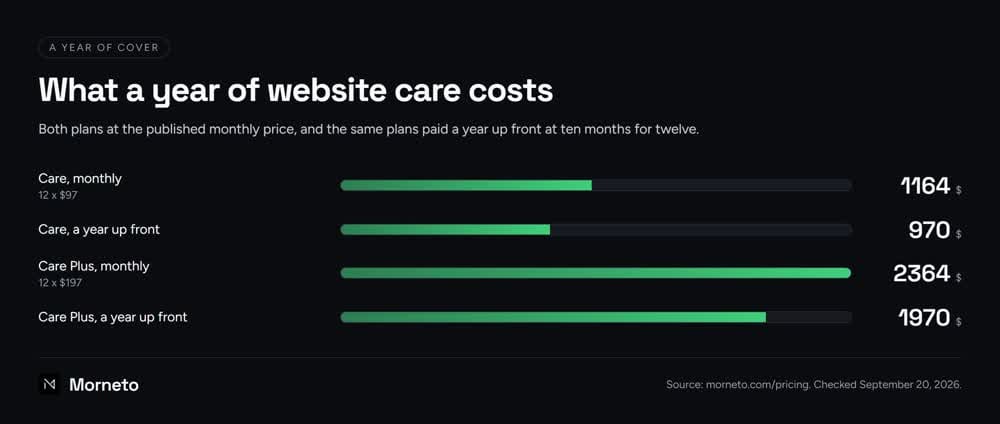
The hosting side is a separate decision with its own trade-offs, and our hosting comparison works through what the cheap tiers leave out. Specifically, no plan can rescue a site from a host that oversells its servers.
What is the average hourly rate for website maintenance?
Hourly rates for this work vary enormously by who is doing it and where they are, so an average is close to useless for a decision. What matters is whether the rate is published, what the minimum increment is, and whether anything is quoted before the meter starts.
Ours is $150 an hour for consulting and for work beyond the plan, billed in half hours after the first hour, and quoted in advance as one number when a job is going to run long. The full list sits on our pricing page alongside the plans. Moreover, an hourly rate is only honest when the plan beside it is specific about what it already covers, otherwise every request quietly becomes billable.
How do you compare website maintenance services?
Seven questions separate a plan from a line item on an invoice. Ask them in writing:
- What exactly is updated, and how often? Weekly, monthly and “as needed” are three different products.
- Where do backups live, how long are they kept, and when was a restore last tested?
- What is the response time for an outage, and what for a normal request?
- How much hands-on work is included, and what happens to unused time?
- Who owns the site, the hosting account and the domain? The answer should be you, in every case.
- What is explicitly excluded? A provider who cannot answer this has not thought about it.
- What happens if the site is hacked? Cleanup inside the plan, at cost, or not at all.
Then get it written down. Our guide to what belongs in a retainer agreement covers the clauses that matter when a relationship is under strain rather than when it is new.
Should you do it yourself or buy a plan?
Doing it yourself is entirely reasonable if you are comfortable in the dashboard, you have somewhere to test updates, and you will genuinely do it on the weeks nothing is on fire. The work is not difficult. It is just relentless, and it competes with running your business.
The realistic failure is not a dramatic hack. It is drift: updates postponed for four months, a backup plugin that stopped running in March, and a theme two major versions behind that finally breaks a page during your busiest week. In addition, recovery costs far more than prevention, and it always lands at the worst possible time.
One more case argues for a plan: anything that touches how you are found. Changes to pages, redirects and templates have search consequences, which is why protecting rankings through a redesign is its own discipline. If you would rather hand the whole thing over, tell us what your site runs on and we will say plainly which plan fits, or that you do not need one.
Common questions about website maintenance services
What do website maintenance services actually do?
They apply updates to WordPress core, plugins and themes, take and test backups, monitor whether the site is up, scan for malware, and fix what breaks. Better plans add a small amount of hands-on work each month and a report showing what was done.
How much do website maintenance services cost?
Ours are $97 a month for Website Care and $197 a month for Website Care Plus, which adds an hour of work each month. Paid a year up front, either plan is ten months for twelve. Hosting, the domain and premium plugin licenses are separate bills you owe other companies.
Is hosting the same as website maintenance?
No. Hosting is the server your site runs on. Maintenance is the work of keeping the software on it current, backed up and working. A good host makes maintenance easier, but it does not do it for you.
How long does website maintenance take each month?
For a normal small business site, the routine updates, backup checks and monitoring review take well under an hour of attention spread through the month. The time goes when something conflicts after an update and has to be traced.
Do I still need maintenance on Wix or Squarespace?
Less of it. Those platforms update themselves, so the update and backup work largely disappears. What remains is the content side: dead links, outdated pages, forms that stopped delivering, and images that slow the site down.