Short answer: if your website traffic is dropping, open Search Console first. When impressions hold up but clicks fall, an AI answer is taking the click before you get it. When both fall, you have lost rankings to competitors or broken something technical. In New York in 2026 the first case is now common, and the fix is not more blog posts: it is being the page the answer is built from.
Last updated 18 August 2026. The AI-crawler numbers in this guide come from our own server and Cloudflare logs; the click data comes from Pew Research; Google’s own documentation is linked where it matters.
Website traffic dropping is rarely dramatic. Most owners notice it the same way. The phone is quieter, the form is quieter, and the site looks exactly as it did last year. Nothing broke. Nobody changed anything. And still, month after month, fewer people arrive. This guide explains the five real causes, how to tell in ten minutes which one is yours, what the acronyms flying around (AIO, AEO, GEO) actually mean, and what a New York business should do about it in 2026.
Why is my website traffic dropping? Find the cause in ten minutes
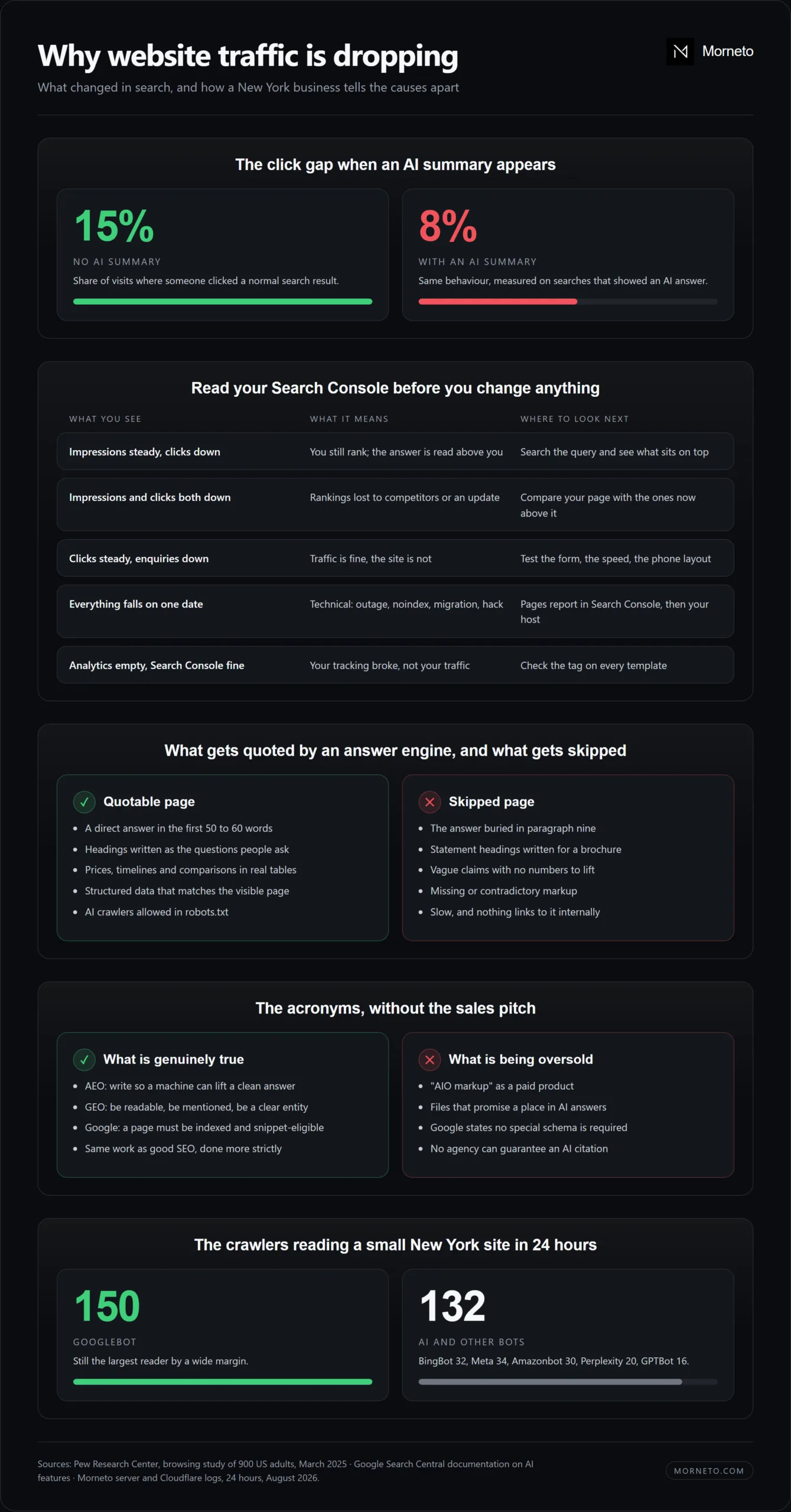
Open Google Search Console, go to the Performance report, set the range to the last 16 months and compare this quarter with the same quarter last year. Then read the two lines against each other. Google explains the report itself in its Performance report documentation; what matters here is the shape.
| What you see | What it means | Where to look next |
|---|---|---|
| Impressions flat or up, clicks down, average position stable | You still rank. The answer is being read on the results page instead of on your site: AI Overviews, featured snippets, the map pack | Search the query yourself and see what sits above you |
| Impressions down and clicks down, position worse | You have lost rankings to competitors or to a core update | Compare your page with the ones now above it |
| Clicks flat but enquiries down | Traffic is fine; the site or the form is the problem | Test the form, the speed and the phone layout |
| Everything drops off a cliff on one date | Technical: an outage, a noindex left on after a rebuild, a migration, a hacked site | Pages report in Search Console, plus your host |
| Analytics shows nothing but Search Console shows traffic | Your tracking is broken, not your traffic | Check the analytics tag on every template |
That table settles most cases of website traffic dropping. Two of them are ordinary and fixable in a week. The first one is the new one, and it is the reason this article exists.
Website traffic dropping while rankings hold: the cause most owners miss
Search results used to be a list of doors. Increasingly they are an answer with a few doors underneath. Google has been expanding AI Overviews and AI Mode, and ChatGPT, Perplexity and Copilot answer the same questions somewhere else entirely.
The effect on clicks is measurable. Pew Research Center tracked the real browsing of 900 US adults across nearly 69,000 Google searches in March 2025. When an AI summary appeared, 8 percent of users clicked a traditional result. When no summary appeared, 15 percent did. Roughly one in a hundred visits led to a click on a source cited inside the summary. Users were also more likely to end their session altogether after seeing a summary page.
Read that carefully, because it is not the end of search. Half the clicks still happen, and they concentrate on fewer pages: the ones the answer trusts. So the question stops being “how do I get more traffic” and becomes “why is my website traffic dropping while my competitor’s is not”. Usually the answer is that their pages are easier for a machine to quote and yours are not.
The traffic is real, too. On our own site, in a single 24-hour window this month, our logs showed Googlebot 150 visits, BingBot 32, Meta’s crawler 34, Amazonbot 30, PerplexityBot 20 and GPTBot 16. Those bots are reading small business websites in New York right now and deciding which ones to quote. Most sites we audit have never checked whether they are readable at all.
AIO, AEO and GEO: what the acronyms mean, and which ones matter
AIO: AI Overview optimization
Being eligible for the AI answer box on Google. Here is the part the agencies selling “AIO packages” leave out, and it comes straight from Google’s own documentation on AI features: there are no additional requirements to appear, no special files and no special structured data. A page qualifies when it is indexed and eligible to be shown with a snippet. Anyone charging you for a magic AI markup is selling you something Google says does not exist. If you are curious about the optional file itself, our honest guide to llms.txt explains it without the sales pitch.
AEO: answer engine optimization
Writing so a machine can lift a clean answer out of your page: a direct answer in the first 60 words, question-shaped headings, short paragraphs, FAQ blocks, tables with real numbers. This is the part that genuinely changes whether you get quoted, and it is mostly writing discipline rather than technology.
GEO: generative engine optimization
The same idea aimed at ChatGPT, Perplexity and Copilot rather than Google. It adds three things: letting AI crawlers in through robots.txt, being mentioned on sites the models already trust (directories, reviews, press), and being a clear, consistent entity so a model knows who you are, what you sell and where.
One honest sentence about all three: they are new labels on old work. Clear content, clean technology, real trust signals. If you already do SEO in New York properly, you are most of the way there; our guide to getting found by AI search is the practical version of this section. Want the acronyms side by side with classic SEO? We lay out the difference between GEO and SEO in one table, including how Bing now counts AI citations.
Website traffic dropping: the four ordinary causes we find first
- Competitors published and you did not. The most common reason for website traffic dropping, by far. A rival added twenty pages that answer real questions while your site stayed at five. Their pages now sit above yours and feed the AI answers too. Publishing is unglamorous and it works.
- Technical decay. A rebuild left a noindex tag on, a plugin update broke the sitemap, images grew, the site is slow on the train. If the drop began the week a new site went live, start with the redirects: how to protect SEO during a website redesign lists the checks in order. Speed is not a ranking miracle, but it is a tiebreak and a conversion lever; the fix list is in how to make your website faster.
- Your local presence went stale. Hours, categories, photos, reviews. In New York the map pack takes a large share of local intent before the blue links even start; see the Google map pack in New York and whether you need a Google Business Profile.
- Seasonality and updates. Some drops are the calendar, and some are a core update. Compare year on year, not month on month, before you panic or pay anyone.
What actually works in 2026, in the order that pays
- Answer first, on the page. Put a 50 to 60 word answer at the top of every important page, then the detail. It helps the reader who is in a hurry and it is the block a machine can quote.
- Write in questions. Headings that match how people ask, because that is what both Google and the models match against. Google’s own guidance on creating helpful, people-first content has not changed with AI; it just matters more.
- Give the facts a shape. Prices, timelines and comparisons in tables. Vague pages do not get quoted because there is nothing to quote.
- Use structured data honestly. FAQ, LocalBusiness, Service and Article markup that matches what is visible on the page. It will not force you into an AI answer, but it removes all doubt about what your page is.
- Let the AI crawlers in. Check robots.txt actually allows GPTBot, PerplexityBot, ClaudeBot and the rest, unless you have decided otherwise on purpose.
- Build the trust that a model can see. Reviews, directory listings, a consistent name, address and phone, real authorship. This is the slowest lever and the one that decides whether you get named at all.
- Measure the right thing. Track enquiries, not sessions. In a world with fewer clicks, an assisted enquiry from someone who read about you in an answer is still a customer.
- Link your own pages together. A page nothing links to is invisible to crawlers and to readers; see internal links and why they matter for SEO.
What this costs in New York, and how long it takes
New York is one of the most competitive search markets in the world, so the numbers are higher than the national advice you read. Directories such as Clutch’s list of New York SEO firms are a fair way to see the field, and agencies like SmartSites and Ironpaper are the kind of established shops you will meet on a shortlist. Across those sources the pattern is consistent.
| What | Typical New York range | What you should get for it |
|---|---|---|
| Monthly retainer, basic | From about $1,500 a month | Technical fixes, a few pages a month, local listing upkeep, reporting |
| Monthly retainer, competitive | $2,000 to $2,500 and up | Content program, digital PR or links, ongoing technical work |
| Annual budget, small to mid business | $18,000 to $36,000 a year | A full year of compounding work, not a campaign |
| Morneto | $799 a month, no contract | The same core work for a smaller business: technical, local, content and the answer-first structure this article describes |
| Time to a real change | 6 to 12 months | Movement in months 3 to 4, meaningful traffic later |
Two honest notes about that table. First, a higher retainer is not automatically better work; ask what is actually produced each month. Second, our own price is lower because we are a small studio with low overhead, and because we would rather publish the number than quote it. The full list is on our web design cost in New York page, and if you are choosing between shops, how to choose a web design agency is the checklist we would want you to use on us too.
Why so many businesses are behind, and why that is your opening
Here is the part worth being blunt about, because it explains why website traffic dropping is so widespread right now. Most small New York websites we audit have no answer block, no FAQ markup, statement headings instead of questions, and no idea whether an AI crawler can read them. Not because their owners are careless, but because nobody told them the rules changed. That is exactly why the gap is an opportunity: in a market where the big agencies are still selling last year’s checklist, being genuinely quotable is cheap.
We do it on our own site before we sell it. Every guide opens with a short answer, every page carries schema that matches what you can see, the site scores 99 to 100 on Google’s speed test, and we publish a plain-text summary at morneto.com/llms.txt so an AI reading us gets the facts right. We are not claiming that file is a ranking factor, and Google says no such file is required; we keep it because it costs nothing and it makes the facts unambiguous. That is the whole philosophy: do the things that are true, skip the things that are sold.
If your traffic is sliding and you want to know which of the five causes is yours, our free SEO audit answers exactly that question, with the Search Console screenshots to prove it. If you would rather read first, why small businesses stay invisible online covers the sites that never got traffic in the first place.
Prefer to see the work itself priced out? SEO services in New York lists the four jobs, what each costs in 2026 and how to judge who does them.
If the cause turns out to be the site itself rather than search, performance web design is the rebuild standard we work to.
Common questions about website traffic dropping
Why is my website traffic dropping but my rankings are the same?
Because the click is being taken above you. AI Overviews, featured snippets and the map pack answer the question on the results page. Pew found clicks fall from about 15 percent to 8 percent when an AI summary appears. The fix is to be the source the answer uses, and to chase the searches where people still need your page.
Is SEO dead because of AI?
No, but the easy half is gone. Thin pages written for keywords are worth nothing now. Clear answers, real expertise, working technology and genuine trust signals are worth more, because they decide who gets quoted as well as who ranks.
Do I need special markup or an llms.txt file to appear in AI answers?
No. Google states plainly that there are no additional requirements, no AI text files and no special schema needed for AI Overviews or AI Mode; a page needs to be indexed and snippet-eligible. Files like llms.txt are optional extras. Be suspicious of anyone selling them as a ranking product.
How long before traffic recovers?
Technical faults recover in days once fixed. Losing to competitors takes three to six months of consistent publishing to turn around. Adapting to AI answers is continuous rather than a project, and in New York the honest window for meaningful change is 6 to 12 months.
What should a New York small business do first?
Open Search Console and find out which of the five causes you have. Then fix the technical faults, complete your Google Business Profile, and rewrite your three most important pages answer-first with question headings. That sequence costs little and settles most of the problem before anyone quotes you a retainer.
Does a lower retainer mean worse SEO?
Not on its own. New York retainers commonly run $1,500 to $2,500 a month, and plenty of that is office overhead and account management. Ask what is delivered each month, who does the work, and what happens if you leave. Judge the output, not the invoice.