
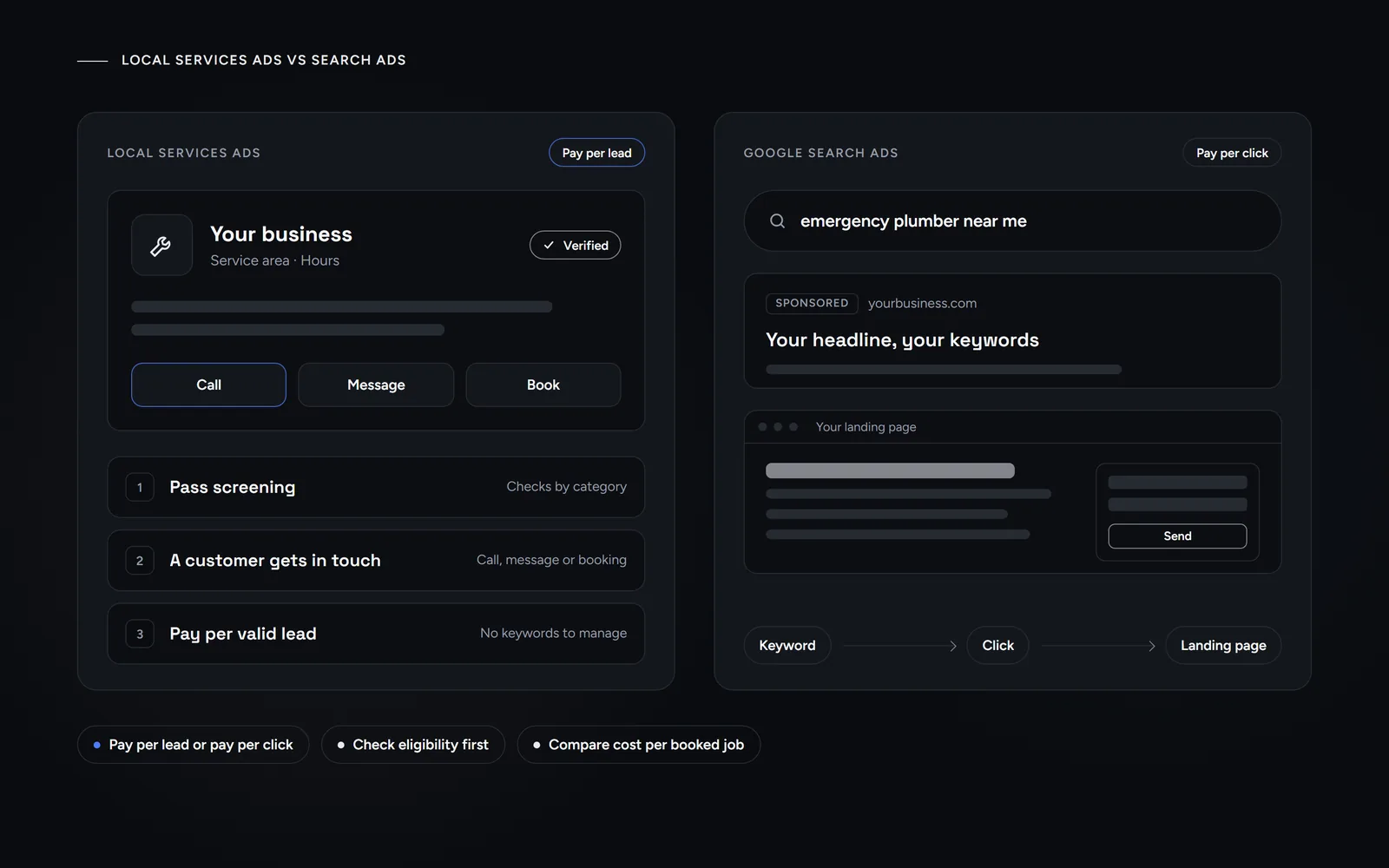
Short answer: Google local services ads charge you for each valid lead, not for each click, and they only run after your business passes Google’s screening. Search ads, by contrast, charge per click and let you pick keywords and the landing page. For most New York service businesses, we would start a narrow Search campaign now and add LSA once screening clears.
Morneto is a web design, SEO and Google Ads studio in New York. We wrote this guide for contractors, plumbers, electricians, cleaners and law firms in the five boroughs who are choosing between two Google ad types, or wondering whether to run both. Every Google rule below comes from Google’s own help pages, and every number also carries its source. Last checked: October 31, 2026.
What are local services ads, and how do they work?
Local Services Ads (LSA) are a separate Google ad format, built especially for service businesses. When someone searches for a service you offer in an area you cover, your ad can show your business name, star rating, number of reviews, hours and service area. The customer then calls you, sends a message or requests a booking straight from the ad.
Still, the billing model is the real difference. Google’s help page on how Local Services leads are charged puts it plainly: you are charged for each valid lead you receive. However, Google decides what counts as valid:
- Answered calls. You pick up, or you call the customer back and speak with them.
- Missed calls. A call during your business hours where the caller stays on the line for more than 20 seconds.
- Messages. A text or an email from the customer, and also a voicemail.
- Bookings. A booking request, which is available in the United States and Canada only.
Follow-ups are free for a while, too. Once a lead is charged, later calls or messages from the same number or email are not charged again, as long as there is contact within 15 days.
So who shows first? Google orders LSA profiles in an auction. Its ad rankings page names your bid first, then the context of the search and how relevant your business is. Responsiveness counts as well, because missed calls may hurt you. Profile quality matters too: your rating, number of reviews, average response time, photos and the verification checks you have completed. Hours matter as well, because outside your business hours Google says your ad won’t show in searches with a badge.
Which New York businesses can run local services ads?
Not every business qualifies. Google’s getting-started page says the ads are available only for certain service categories, and it lists them. The list covers the US as a whole, and it includes electricians, plumbers, HVAC, roofers, general contractors, handymen, house cleaning services, locksmiths, pest control and movers. It also covers many types of lawyers, from personal injury and immigration law to family and real estate law.
Some entries also carry a state limit. For example, drain experts, architects, home insulation, interior designers and insurance agencies are marked California and Florida only. So a New York business in those trades can’t use LSA for now. Availability also depends on your area, so Google points you to an eligibility check before you sign up.
What does Google check before your ads go live?
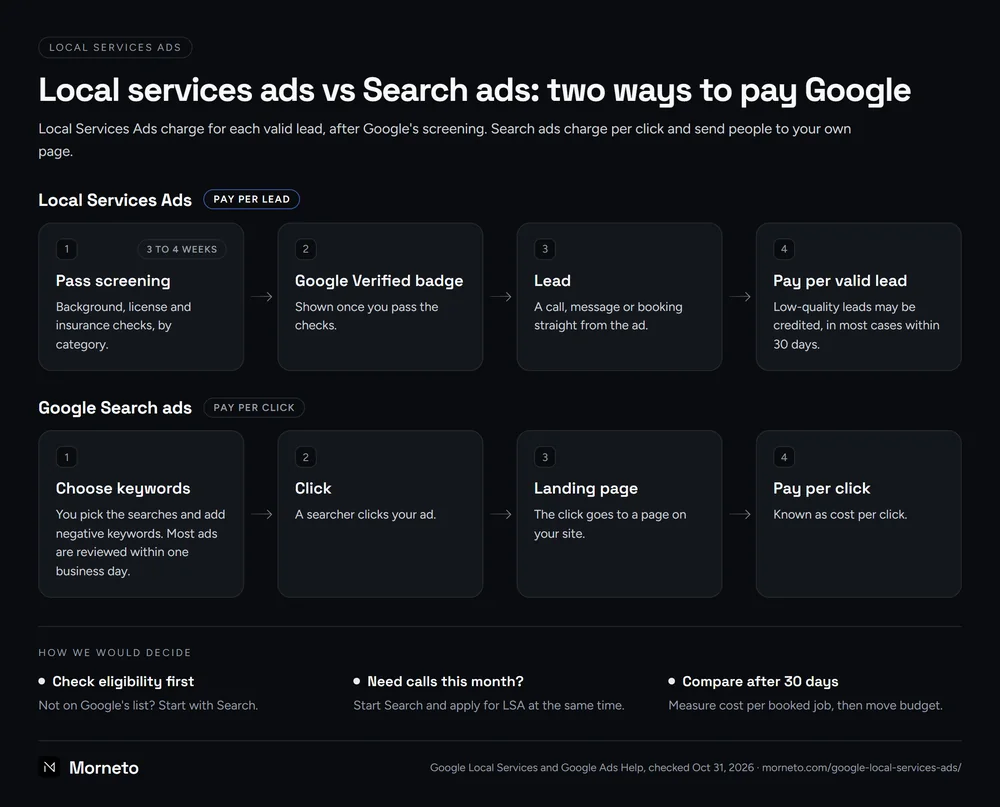
Screening comes next. According to Google, the checks vary by category and location. In addition, they may include background, business registration, insurance and license checks, plus minimum review requirements. You also need a public, verified Google Business Profile. On average, Google says screening takes 3 to 4 weeks after you submit your documents. Here are a few New York examples:
- Electricians and plumbers. Google treats both as urgent categories, so they get an extra level of screening that includes background checks for service professionals.
- House cleaners. Similarly, for select users the requirements list general liability insurance, plus state-level business and owner licenses where local law requires them.
- Lawyers. For practice areas such as personal injury, Google lists professional liability insurance and a state bar license check for each lawyer in the firm.
On the plus side, Google says businesses aren’t charged for the background check, and it involves no credit check. Since the ads lean on your Business Profile, keep that profile healthy. If it ever runs into trouble, our guide on what to do when a Google Business Profile is suspended covers the next steps.
What happened to Google Guaranteed and Google Screened?
Many guides still describe the Google Guaranteed and Google Screened badges. However, that advice is out of date. On August 20, 2025, Google announced that one Google Verified badge would replace Google Guaranteed, Google Screened, License Verified by Google and the Money Back Guarantee, starting that October. Here is what that means today:
- Existing advertisers. Those who had completed verification earned the new badge automatically, with no action needed.
- New advertisers. You earn the badge only when you meet all verification requirements.
- The money-back promise. Google discontinued it, and reimbursement requests had to be submitted before December 7, 2025.
- Ranking. Google also says the badge change does not affect LSA ranking.
- Exceptions. Finally, the badge is currently unavailable in the auto, beauty and dining categories.
Google also offers pre-badge ads. After you pass the preliminary checks, your ad can run while you finish onboarding. However, Google places those listings below providers who have completed every requirement.
One more change is underway, too. Google is moving LSA into Google Ads as Performance Max campaigns with pay-per-lead goals. The first phase began in August 2026 for select US home and storefront service advertisers, including plumbing, HVAC and electrical. Then service-area businesses without a storefront follow in late 2026. You still pay per valid lead, and the ads still show only on Google Search and Maps. For now, though, Google says you can’t create a new pay-per-lead campaign inside Google Ads, so new advertisers still sign up at g.co/localservices.
How much do local services ads cost?
Google does not publish a price list for these leads. Instead, it says lead prices may vary by your location, the job type, the type of lead and your bidding mode. Message leads are typically priced lower than phone leads, although Google adds that this is not always the case.
Even so, you control spend with a budget. In the classic LSA dashboard, you set an average weekly budget. You can spend more than that in a given week, but never more than your monthly max. After the move to Google Ads, the weekly budget is divided by 7 into a daily average. Monthly spend is then capped at that daily figure times 30.4.
The honest answer, then, is that your cost per lead depends on your trade, your neighborhood and your competitors. For a reference point on regular Search ads, our Google Ads guide for plumbers cites a LocaliQ study from 2025: plumbing Search ads averaged $10.49 per click and $129.02 per lead. Therefore, treat them as LocaliQ’s averages for Search ads, not as LSA lead prices.
If you hire help, a management fee also comes on top of the ad spend. Ours is public: our published Google Ads management fee is $497 a month for accounts spending up to $5,000, plus 12 percent of spend above that. Your ad budget is paid directly to Google, and the plan runs month to month with 30 days notice.
How do lead credits work when a lead is junk?
Google now handles most credits automatically. First, it assesses each lead at initial contact and does not charge leads it finds invalid or low quality. After that, its models reassess charged leads over time. If a lead later looks low quality, Google may credit it automatically, in most cases within 30 days. Still, a few details matter for your bill:
- Feedback. When a lead is poor, use Rate this lead on the Leads page. Google may also give a bonus credit for leaving feedback.
- Wrong settings. Google no longer credits leads flagged as job type not serviced or geo not serviced. So switch off every job type and area you won’t take.
- Invoices. The original charge still appears on your invoice, even after a credit.
- Exceptions. Lastly, lead credits aren’t available for health care verticals or tax specialists.
What did we find in the search data on Oct 31, 2026?
Before writing, we pulled US keyword data on October 31, 2026, from DataWise SEO, which reports Google Ads search volumes and costs per click based on DataForSEO data. Volumes are average monthly searches in the US, while a dash means the data showed no cost per click.
| Search | Monthly US searches | Cost per click |
|---|---|---|
| local services ads | 49,500 | – |
| google local services ads | 33,100 | $12.97 |
| google guaranteed | 4,400 | – |
| google screened | 3,600 | – |
| google local services ads cost | 170 | $68 |
| what are local services ads | 140 | – |
| google local services ads for lawyers | 90 | – |
| local service ads vs google ads | 70 | – |
| is google guaranteed worth it | 30 | $96 |
Overall, three things stand out to us:
- Old badge names live on. About 8,000 searches a month still use Google Guaranteed or Google Screened, even though Google replaced both. So expect outdated advice in many results.
- These costs per click are not lead prices. A search like is google guaranteed worth it most likely comes from a business owner rather than a customer. So, in our reading, that $96 reflects firms that market to business owners. It therefore tells you nothing about what your own LSA lead will cost.
- The comparison question is small but sharp. For instance, only 70 searches a month ask about LSA versus Google Ads. Still, it is the exact decision this guide is about.
Local Services Ads or Search ads: what is the difference?
Both appear on Google, but they work in opposite ways. For that reason, the table compares them on the points that decide most budgets.
| Local Services Ads | Google Search ads | |
|---|---|---|
| Control | Google builds the ad from your profile. You set categories, job types, service areas, hours and budget. | You write the ads and choose keywords, match types, locations and the schedule. |
| Keywords | None. Targeting follows your categories and service areas. | Yes. You pick them and add negative keywords. |
| Landing page | Not needed. Customers contact you from the ad. | Needed. The click goes to a page on your site. |
| Billing | Per valid lead: a call, message or booking. | Per click, known as cost per click. |
| Setup time | Screening averages 3 to 4 weeks after you submit documents. | Most ads are reviewed within one business day. |
| Badge | Google Verified, once you pass the checks. | No badge. |
In practice, LSA trades control for simplicity, while Search ads trade simplicity for control. Search also needs a page that turns visits into calls. If a campaign already brings clicks but the phone stays quiet, read our guide on why Google Ads get clicks but no calls before you add budget.
Which should a New York service business run first?
Here is how we would decide for a New York service business. Note that this is a framework rather than a promise of results:
- Check eligibility first. If your category is not on Google’s list, or is limited to California and Florida, you can only start with Search.
- Look at your calendar. If you need calls this month, Search can start after ad review, while LSA screening takes weeks. So start Search and apply for LSA at the same time.
- Be honest about the phone. Missed calls may hurt your LSA ranking, so plan for that. If nobody answers during the day, set a schedule that matches when someone can pick up.
- Count your reviews. Rating and number of reviews feed LSA profile quality. Consequently, a young profile with few reviews may struggle at first.
- Weigh your website. Search ads need a strong landing page, whereas LSA does not. If your site is weak, LSA can bring leads while you fix it.
- Compare after 30 days. Measure cost per booked job for each channel, rather than cost per lead. Then move budget toward the cheaper one.
As for our side, we run Search, Performance Max and remarketing campaigns, with conversion tracking set up before any bidding. That is the core of our Google Ads agency work in New York, and the account always stays in your name. Also, if you already run ads, you can ask for a free audit of your existing ad account. Either way, we reply within one working day.
Common questions about local services ads
Is there a difference between Google Ads and Google Local Services Ads?
Yes. LSA charges per valid lead, needs Google screening and uses no keywords or landing page. In contrast, standard Search campaigns in Google Ads charge per click and let you choose keywords, ads and the landing page. Google is now moving LSA into Google Ads as a pay-per-lead campaign type.
How much do Google Local Services Ads cost?
Google publishes no fixed price, because lead prices vary by location, job type, lead type and bidding mode, and you cap spend with a budget. Message leads are typically priced lower than phone leads, although not always.
Are Google Local Services Ads worth it?
They can be when your category is eligible, you answer calls quickly and your profile has solid reviews. Judge them on cost per booked job after about 30 days, side by side with Search ads.
How do I pause Local Services Ads?
In the LSA dashboard, set your ad to paused in the ad schedule settings. Meanwhile, a free version of your listing may still show. After the move to Google Ads, open the campaign settings and switch the status to Paused.
Does the Google Guaranteed badge still exist?
No. Starting in October 2025, Google replaced Google Guaranteed, Google Screened and License Verified by Google with one Google Verified badge. It also ended the Money Back Guarantee.