Short answer: how long does SEO take? For most sites, three to six months before results you can feel, and six to twelve in competitive markets. Independent studies land in the same range — Orbit Media puts low-competition rankings at two to three months and significant success at four to twelve. Below, something rarer than another estimate: our own three-week-old site, measured in public, so you can see what actually happens in the opening weeks.
Last updated September 1, 2026. The industry ranges are linked to their sources; every number about our own site comes straight from our Search Console. No invented case studies.
Every owner asks this question, and most answers are either sales optimism or a shrug. The honest version has two halves: what the industry consistently measures across thousands of sites, and what one specific new site — this one — is measuring right now, week by week, with nothing hidden.
How long does SEO take to work?
The ranges barely move from study to study: three to six months for measurable results on most sites, six to twelve where competition is heavy. Orbit Media’s analysis — one of the few grounded in actual data rather than vibes — puts low-competition keywords at roughly two to three months and significant success at four to twelve. Nobody honest quotes weeks. That is not caution; it is how the machinery works: Google has to discover pages, index them, test them against searchers, and gather enough click evidence to trust them. Each stage simply takes calendar time.
A real timeline: our own site, measured weekly
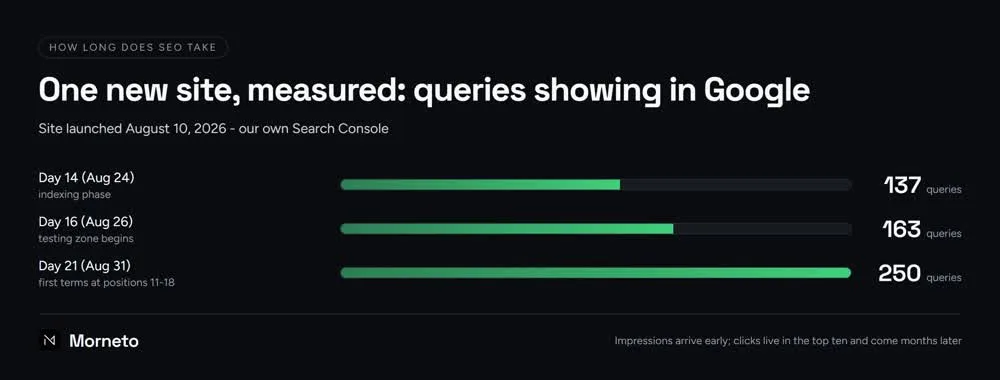
This website launched on August 10, 2026. Instead of telling you what a typical first month looks like, here is ours, from Search Console:
- Week 1–2: indexing. Pages get discovered; impressions trickle in at positions 70 to 100, which is Google filing you, not ranking you.
- Day 14 (August 24): 137 different search queries show the site somewhere in results. Clicks: effectively zero that are not us.
- Day 16 (August 26): 163 queries.
- Day 21 (August 31): 250 queries, the brand name at position 3, and the first handful of real terms at positions 11 to 18 — visible on page two, earning almost no clicks yet.
That is what on schedule looks like at three weeks: broad, shallow visibility and almost no traffic. If a provider had promised us page one by now, they would have been lying; if one had said nothing would happen for six months, that would be wrong too. Impressions arrive early. Clicks are the slow part, because clicks live in the top ten.
Month by month: what happens when
- Weeks 1–4: foundation. Technical health, indexing, page structure. Nothing visible happens and everything important does. Skipping this is why some sites are still invisible in month six.
- Months 2–3: the testing zone. Impressions grow across dozens, then hundreds of queries at positions 30 to 100. Google is auditioning your pages.
- Months 3–6: striking distance. Your best pages climb into positions 11 to 20, then break into the top ten one by one. First real clicks and first enquiries.
- Months 6–12: the compounding stretch. Money terms mature, authority accumulates, and pages start reinforcing each other. This is where the work done in month one finally pays.
- Local businesses, one addition: the map pack runs on your Google Business Profile, reviews and consistency — a parallel track that often moves faster than the blue links once the profile exists.
What decides how long SEO takes
Four things stretch or shrink every timeline. Domain age: established sites with history rank new pages in days; new domains queue for months. The same machinery runs again after a redesign that changes URLs, which is why protecting your rankings through a website redesign starts with redirects and a fresh sitemap. Competition: a niche service in one borough moves far faster than a national money term. In our own keyword research, the Bronx shows the lightest competition of the five boroughs, so west Bronx businesses become visible fastest. Cadence: a site publishing honest, useful pages weekly gives Google more to test than one updated quarterly. Authority: mentions and links decide how much benefit of the doubt you get — and shortcuts here backfire, because bought links accelerate exactly one thing: the penalty. Whether the wait is worth the money is its own question with its own math, which is why is SEO worth it in 2026 and what SEO costs exist as the other two thirds of this trilogy.
One honest rule ties it together: judge SEO at ninety days on direction, not destination. Rising impressions and improving average position mean the machine is working; flat everything means something is wrong — and finding out which is precisely what a good SEO audit tells you. If you want ours, it is free and you keep it either way.
Common questions about how long SEO takes
Can you speed SEO up?
You can stop losing time: fix technical blockers first, target low-competition terms early, and publish consistently. What you cannot do is skip Google’s testing process. Anyone selling guaranteed fast rankings is selling either brand terms you would rank for anyway, or trouble.
Why does SEO take so long?
Because rankings are earned evidence, not settings. Google has to crawl, index, test your pages against real searchers, and watch how people respond, and each cycle takes weeks. New domains also start with no history, so trust builds from zero.
How long before a brand-new website ranks?
Expect impressions within two to four weeks, page-two positions on easier terms within two to three months, and first meaningful clicks around months three to six. Our own site had 250 queries showing at day 21, with the first terms at positions 11 to 18 and almost no clicks yet.
Is SEO dead now with AI?
No, it moved. AI answers cite pages that are indexed, factual and clearly written, so the same honest work now earns visibility in two places. Sites that never did the fundamentals are the ones AI answers skip.
Is SEO still worth it in 2026?
If a customer is worth $500 or more and you can wait two quarters, usually yes. The break-even arithmetic, on a real published price, is worked out in our worth-it guide rather than asserted here.