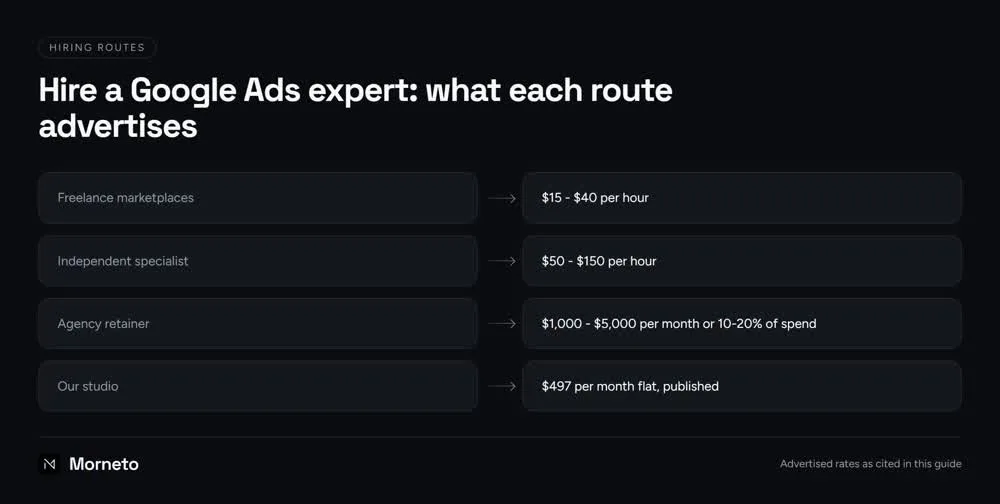
Short answer: to hire a Google Ads expert in 2026 you have four routes — marketplaces advertising $15 to $40 an hour, independent specialists at $50 to $150, agencies at $1,000 to $5,000 a month or a share of spend, and flat-fee studios like ours at $497 a month, published. The route matters less than the vetting: ask to see a search-terms cleanup, ask how a conversion is defined, and walk away from anyone who guarantees results. Nobody honest does.
Last updated August 31, 2026. Rates are either our own published prices or figures the platforms advertise openly. No invented client results.
Typing this search puts you one click away from eighty million freelancers, a thousand agencies and Google’s own phone line — all confident, none of them automatically right for a small business. This guide sorts the routes by what they really cost, gives you the five questions that expose a real expert in ten minutes, and says plainly when you should not hire anyone at all yet.
Where to hire a Google Ads expert, and what each route costs
| Route | Advertised 2026 cost | The honest description |
|---|---|---|
| Freelance marketplaces | $15–$40/hour | Upwork and Fiverr rates; quality varies wildly and vetting is entirely on you |
| Independent specialist | $50–$150/hour | Often excellent; capacity is limited and holidays are yours to cover |
| Agency | $1,000–$5,000/month or 10–20% of spend | A team and a process; ask who actually touches the account |
| Our studio | $497/month flat, published | Up to $5,000 of spend, month to month, conversion tracking first |
There is also Google’s own free expert line. Use it with open eyes: those advisers are paid to grow your spend, not your profit, and the recommendations lean accordingly. Google’s Partners directory is the more useful official resource, because it at least shows certified companies you can vet yourself.
Freelancer or agency: which Google Ads expert should you hire?
The table sorts the routes by price, and our guide to Google Ads for a small business covers the spending side, but the better filter is your own account. A freelancer or independent specialist fits one campaign, one service and a budget you want one person to watch closely. Ask who covers the account when they are on vacation, because search terms keep arriving while nobody reviews them.
An agency fits when the account spans several campaigns, locations or products, or when landing pages, tracking and reporting should come from one place. In that case, ask who does the work rather than how big the team is. A flat-fee studio sits in between: one published monthly fee that covers the work up to a set level of spend. Either way, the vetting below stays the same.
The five questions that expose a real expert
- Show me a search-terms cleanup from a real account. Anonymized is fine. The search-terms report is where wasted spend hides, and an expert who cannot talk about it fluently has never really managed an account.
- What counts as a conversion, and who defines it? The right answer names enquiries — calls over a minimum length, submitted forms — not clicks, page views or every tap on a phone number.
- Who touches my account week to week? At many agencies the expert sells and a junior delivers. You are allowed to ask for the name.
- Whose name is on the account? Yours, always, with its history and conversion data. Anyone who insists on running ads from their own account is holding your data hostage for later.
- What happens if it does not work? The honest answer involves a diagnosis and an exit, not a longer contract. Month to month with notice is a sign of confidence.
These questions work identically whether the card says expert, specialist or consultant — locally we wrote the same playbook as a guide to hiring a Google Ads consultant in NYC, and the titles turn out to matter far less than the answers.
What should a good candidate ask you first?
The interview runs both ways. A real expert asks about your business before quoting, because an account can only be as good as the facts behind it. Expect these questions:
- What is a new customer worth to you? Without that number, nobody can say what a lead may cost.
- Which services earn the best margin? Budget belongs there first, rather than spread evenly.
- Where do you actually serve? Location settings then decide who sees the ads at all.
- What counts as a lead? A call, a form or a booking becomes the conversion definition.
- How much new work can you take on each week? Buying more leads than you can serve wastes money.
A candidate who names a fee without asking any of this is therefore pricing a template, not your account. Our guide to Google Ads for plumbing shops with one to five trucks shows how these answers turn into settings for one trade.
How do you test a candidate before you sign?
Questions show how someone talks, whereas a small test shows how they work. Three checks take little time:
- Give read-only access. Google Ads lets you add a user with read-only access, so a candidate can look without changing anything. Ask what they would fix first, and why.
- Ask for a written first-month plan. It should name tracking, search terms and negative keywords before it mentions new campaigns.
- Compare two candidates on the same account. When both review the same data, the gap in what they find is easy to see.
Afterward, remove the access for anyone you do not hire.
What does it cost to hire a Google Ads expert?
Add the management fee to the ad budget, because you are paying both. Marketplaces advertise $15 to $40 an hour, specialists $50 to $150, and agencies $1,000 to $5,000 a month or a percentage of what you spend — a model that quietly rewards them for growing the budget. Our own price is $497 a month flat up to $5,000 of spend, published so you can compare it without a call. What the work itself should include each week — search-terms review, negatives, bid and budget shifts, a report counted in enquiries — is laid out in our guide to what Google Ads management in NYC includes and costs, and it is a fair checklist to hold any provider against.
One honest warning about percentage-of-spend pricing: at 15% of a $10,000 budget, your expert earns more when you spend more, whether or not the extra spend produces enquiries. It is a normal model at scale; just notice whose incentive it feeds.
Which costs sit outside the management fee?
Even with the ad budget counted, the monthly fee may not be the whole bill. Before you compare quotes, ask each candidate to put these in writing:
- Setup or onboarding. Some providers charge once to rebuild or audit the account, while others fold it into the first month.
- Tracking tools. Call tracking or form tracking can need a paid tool or a developer’s time.
- Landing pages. Changes to the page an ad sends people to can be billed as separate web work.
- Creative. Images and video for Performance Max or Display campaigns may also cost extra.
- Notice period. A long notice period is a cost too, because you keep paying after you decide to leave.
With those lines filled in, two quotes finally compare like for like. Our own flat-fee Google Ads service publishes its price and terms, so you can run the same check on us before any call.
Red flags that cost you months
- Guaranteed results. The auction changes daily and nobody controls it. Every experienced advertiser community repeats the same rule: promises of guaranteed performance are the surest mark of an amateur or worse.
- No conversion tracking in the proposal. Without it the account cannot learn and neither can you — the pattern behind most of the wasted accounts we audit, and the theme of our guide to clicks without calls.
- The account lives in their login. When you leave, the history leaves with them and you start from zero.
- Reports full of impressions and clicks, silent on enquiries and cost per enquiry.
- Instant Performance Max for a tiny account. Automation needs data to learn from; our plain-English Performance Max guide explains why a Search campaign usually comes first.
When you should not hire anyone yet
If your budget is under roughly $500 a month, you sell one service in one area, and you can give the account two hours a week, run it yourself first. A small Search campaign with honest conversion tracking will teach you the words customers use, and the management fee would eat too large a share of a small budget. Our guide to a realistic Google Ads budget for a small business shows the arithmetic. Hiring starts to pay when the budget clears $1,000 a month or the account outgrows one campaign — and if you want a second opinion before deciding either way, we audit accounts for wasted spend free of charge and you keep the audit whether or not you hire us.
Ask any candidate how they would handle geography before you sign, because a New York account that targets the whole city equally is usually leaving money on the table. Our own borough work splits out Brooklyn campaigns from Manhattan campaigns for exactly that reason.
When is the right time to hire a Google Ads expert?
Ideally a season before your busy period, not in the middle of it. After all, a new expert needs time to set up tracking, clean up the search terms and let the account learn. Even then, a fair verdict takes about ninety days of clean conversion data. So if spring or the holidays bring most of your revenue, hire a Google Ads expert well ahead of them.
Other good moments are easier to spot. For example, the budget has cleared the level where a fee makes sense. You may also be launching a new service or location, or your own hours in the account now cost more than the fee would. The worst moment is the week after a bad month, when the pressure is to change everything at once.
Common questions about hiring a Google Ads expert
How much does it cost to hire a Google Ads expert?
Marketplaces advertise $15 to $40 an hour, independent specialists $50 to $150, and agencies $1,000 to $5,000 a month or 10 to 20 percent of spend. Our studio charges a flat $497 a month up to $5,000 of spend, published openly.
How much does it cost to have someone manage your Google Ads?
Plan for two costs: the management fee and the ad budget, which goes to Google. With our flat $497 fee and a $1,500 monthly budget, for example, the total is $1,997 a month.
Is $10 or $20 a day enough for Google Ads?
Rarely in a competitive market. $10 a day buys a handful of clicks and too little data for the account to learn from. Most small accounts start working between $1,000 and $3,000 a month; below roughly $500 it is hard to learn anything.
What is the difference between a Google Ads expert, specialist and manager?
Mostly the business card. All three should do the same weekly work: search-terms review, negative keywords, bid and budget management, and reporting counted in enquiries. Judge the named deliverables, not the title.
Are Google’s own free Ads experts worth using?
They are real Google employees, and their advice reliably leans toward spending more. Use them to learn the interface, not to set strategy, and treat every recommendation that raises the budget with healthy suspicion.
How fast should results show after hiring?
First enquiries usually arrive within days on Search campaigns, and a fair verdict takes about ninety days of clean conversion data. Anyone promising a specific position or result on a schedule is guessing at best.