Short answer: an SEO strategist plans the search work — which pages get built, which searches they target, in what order, and how success is measured. Execution is often not included, and that split is what decides the price. Freelance strategists bill $75 to $200 an hour, in-house roles list around $65,000 to $80,000 a year, and most small businesses need the plan and the hands in one place rather than a strategy document and a second invoice.
Last updated August 30, 2026. Rates below are our own published prices or openly advertised ranges, linked to their sources. No invented case studies.
The job title turns up in two very different searches: businesses wondering whether they should hire one, and people wondering whether they should become one. This guide is written for the first group, though the second will learn what the work actually is. Because the title is unregulated — anyone can print it on a proposal — the useful skill is not finding an SEO strategist but judging one, and that is where this guide ends.
What is an SEO strategist?
An SEO strategist is the person who decides what search work happens, in what order, and how success gets measured — before anyone writes a page or builds a link. The title describes a role, not a credential: nobody licenses it, which is why the same two words can mean a senior specialist or a junior with a new business card.
The meaning becomes concrete in the deliverables. A real strategist hands you three things: a diagnosis of why the site earns what it earns today, a sequenced roadmap of what to change, and a measurement plan that says out loud what working will look like. If a proposal contains none of those, the strategy is the invoice.
What does an SEO strategist actually do?
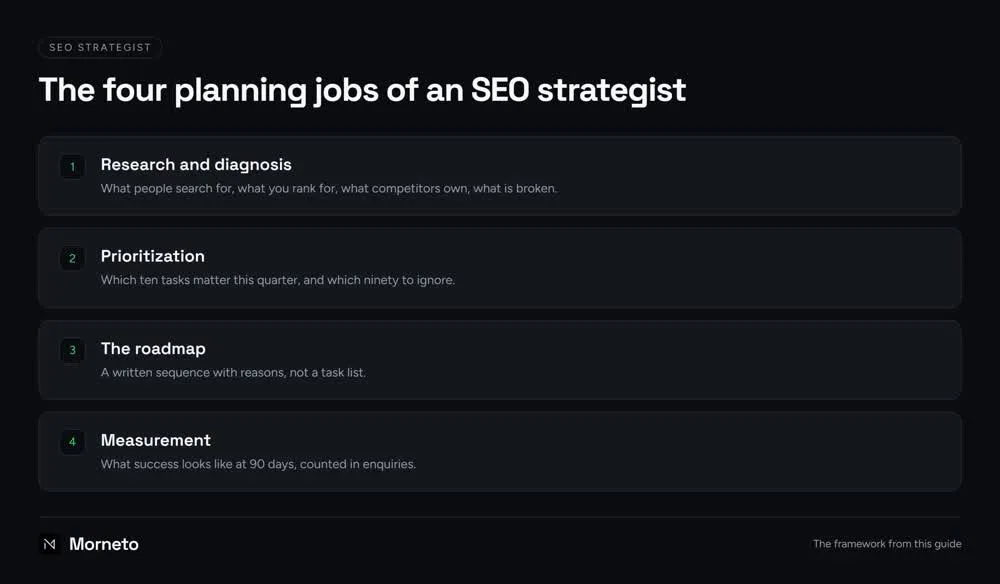
Strip the title down and the work is four planning jobs:
- Research and diagnosis. What people actually search for, what the site currently ranks for, what competitors own, and what is technically broken. This is data work, not intuition.
- Prioritization. The defining skill. Every site has a hundred possible tasks; a strategist decides which ten matter and — harder — which ninety to ignore this quarter. Bad SEO is rarely wrong work; it is usually right work in the wrong order.
- The roadmap. A written sequence: fix these blockers, build these pages, earn these links, in this order, for these reasons. If the reasons are missing, it is a task list, not a strategy.
- Measurement. Deciding in advance what success looks like — enquiries, not just rankings — and how the work will be judged at 90 days. In 2026, good strategists also plan for citations in AI answers, since Bing now reports them. Google Search Console now reports link impressions in AI Overviews and AI Mode too.
Notice what is not on the list: writing the pages, fixing the code, earning the links. A strategist plans; whether they also execute varies by arrangement, and assuming the plan includes the hands is the most common way this hire disappoints.
What does an SEO strategist do every month?
The monthly rhythm is less glamorous than the title suggests, and that is a good sign. A typical month splits into reading the data (what moved, what stalled, which pages earned impressions without clicks), adjusting the roadmap (one or two priorities promoted or demoted, with reasons), and directing the work the plan calls for next — the pages, the internal links, the technical fixes.
What should worry you is a monthly report that lists activity instead of decisions. Ten blog posts is activity. Moving a page from position 70 to 40 and saying what changes next is a decision trail. This is also why we sell strategy and execution together as one fixed-price monthly SEO plan instead of a separate strategy document: on a small site, the thinking and the doing belong to the same person.
What is an SEO content strategist?
An SEO content strategist narrows the same role to one channel: what gets written, for which searches, and how each piece supports the pages that earn money. On large sites this is a full-time job, because someone has to decide which of five hundred article ideas deserve to exist. E-commerce teams often add an ecommerce SEO strategist for the same reason — category and product pages compete on different rules than articles do.
A small business rarely needs the specialized title. What it needs is the discipline the title stands for: every page gets one clear search intent, no two pages chase the same one, and the writing is planned against data instead of inspiration. Whether that discipline lives with a hire or with a studio is the same trade-off covered in freelancer, agency or in-house.
SEO strategist, consultant or agency: which do you need?
The three titles overlap far more than the proposals admit, but the emphasis differs:
| Title | What you are buying | What is usually not included |
|---|---|---|
| SEO strategist | The plan: research, priorities, roadmap, measurement | The execution — someone still has to do the work |
| SEO consultant | Diagnosis and advice, often one person, often hourly | Implementation, billed separately if at all |
| SEO agency | Plan plus execution under one retainer | Certainty about who actually touches your account |
In practice the deliverables matter and the title does not. A good consultant does strategist work; a good agency employs strategists; a bad version of any of the three sells the same rankings PDF. We keep the comparison honest in our guide to hiring an SEO consultant in NYC, and the same tests apply whichever word is on the business card.
What does it cost to hire one?
Three routes, three price shapes. Freelance strategists bill in the same band as consultants: $75 to $200 an hour, with a strategy engagement typically landing between $1,000 and $5,000 as a project. Hiring in-house is a salary: at the time of writing, job boards list hundreds of full-time SEO strategist roles at roughly $65,000 to $80,000 a year, which only makes sense when there is a team for that person to direct. The third route is a studio or agency where strategy and execution share one price — ours is $799 a month, published, with the plan and the hands included. Where each number sits in the wider market is mapped in our guide to what SEO costs in 2026.
The trap is paying for strategy twice: once as a document, then again when whoever executes it insists on re-auditing everything. If you buy a standalone strategy, agree up front who will implement it and that they will accept it.
When do you actually need one?
You genuinely need dedicated strategy when there is complexity to sequence: several sites or markets, an in-house writer or developer who needs direction, or a history of retainers that produced activity but no enquiries. In those cases the plan is the missing piece, and paying for it separately is rational.
Most small businesses are not in that situation. One site, one market, obvious priorities — what they need is the standard playbook executed honestly: fix the foundation, build the pages, maintain the profile. There, a standalone strategy document is where money goes to die, because the thinking was never the bottleneck; the doing was. Start instead with a real audit — what a good SEO audit tells you shows what one should contain — and buy strategy and execution together, the way our SEO service packages them.
How to judge a strategist before you pay
- Check their own site first. Someone selling search strategy should be findable, fast and honest on their own domain. It is the one client they control completely.
- Ask what they would not do. Prioritization is the job. A candidate who answers “everything matters” has failed the interview.
- Demand reasons on the roadmap. Every item should say why it is there and why now. Sequenced reasons are the difference between strategy and a template.
- Ask for the measurement plan before the work. What number moves, by when, and what happens if it does not.
- Walk away from guarantees. Google’s own guidance on whether you need an SEO warns about exactly this, and its starter guide is the baseline any honest strategist builds on.
If you want the short version of all five: ask one candidate what they would do in month one and why. The answer either names your pages and your searches, or it could have been sent to anyone. Send us your site and we will show you the difference — the audit is free and you keep it either way.
Common questions about hiring an SEO strategist
What is an SEO strategist?
Someone who plans search work: researching what people search for, prioritizing what to build first, writing the roadmap, and defining how success is measured. Execution — the writing, fixing and link work — may or may not be included, so always ask.
What is the difference between an SEO strategist and an SEO consultant?
Mostly emphasis. A strategist leans toward the plan, a consultant toward diagnosis and advice, and both titles are unregulated. Judge the named deliverables and the reasons on the roadmap, not the word on the proposal.
How much does an SEO strategist cost?
Freelance, $75 to $200 an hour or $1,000 to $5,000 per strategy project. In-house, listings run roughly $65,000 to $80,000 a year. Small businesses usually do better buying strategy and execution together in one monthly price.
Can AI replace an SEO strategist?
AI speeds up the research and the drafts. The judgment calls — what to ignore, what order, what an honest measurement looks like — still need someone accountable. Treat an agency saying AI does our strategy as a red flag, not a feature.
Does a small business need an SEO strategist?
Usually not as a separate hire. One site with one market needs the standard work done honestly, with strategy included rather than sold as a document. Dedicated strategy pays off when there is real complexity to sequence or a team to direct.