Short answer: creative web design means the layout, imagery, typography and motion are made for your business instead of picked from a template. For a small business it earns its price when it makes the site clearer, faster and easier to act on. On our pricing page, custom builds of 5 to 15 pages start from $997 one-time, and typical New York brochure sites of 5 to 10 pages run roughly $1,000 to $3,000.
The word creative does a lot of work in agency marketing, and it rarely comes with a definition. When we looked at the People Also Ask box for this search in September 2026, most questions came from people learning the craft or weighing it as a career. This guide answers the buyer’s set instead. Prices are therefore checked against our pricing page on September 20, 2026.
What are you actually paying for in creative web design?
Strip away the language and a creative website design project buys a handful of concrete things, each of them done by hand for your business.
- An original layout. Someone decides the order of the page and what sits on the first screen, based on your customers rather than a demo site.
- Visual identity applied consistently. Color, type and spacing carry across every page, which is why our brand and creative work usually runs before or alongside the build.
- Imagery that belongs to you. Photographs of your team, your premises or your finished work, rather than the stock photography that makes one site look like the next.
- Copy shaped to the page. Headlines, captions and button text written for the layout, not poured into it afterward.
- Motion used sparingly. A hover state, a considered transition, a small animation where it explains something.
- A build that holds up. The design still has to survive a phone, a slow connection and a screen reader, which is where our web design and build work spends most of the hours.
What it is not is a purchased theme with your logo dropped into the header. That route is legitimate, and in fact plenty of businesses should take it. It is simply a different product at a different price.
Where does creativity earn money on a small business site?
In practice, creative web design pays for itself in a small number of places. In our experience these four do most of the work.
- The first screen. A stranger should learn what you do, who you do it for and where you do it without scrolling. Originality helps here only if it makes that sentence land faster.
- Proof. Photos of real work usually do more than an illustration style. In fact, a gallery of your own jobs is often the strongest proof a service business has.
- One obvious next step. Call, book, or request a quote. Three equally weighted options make the visitor choose before acting, and that is one decision too many.
- Being remembered. Distinctive color and type earn their keep when somebody compares three quotes a week later, which is also why the different types of logos suit different businesses.
Notice what is missing: novelty for its own sake. A layout nobody has seen before helps only if the visitor still knows where to click. Our guide to what a small business site in New York needs covers the practical version.
Which creative web design ideas quietly cost you customers?
Some creative web design ideas look excellent in a case study and lose inquiries in production. However, these are the ones we are asked to undo most often.
- Invented navigation. A hidden desktop menu, or labels like Explore and Journey instead of Services and Pricing. As a result, the visitor has to learn your vocabulary first.
- An autoplaying hero video. It is usually the heaviest thing on the page, so it delays the moment the main content appears. Google’s own developer site puts a good Largest Contentful Paint at 2.5 seconds or less, measured at the 75th percentile of page loads. A full-width autoplaying video competes directly for that budget.
- Text laid over photography. It reads beautifully on the designer’s monitor and turns to mush on a phone in daylight.
- Scroll effects. Sections that take over the scroll, elements that fly in late and parallax that stutters frequently break on a mid-range Android phone.
- Styling that fights the form. Custom cursors, ultra-thin type and labels that vanish once you start typing all raise the cost of contacting you.
None of this argues for a plain site. Instead, it argues for testing the work on the devices your customers hold, which is where our approach to fast web design in New York starts. Similarly, our piece on how a slow site costs you customers covers the money side of the same problem.
How do you judge a creative web design agency portfolio?
A portfolio is a sales document. Every creative web design agency shows the work it is proudest of, and screenshots hide the rest. Still, six questions get past the presentation.
- Which parts did you make? Ask whether the agency did the design, the build, the copy and the photography, or inherited some of it.
- Is it still live? Open the sites, because a portfolio full of projects that no longer exist tells you how those relationships ended.
- How does it behave on my phone? Open three on your own device, on mobile data rather than office Wi-Fi, and try to find the contact details.
- Is there a business like mine? Award-winning work for a fashion label says little about a plumbing company that needs the phone to ring.
- What changed afterward? Ask what the client saw after launch. However, any agency promising a specific ranking is guessing.
- Who owns the files? Our pricing page puts the site, the code and the design files in your name, and any quote you compare should say the same.
Meanwhile, our guide on how to choose a web design agency covers the contract and the process around that decision.
What does creative web design cost?
In short, creative web design costs roughly what any custom build of the same size costs, because the design hours sit inside the build rather than on an extra line. These are the typical New York ranges we publish, and where we sit in them:
- Brochure site, 5 to 10 pages: roughly $1,000 to $3,000. Home page, service pages, about and contact, designed rather than templated.
- CMS site, 10 to 20 pages: roughly $3,000 to $8,000. Most businesses land here once a blog, case studies or a longer service list are involved.
- Bookings, payments or an integration: $8,000 and up. Here the connected system drives the price, not the design.
- A Morneto build, 5 to 15 pages: from $997 one-time. One fixed price and one launch date, agreed in writing before work starts.
- Identity work by itself. Logo design starts from $250 when you need the visual side priced on its own, without a new site.
Some costs sit outside every quote: hosting, domain registration, paid stock photography and premium plugin licenses are not included in any of our prices. Meanwhile, our ongoing SEO and marketing work in New York is priced separately, from $799 per month. Our page of fixed-price website builds from $997 carries the full breakdown.
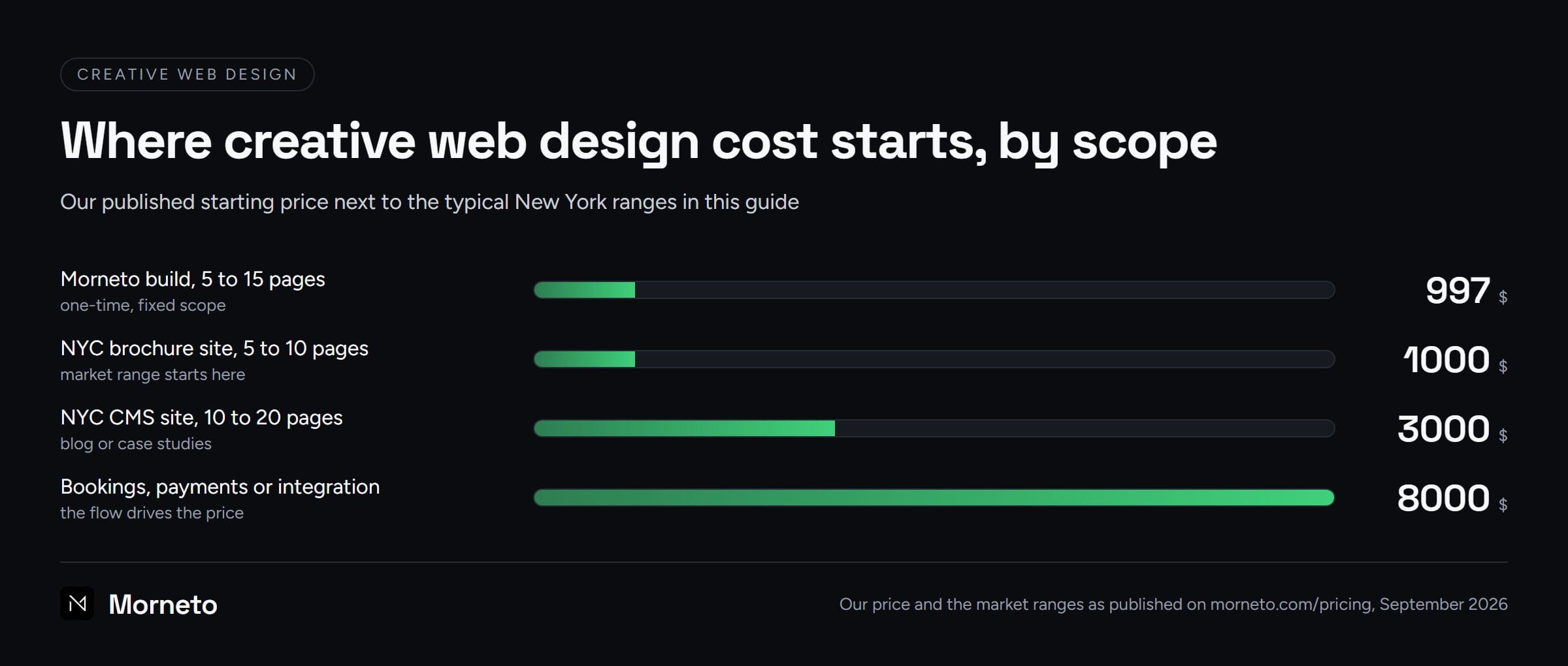
Compare scopes rather than totals. Our guide to what a fair price for a website in New York looks like lists the checks that tell you whether a number holds up.
What belongs in a creative brief for web design?
A creative brief keeps a project from drifting. In practice one or two pages is enough, and writing it yourself is the cheapest way to control the outcome.
- The commercial goal. More calls, more quote requests, fewer time-wasting inquiries. One primary goal, not five.
- Who the site is for. The customer you want more of, and the decision they are making when they arrive.
- What you sell, and the proof. Services, service area, prices if you publish them, and the photos or reviews that back the claims.
- Sites you like and sites you do not. Three of each, with a sentence on why. Above all, this is worth more than any adjective.
- What cannot change. An existing logo, colors, a name, or a booking system you already pay for.
- Scope. A page list, even a rough one. Page count is one of the clearest things that moves a quote.
- Constraints. Your deadline, who writes the copy, who supplies photography, and a budget range. In fact, naming the range saves two rounds of proposals.
A good agency will interrogate that brief rather than accept it. Meanwhile, a proposal that reflects none of it back at you tells you something too.
Is custom web design worth it for a small business?
Not always, and it is worth saying when it is not. A template is usually the right call when you need to be online this month, when the site is a business card rather than a sales channel, or when you have no photography. However, custom web design starts to pay when you compete on something other than price, when the site is the main way people judge you, or when the template does not fit how you sell. For the galleries and labels of SoHo and Chelsea, the site is the brand, so it has to look right and still load fast.
Many clients start with the build and add marketing once the first package is paying for itself, because a site nobody finds is a slow purchase whatever it looks like. Our page on keeping web design, SEO and ads under one roof sets out how those pieces fit together. For a straight answer, send us the site you have now and we will say whether a redesign or a repair is the better use of the money. That audit is free. Ultimately, creative web design earns its price when the site has real work to do, and not before.
Common questions about creative web design
How much should I pay a website designer?
Judge the scope rather than the hourly rate. Typical New York ranges on our pricing page run roughly $1,000 to $3,000 for a 5 to 10 page brochure site and $3,000 to $8,000 for a CMS site of 10 to 20 pages. Our builds of 5 to 15 pages start from $997 one-time.
What are common website design mistakes?
The expensive ones are usually navigation the visitor has to decode, a heavy hero video that delays the main content, text laid over busy photography, and scroll effects that stutter on a mid-range phone. In each case it looks fine in a design review and costs inquiries in production.
What is the first thing to consider when designing a website?
What you want a visitor to do, and what they need to believe before they will do it. Decide that first and the layout, the photography and the wording all have something to answer to. Otherwise the site becomes a matter of taste.
What is a creative brief for web design?
A short document, usually one or two pages. It states the commercial goal, the customer, what you sell, the proof you can supply, examples you like and dislike, a rough page list and your budget range. In short, writing it yourself keeps a project on course.
What are the top website design trends for 2026?
Trends are a weak basis for a business decision, because a site built to look current in 2026 looks dated in 2028. However, speed, clarity on a phone, real photography and legible contrast hold their value. If you follow a trend, follow one that survives a slow connection.