Short answer: freelancer or agency? For most small businesses the answer is neither extreme: a small senior studio is the sweet spot for building a website. A freelancer can be brilliant but is a single point of failure. A large agency carries overhead you end up paying for. In-house only pays off once you have enough steady work to keep someone busy. What matters more than the label is who actually does the work and whether they will still be reachable after launch.
What is the real choice behind "who should build my small business website"?
When a small business decides to build or rebuild its website, people usually frame the question as “how much will it cost?” The more useful question is “who will actually do the work, and what happens after it goes live?” Price follows from that answer. There are four realistic options: a freelancer, a large agency, an in-house hire, or a small senior studio. Each suits a different kind of business. Choosing well is mostly about being honest with yourself — and once you know which route fits, how to hire a web designer in New York walks through the next step. How much work do you actually have, and how much attention do you need?
Freelancer or agency: should a freelancer build your website?
A good freelancer can be excellent value and genuinely personal to work with. The catch is capacity and breadth. One person rarely covers design, development, SEO and paid advertising to the same depth. And when they take a holiday, fall ill, or land a bigger client, your project waits. For a simple brochure site this risk is small. For anything you depend on for enquiries, the single-point-of-failure problem is real — and it tends to show up at the worst possible moment.
Freelancer or agency: is a large agency worth the premium?
Big agencies have deep benches and polished processes, but that machinery is expensive, and someone has to fund it. As a small client, your fee is a rounding error. That is exactly why your project drifts to the bottom of the queue. You end up talking to an account manager rather than the person doing the work. Nobody is cheating you; you are simply the wrong size for the model. Want a sense of what fair numbers look like before you talk to anyone? Our breakdown of what a website should cost a small business is a good reality check.
When is hiring in-house worth it?
Hiring someone in-house gives you control and availability, but a website is not a full-time job once it’s live. Unless you have a steady stream of digital work — ongoing content, campaigns, product changes — an in-house hire spends much of their time underused. And a single person still cannot be expert at design, development and marketing all at once, which is why even an in-house SEO strategist usually makes sense later than owners expect. For most small businesses, in-house makes sense only after they have outgrown every other option.
Why is a small senior studio the middle path?
Between the lone freelancer and the sprawling agency sits the option most small businesses are actually looking for: a small, senior team that treats a modest budget with real seriousness. It covers web design, SEO and marketing under one roof. You get the attention of a freelancer with the breadth and resilience of an agency, without the overhead of either. The trade-off is that you have to choose the right one — which is a skill in itself.
Freelancer or agency: how do you decide, in practice?
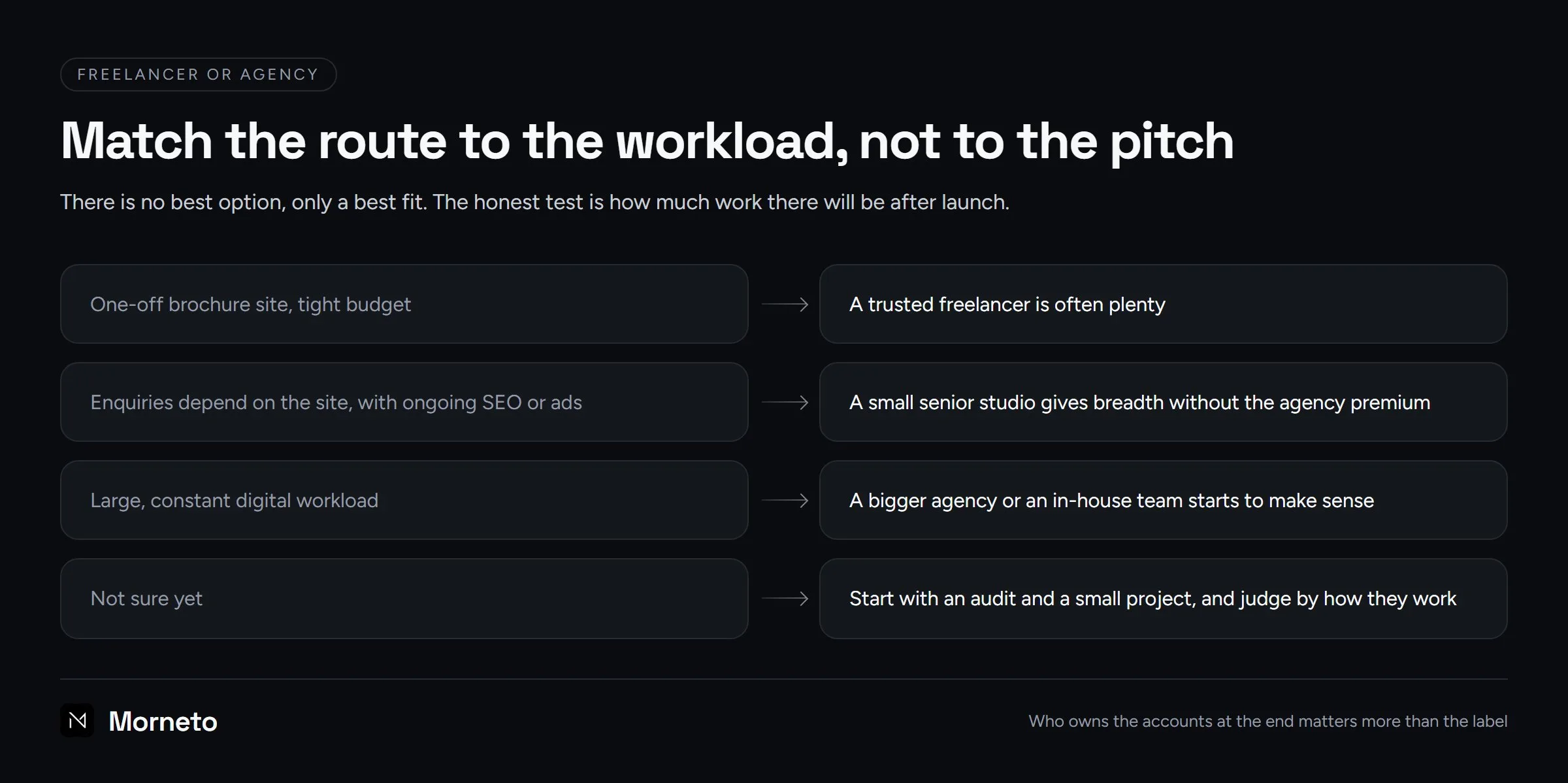
Match the option to your reality, not to what sounds impressive:
- One-off brochure site, tight budget: a trusted freelancer is often plenty.
- Enquiries depend on the site, ongoing SEO or ads needed: a small senior studio gives you breadth without the agency premium.
- Large, constant digital workload: a bigger agency or an in-house team starts to make sense.
- Not sure yet: start with an audit and a small project, and judge by how they work before committing to more.
Which question matters more than the label?
Whichever route you pick, freelancer or agency, the deciding factor is not the category but the relationship. Google’s guidance on hiring an SEO makes the same point: judge the people and the process, not the label. Will the person doing the work talk to you directly? Is the price fixed against a written scope? Will they still answer the phone in week six? Those questions cut across freelancer, agency and studio alike. That is why it is worth reading how to choose a web design agency that actually works with you before you sign anything. If you are not sure your current site is even the problem, it may be worth checking why good small businesses stay invisible online first.
Freelancer or agency: what hidden costs does each option carry?
Every option has a sticker price and a hidden one. The hidden cost is usually what catches small businesses out. With a freelancer the hidden cost is availability: the day you urgently need a change and they are unreachable. A large agency’s hidden cost is attention and slow turnaround — you pay premium rates to wait in a queue. An in-house hire’s hidden cost is idle time and the ceiling of a single skill set. Even the small studio has one: you have to choose the right team, because a bad small studio is just an expensive freelancer with a nicer website. The honest way to compare options is to add the hidden cost to the sticker price. Then ask which total you can actually live with over a year, not just at launch.
What is the reality check before you choose?
Answer three questions honestly and the right option usually reveals itself. First, how much does your business depend on this website for new enquiries? Is it a digital shopfront or a digital business card? Second, how much ongoing work will there be after launch — a one-off build, or continuous content, SEO and campaigns? Third, how much of this do you want to manage yourself versus hand over entirely? A business card site with little follow-up work points to a freelancer. A shopfront that needs ongoing visibility, and that you want to hand to someone else, points squarely at a small senior studio. Constant, large-scale work points to an agency or in-house team. There is no universally correct answer — only the one that fits how you actually run.
Whichever you choose, there is a strong case for keeping web, SEO and ads under one roof.
Cost depends on the model as much as the provider — see how agency pricing works.
For a borough-specific version of this decision, see what Queens businesses should look for in a web designer.
If you are choosing in Brooklyn specifically, our checklist for comparing Brooklyn web design companies puts these trade-offs side by side.
If the labels themselves confuse you, web development company or web design agency: who does a NYC business need sorts out which one your project calls for.
There is a fourth option, doing it yourself on a builder; see the best website builders for entrepreneurs for when that is enough.
Common questions
Is a freelancer cheaper than an agency?
Often yes, up front. But factor in the risk of delays, the narrower skill set, and what happens if they become unavailable. A small studio can land close to freelancer pricing while removing those risks.
Do I need an agency for SEO as well as the website?
You need whoever builds the site to understand SEO, because the two are inseparable. A team that handles both builds the site to be found from day one, instead of fixing it afterwards.
Should a very small business hire in-house?
Rarely. Unless you have enough ongoing digital work to keep someone busy, an in-house hire is underused and cannot cover every skill. Most small businesses do better with an external team until they scale.
How do I test a builder before committing?
Start with an audit or a small, well-defined project. How they communicate, quote and deliver on something small tells you almost everything about how they will handle something big.
Not sure which fits you?
Tell us what you are building and how much ongoing work you expect, and we will give you an honest answer — even when that answer is “a freelancer is all you need.” Get in touch and we will point you the right way, and you can see our own fixed pricing up front.