Short answer: law firm web design is a business problem before it is a styling problem. A small or solo firm’s site has to make the practice area obvious, make contacting the firm effortless, carry whatever disclosures your state’s advertising rules require, and load fast on a phone. On our pricing page, custom builds of 5 to 15 pages start from $997 one-time, and typical New York brochure sites of 5 to 10 pages run roughly $1,000 to $3,000.
Last updated September 20, 2026. We build websites and do not practice law, so nothing here is legal advice. The rules below are New York’s, they changed in 2026, and your own bar is the authority on yours.
Most law firm web design pitches open with the homepage. However, the partner paying has a narrower question: will this site turn a worried stranger into a signed matter, and keep the firm out of trouble?
What does a law firm website actually have to do?
In short, strip away the portfolio language and a small firm site has about five jobs.
- Be found for the matter, not the firm name. Nobody searches for a firm they have not heard of. Instead, they search for the problem, in their own words.
- Answer the question the visitor arrived with. What happens next, how long it takes, what it costs, and whether you handle that matter.
- Make one next step obvious. Otherwise three equal options make a distressed visitor choose before acting.
- Show who the lawyers are. A named attorney with a photograph and bar admissions beats any stock image of a gavel.
- Stay inside the advertising rules. Whatever your state currently asks of the pages, the footer and any claim about results.
Little of that is about taste. As a result, the hours in our web design and build work go into structure, speed and the contact path, where a legal site is won or lost.
Why does the intake path matter more than the styling?
A person with a legal problem rarely picks one firm. Instead, they open four tabs and hire whoever answers first. In practice, design decides whether they can reach you, and the firm decides whether they hear back.
- A phone number that dials. Real text in the header, tappable, visible without scrolling.
- One short form. Name, a way to reach them, matter type and a free text box. After all, every extra field is another reason to close the tab.
- A named destination for that form. Decide who watches the inbox on a Saturday, because a form nobody reads is worse than no form.
- Chat only if it is staffed. Otherwise the bubble reads as an empty reception desk.
- A short note beside the form. Many firms explain that a message does not by itself create a relationship. Still, the wording is a question for your own counsel.
Speed is the other half. A site that is slow to paint on a phone loses people before the form appears, which is why our approach to performance-first web design in New York treats load time as a scoping decision. Meanwhile, our piece on how a slow site quietly costs you customers covers the money side.
Why do practice area pages rank in law firm web design?
Search engines rank pages, not firms. Therefore, in law firm web design the page that ranks is almost always the practice area page, and a single list headed Practice Areas is not one.
- One page per matter type, named in plain language. Uncontested divorce, commercial lease disputes, green card renewals. Write around the phrase a non-lawyer types. In crowded Midtown Manhattan searches, a matter plus a landmark, like trademark attorney near Bryant Park, beats a broad term.
- Long enough to be useful. The process, what the firm does at each stage, what the client supplies, and what usually causes delay.
- Location handled once. One honest page about where you practice beats a folder of near-identical neighborhood pages, which Google’s spam policies treat as doorway abuse when they are substantially similar and funnel visitors to one page.
Similarly, those pages are what an AI assistant works from when it answers a question about that kind of matter. Our guide on what a small business website in New York needs covers the same structure outside law. If you are weighing the spend, meanwhile, whether SEO is still worth paying for is the honest first question. Work of that kind sits in our SEO and marketing service rather than in the build.
How do attorney advertising rules shape a law firm website?
States regulate how lawyers advertise, and a website counts as advertising in most of them. Accordingly, treat what follows as an illustration of what to check rather than a rule you can apply anywhere.
New York is a useful example, because it rewrote these rules this year. As the state bar association reports in its note on the amendments adopted to the advertising rules, the Appellate Division’s Presiding Justices adopted amendments effective June 1, 2026 that, in its words, “adopt the advertising rules and comments promulgated in 2018 by the American Bar Association”.
The ABA model those amendments follow replaces a long list of prescriptive requirements with one principle: a communication about a lawyer’s services may not be false or misleading. What that means for your own footer, your disclaimers and any results you publish is a question for your ethics counsel rather than for us, because the text that binds you is the rule as adopted in your state. For the partner commissioning a site, the useful response is to build for whatever the answer turns out to be.
- A disclosure area the firm can edit. Wherever your state wants a label or qualifying wording, the firm changes it without a developer.
- A results section that can carry a disclaimer. If qualifying wording cannot sit next to the claim, the layout is wrong.
- Written permission for testimonials. Ask for consent in writing for the person’s name and image before a testimonial goes on the page.
- A review step before launch. Name who reads every page against your state’s rules, since record keeping stays with the firm.
Retrofit disclosures into a finished design and the project loses weeks, so have that conversation early with your own bar. We apply the same rule for regulated firms in the Financial District, writing to the constraints from the first draft.
Which trust signals can a small firm actually use?
Legal buyers are nervous buyers. Generally, the signals that work are the plain ones a firm can prove.
- Real photographs. The attorneys, the office, the street outside it. By contrast, stock columns and gavels signal a budget spent elsewhere.
- Bar admissions and dates. Which courts, which states, since when.
- Case results only where your rules allow them. Substantiable on the day you publish, with whatever qualifying wording your counsel wants.
- A consistent name, address and phone. The same details on the site, the Google profile and every directory.
- Nothing invented. No made-up badges, no counters of cases won, no awards nobody granted.
Visual identity matters less than partners expect: it has to look current, legible and consistent. Still, if the firm is rebranding, our explainer on the different types of logos and what they suit is a reasonable place to start.
What does law firm web design cost?
Legal is a high-value market and some agencies price accordingly. In reality, a small firm website is not technically different from any other small business site of the same size, so these are the New York ranges we publish.
- Brochure site, 5 to 10 pages: roughly $1,000 to $3,000. Home, a few practice areas, bios and contact.
- CMS site, 10 to 20 pages: roughly $3,000 to $8,000. Where most firms land once several areas and a blog are involved.
- Bookings, payments or an integration: $8,000 and up. The connected system drives that number, not the design.
- A Morneto build, 5 to 15 pages: from $997 one-time. One fixed price and one launch date, agreed in writing before work starts.
- Identity work on its own: logo design from $250. Useful when the firm needs a mark rather than a new site.
Ongoing work is priced separately: SEO and marketing from $799 per month, month to month, and Google Ads management at $497 per month up to $5,000 of spend, then 12 percent above that. Clicks in legal categories tend to be expensive, so the budget deserves more planning than the management fee. Likewise, your Google Ads budget, hosting, domain registration, paid stock photography and premium plugin licenses sit outside every price we quote.
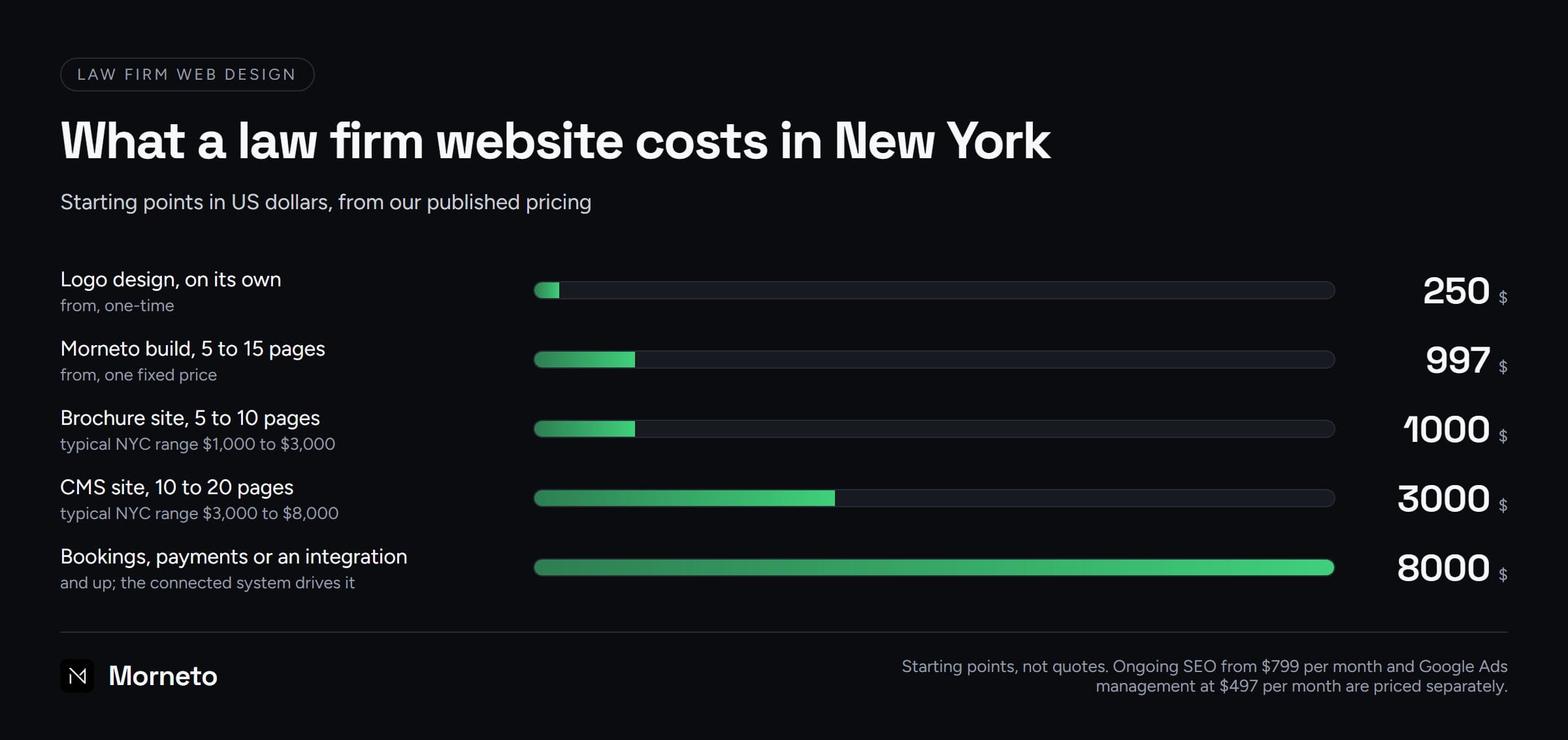
Compare scopes, not totals. Our guide to what a fair price for a website in New York looks like lists the checks that show whether a quote holds up. Meanwhile, our fixed-price builds from $997 are published in full.
How should a small firm brief a law firm web design agency?
Small law firm web design goes wrong in the brief more often than in the build. One page written by the firm is enough, and writing it yourself is the cheapest control you have.
- The matters you want more of. Not everything you are admitted to handle: rather, the two or three that pay.
- Who writes the pages. An attorney who drafts the practice area pages beats agency copy, although it will still need editing.
- Examples you like and dislike. Three of each, with a sentence on why. Studying the best law firm web design you can find helps only if you can say what you are reacting to.
- Ownership. The site, the code, the design files and the domain in the firm’s name, and similarly in any quote you compare.
Finally, ask who does the work. We run the relationship, the strategy and the account, and bring in the specialists a project needs. Our guide on how to choose a web design agency covers the contract and the process, and the search side for firms sits with our SEO for lawyers work rather than here.
If the firm already has a site, the first question is whether to repair or replace it. Send us what you have and we will tell you which we would do, at no cost. In the end, law firm web design earns its price when a person in trouble finds the right page and reaches a human.
Common questions about law firm web design
How much does a law firm website cost?
Judge it by scope rather than by industry. The New York ranges we publish run roughly $1,000 to $3,000 for a brochure site of 5 to 10 pages and $3,000 to $8,000 for a CMS site of 10 to 20 pages. Our own builds start from $997 one-time.
Do lawyers need a website?
For most firms, yes, because people check you online before calling, and a profile on someone else’s directory is a page you do not control. A referral-only practice may need much less.
What pages does a law firm website need?
Generally: a home page, one page per practice area you want matters in, a bio page for each attorney, a contact page with the firm name, address and phone, and any disclosure pages your state requires.
Does a law firm website have to say Attorney Advertising?
It depends on the state, and it can change. New York’s Appellate Division amended its advertising rules effective June 1, 2026 to follow the American Bar Association’s 2018 model, so a footer that was drafted under the older New York rules may no longer say the right thing. Ask your own bar or your ethics counsel before you add or remove a label, rather than copying another firm’s footer.
Can a law firm put case results on its website?
In many places yes, under conditions, and the common thread is that the claim must not be false or misleading and has to be substantiable on the day you publish it. The conditions differ by state and they change, so put the question to your ethics counsel and build the page so qualifying wording can sit next to the claim.