Short answer: GEO vs SEO is not a choice between two jobs. SEO earns your page a place in the search results. In contrast, GEO (generative engine optimization) earns your business a citation in an AI-written answer, such as one from Microsoft Copilot or ChatGPT. GEO builds on SEO, because AI engines can only cite pages they can find and read.
Last updated September 19, 2026. Our own numbers carry the date we measured them.
Most GEO vs SEO questions hide a simpler one: will a machine name your business when someone asks?
GEO vs SEO: what is the actual difference?
SEO aims for a ranked link that a person clicks. GEO, in contrast, aims for a citation inside an answer that an AI engine writes. So SEO wins a spot on the page, while GEO wins a place in the sentence.
However, GEO does not replace SEO. That is because AI engines that search the web can only cite pages they can find and read. Google’s documentation on AI features also agrees: AI Overviews and AI Mode add no extra requirements. The page just has to sit in Google’s index and qualify for a snippet. In other words, GEO is a layer on top of SEO.
What do GEO, AEO and AIO mean, and are they the same thing?
They overlap, but each name points at a different output:
- SEO (search engine optimization). Earning a ranked place for your pages in Google and Bing.
- AEO (answer engine optimization). Being the one direct answer, such as a featured snippet or a voice reply.
- GEO (generative engine optimization). Earning citations in answers that AI engines write, such as Copilot, ChatGPT, Gemini and Perplexity.
- AIO (AI Overview optimization). The Google-only slice: becoming a source for AI Overviews. Some people also use AIO for AI optimization in general.
| Question | SEO | AEO | GEO |
|---|---|---|---|
| Goal | A ranked link that people click | One direct answer taken from your page | A citation inside an AI-written answer |
| Where it shows | Google and Bing results pages | Featured snippets, voice replies, AI Overviews | Copilot, ChatGPT, Gemini, Perplexity, AI Overviews, AI Mode |
| What counts as success | Rankings, clicks and inquiries | Your wording shown as the answer | Citations and mentions, plus any clicks |
| What measures it | Search Console and Bing Webmaster Tools | Google counts AI features under Web; a separate Generative AI report shows impressions only | Bing’s AI Performance report, plus manual checks |
| Main levers | Crawlable pages, relevance, links, speed | Answer-first writing, question headings, FAQs, tables | Indexing in Bing and Google, clear entity facts, trusted mentions |
Notice, too, that AI Overviews sit in two columns. That overlap is why the labels confuse people.
What stays the same in GEO vs SEO, and what changes?
Most of the foundation stays the same. Specifically, both need crawlable pages in the index, one clear topic per page, fast loading and consistent business facts.
Still, four things shift when an AI writes the answer:
- The unit is a passage. An engine lifts a few sentences, so each section should stand on its own.
- Entities matter more. Before it names you, a model needs to know who you are, where you work and what you sell.
- Mentions count, even without a link. In fact, what trusted sites say about you can shape whether an engine names you.
- A citation can arrive without a click. So a flat traffic chart no longer proves that nobody saw you.
Some tactics get more attention than they deserve. For example, llms.txt is optional and unproven, so read what an llms.txt file does and does not do first.
Why does Bing carry more weight in GEO than in classic SEO?
In classic SEO, many small businesses check Google first and Bing much later. In GEO, however, that order deserves a second look. That matters because Microsoft Copilot and the AI summaries in Bing draw on Bing’s index. So if Bing has not indexed a page, those answers cannot cite it.
Bing also offers a faster way in. IndexNow lets your site tell Bing and other participating engines about a new or changed URL. As a result, you do not wait for the next crawl. We ping it whenever we publish a post, and our guide to getting a small business found on Bing covers the rest.
How do you measure AI citations next to rankings?
Rankings have mature tools in Google Search Console and Bing Webmaster Tools.
AI citations, on the other hand, are newer territory. Since February 2026, Bing has offered the AI Performance report in Bing Webmaster Tools as a public preview. It covers Microsoft Copilot, AI summaries in Bing and select partner integrations. It also reports total citations, average cited pages, grounding queries (the searches behind each citation) and page-level activity.
Bing’s post also recommends clear headings, tables, FAQ sections and fresh content. Google, however, handles it differently. Since 31 August 2026 its Generative AI performance report has been available on every Search Console property, and it shows impressions from AI Overviews, AI Mode and the generative features in Discover on their own. As a result, you see the AI figure separately, but only as impressions: no clicks, no queries. Meanwhile, as far as we know, ChatGPT, Gemini and Perplexity offer site owners no citation report yet.
What did our own numbers show?
In September 2026, we ran two checks:
- Ahrefs Brand Radar, September 6. Morneto appeared in 6 AI answers: 5 in Perplexity, citing 3 of our pages, and 1 in ChatGPT. However, Google AI Overviews, Gemini and Copilot showed 0.
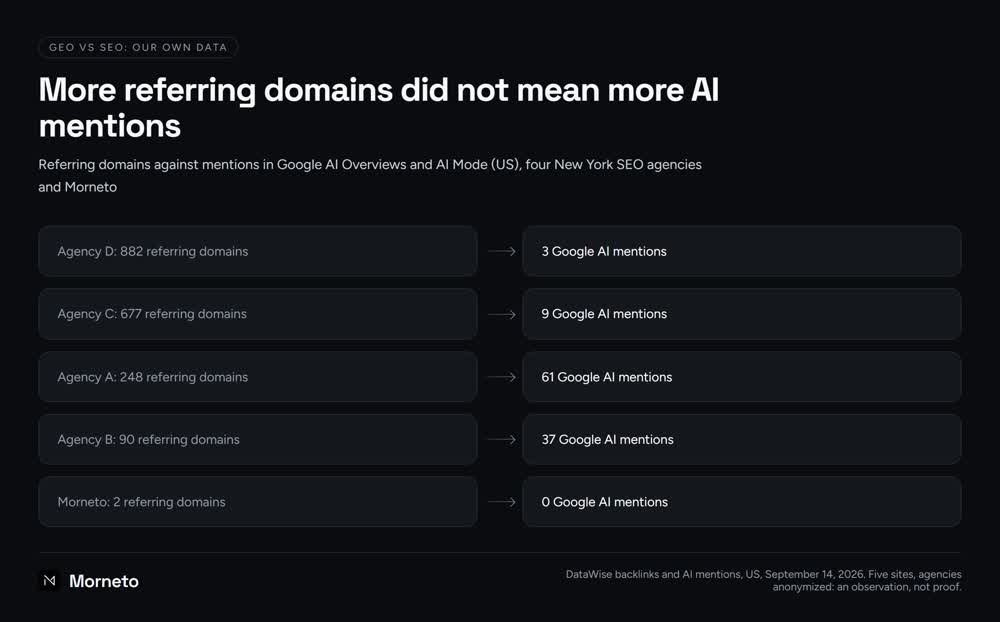
- DataWise, September 14. We compared referring domains with Google AI mentions (AI Overviews and AI Mode, US) for four New York SEO agencies and us. Agency A had 248 domains and 61 mentions, and Agency B had 90 and 37. Meanwhile, Agency C had 677 and 9, Agency D had 882 and 3, and Morneto had 2 and 0.
Two lessons stand out. First, links did not predict AI mentions here, because the agency with the most referring domains had the fewest mentions of the four agencies. Second, visibility differs by engine, since our site showed up in Perplexity and ChatGPT but not yet in Google’s AI answers or Copilot. Five sites are an observation, not proof, so we treat this as a reason to keep testing.
Which should a small business work on first?
For most small businesses, the order is simple: SEO first, because GEO depends on it. After that, the list is short:
- Check indexing in both engines with Search Console and Bing Webmaster Tools, then fix what they flag.
- Rewrite key pages answer-first, with a plain one-line answer and a few real questions near the top.
- Make your business facts match on your site and every profile.
- Watch citations monthly, since Bing’s AI Performance report is free.
Our step-by-step guide to getting found by AI covers each item. Budget usually comes next, so you may be asking whether SEO is still worth paying for. In short, AI answers change where the answer appears, not the math.
That is also why our SEO agency work in New York treats AI answers as part of one plan. If you would rather not run both tracks yourself, our AI SEO and GEO service covers the generative side inside that same plan. For instance, the SEO plan on our pricing page lists AI answers for ChatGPT, Copilot and AI Overviews as a line item. It starts from $799 per month, month to month. Still, nobody can promise a citation, and we do not. To see where you stand, send us your site for a free audit.
Common questions about GEO vs SEO
What is GEO in digital marketing?
GEO stands for generative engine optimization: making your site easy for AI engines such as Copilot and ChatGPT to find, understand and cite. It builds on SEO rather than replacing it.
What is SEO for ChatGPT called?
Usually GEO, for generative engine optimization. You will also see AEO, LLM SEO and AI search optimization. The names differ, but the work is largely the same.
Can I use GEO instead of SEO for my website?
Not really. After all, AI engines that search the web can only cite pages they can find and read. Without that SEO foundation, GEO has nothing to work with.
Are backlinks still relevant in 2026?
Yes, for rankings. For AI mentions, however, our September 2026 check of five New York SEO sites found no clear pattern. There, 882 referring domains came with 3 Google AI mentions, while 248 came with 61. That is an observation, not proof.
Is AEO the same as GEO?
They overlap. AEO aims to be the one direct answer, such as a featured snippet. GEO, meanwhile, aims for a citation in an AI-written answer, and AI Overviews sit where the two meet.