Short answer: local SEO New York comes down to three things Google says it measures: relevance, distance and prominence. You cannot change distance. So the work is a complete Google Business Profile, pages that name the neighborhoods you actually serve, and a steady flow of reviews, gathered the way Google actually permits rather than bought. In a city this dense, the map pack decides who gets the call.
Last updated 19 August 2026. The ranking factors quoted here are Google’s own published ones, not our theory. Prices are our own published rates. No invented case studies and no client numbers we cannot show.
Local SEO in New York is a different sport from local SEO anywhere else. In most cities, ranking for “plumber near me” means beating a dozen businesses spread over twenty miles. Here it means beating forty businesses within a mile, several of them on your own block, while the customer decides in about eight seconds on a phone. This guide is what actually moves that needle, in the order we would do it.
How do you rank higher on Google Maps in New York?
Google Maps SEO in New York comes down to winning the map pack for a specific service in a specific neighborhood, and this playbook works through exactly that. The short version: a complete Google Business Profile in the right categories, reviews that arrive steadily and mention what you actually do, and a website whose pages name the same services and places the profile claims. Google cross-checks all three.
The rest of this guide breaks those factors down borough by borough. If you would rather have Google Maps SEO done for you, our local SEO service for New York runs it month to month — but every step below is doable in-house.
What local SEO New York actually means
Local SEO is the work that makes your business appear when somebody nearby searches for what you sell. It overlaps with ordinary SEO, but the target is different. Ordinary SEO chases a page one ranking. Local SEO chases a place in the three-result map block, plus the pages that feed it.
Consequently the assets are different too. A national site competes with articles. A local business competes with a Google Business Profile, a handful of neighborhood pages, and its review count. Get those three right and the ordinary rankings tend to follow. Get them wrong and no amount of blogging rescues it, which is the pattern behind why small businesses stay invisible online.
Why the map pack decides who gets the call
On a phone, the map block takes the top of the screen. Three businesses appear with a rating, a distance and a call button. Everything else sits below the fold. Therefore the practical question is not “where do I rank” but “am I one of the three”.
That single fact changes the priority order. A beautiful website that is not in the map pack loses to an ordinary website that is. So the profile comes first, the neighborhood pages second, and the design refinements after both. We break the mechanics down further in the Google map pack in New York.
Moreover the map pack is no longer the only surface. People now ask assistants for recommendations, and those answers are assembled from the same public signals: your profile, your reviews and the pages that describe what you do. Our guide to getting found by AI search covers what that changes and, more usefully, what it does not.
The three factors Google says it measures
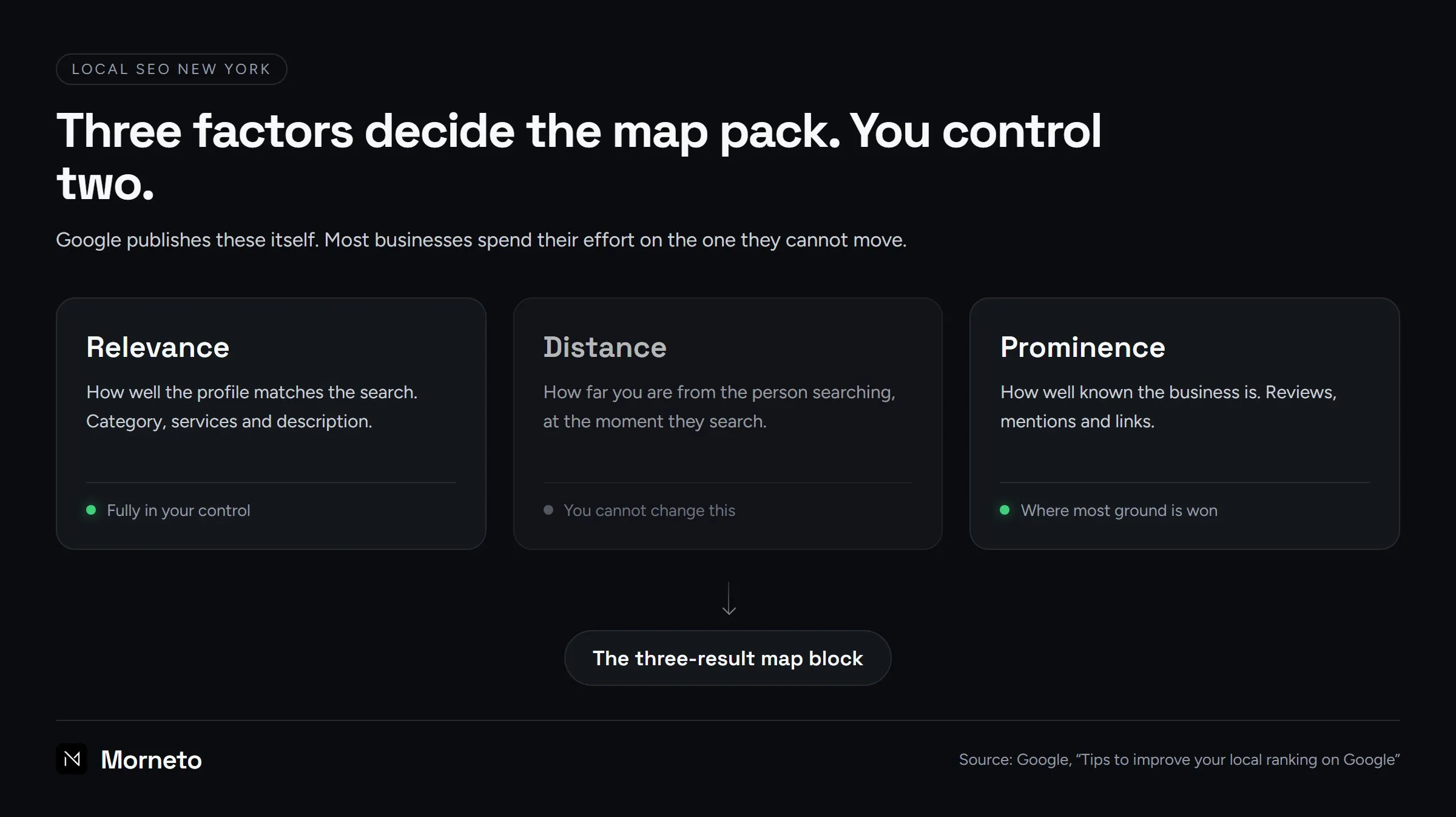
Google publishes this openly. According to its own guidance on improving your local ranking, local results are based mainly on relevance, distance and prominence.
| Factor | What Google means | What you can actually do |
|---|---|---|
| Relevance | How well your profile matches the search | Exact primary category, every service listed, a description in the words customers type |
| Distance | How far you are from the searcher | Nothing directly. Instead, set a truthful service area and build pages for the areas you want |
| Prominence | How well known the business is | Reviews, mentions, and links from sites that already rank |
Notice that only relevance and prominence are open to you. Distance is fixed by geography. Nevertheless most businesses spend their effort on the one thing they cannot change, usually by inventing an address closer to the customer.
Do not do that. Google’s guidelines for representing your business are explicit: the profile must be your real location, and virtual offices and mailboxes are not eligible. A service-area business should hide the address instead. That route is legitimate, and we explain it in plain terms in our glossary entry on a service area business.
Prominence is where most of the winnable ground sits. Reviews are the clearest lever, and the profile itself is the second. The full checklist lives in Google Business Profile optimization for NYC, and there is a free second listing most New York businesses have never claimed, covered in the Apple Maps business listing.
Local SEO New York borough by borough
Nobody searches at city level. They search at neighborhood level, and the winning page is the one that names the ten blocks they are standing in. So a single “we serve New York” page will not do it.
| Borough | What decides it locally | Our page |
|---|---|---|
| Manhattan | Density. Competitors are in the same building, so speed and clarity break the tie | Manhattan |
| Brooklyn | Neighborhood identity is strong; a borough-wide page reads as generic | SEO Brooklyn |
| Queens | Language. A site in English only is invisible to part of the market | Queens |
| The Bronx | Fewer competitors bidding, so the ground is cheaper to take | Bronx web design |
Furthermore the boroughs behave differently enough that the same tactic can win in one and waste money in another. We wrote up the clearest example, the split between two boroughs with very different search behavior, in local SEO for Brooklyn and Queens.
What local SEO New York costs and what it should include
Our own local SEO work starts at $799 a month, and the scope is written down before anything begins. Around the city you will see roughly $500 to $1,500 a month from small studios, and $2,500 upward from larger agencies. The number matters less than the deliverables attached to it. Our local SEO agency work in New York starts at $799 a month. For a wider comparison beyond our own pricing, see how we stack up against the best SEO companies in New York on scope and transparency.
A monthly fee should buy at least this much. Profile maintenance and post updates. One new or rewritten page a month for an area or service you want to win. Review requests going out on a schedule. Citation and listing consistency. Finally, one page of reporting that shows enquiries rather than impressions.
Be careful with two things. Guaranteed rankings are not possible, because nobody controls Google’s results. And a retainer with no named deliverable is a subscription, not a service. Whether the fee makes sense for your customer value at all is the break-even question we work through in is SEO worth it in 2026. Our agency pricing explained guide covers the models and where the incentives go wrong, while the full rate card sits on the pricing page.
If you are weighing this against a rebuild, read a new website or better SEO first. Quite often the site is fine and the profile is the problem, which is a much cheaper fix. The SEO agency in New York page sets out how we run it, and the free audit will tell you which of the two you are actually dealing with.
Common questions about local SEO New York
How long does local SEO take to work in New York?
Profile work can move the map pack within weeks, because it changes signals Google already reads. Page and review work compounds over three to six months. Anyone promising page one in thirty days is describing an ad, not SEO.
Do I need a physical address in New York to rank there?
No. Google supports service-area businesses that hide their address and declare the areas they serve. What is not allowed is a virtual office, a mailbox or an address you do not actually operate from. Those get profiles suspended, and recovery takes longer than doing it properly.
How many reviews do I need to compete?
Enough to sit in the same range as the three businesses currently in the map pack for your search. Look them up and count. Steady beats sudden, because a burst of reviews in one week is the pattern Google filters most aggressively.
Is local SEO different from the SEO an agency normally sells?
Yes. Ordinary SEO optimizes pages for search results. Local SEO optimizes a profile, a service area and a review flow, then supports them with pages. A proposal that never mentions your Google Business Profile is not local SEO.
Can I do local SEO myself?
The profile, yes, and you should. Claim it, fix the category, add real photos, answer every review. The parts that take time are the neighborhood pages and the technical work behind them. Start with the free parts and see how far they get you before paying anyone.
Does local SEO still matter now that AI answers questions directly?
It matters more. Assistants assemble their recommendations from the same public signals: your profile, your reviews and the pages describing what you do. A business with a thin profile is invisible to both a map pack and an AI answer, for the same underlying reason.