
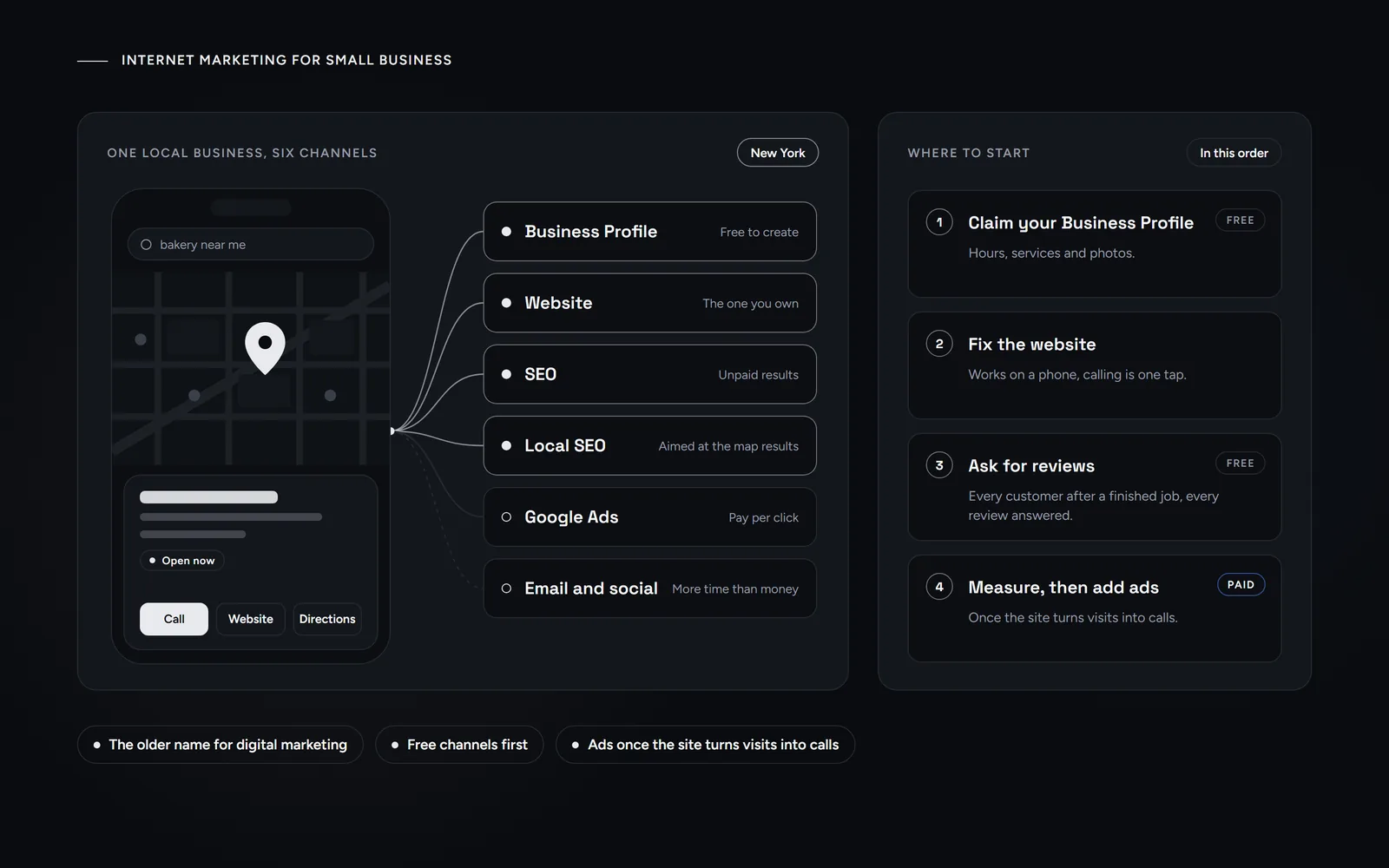
Short answer: internet marketing for small business is the older name for digital marketing: the work that gets a business found and chosen online. For a local New York business, start with a free Google Business Profile, a phone-friendly website and reviews. Add SEO next, and paid ads once the site turns visits into calls.
If you run a shop or a trade business in New York, someone has probably offered you internet marketing. The term sounds big. However, the first steps are small enough to take on your own, and most of the early tools are free. Morneto is a web design, SEO and Google Ads studio in New York. This guide explains the term, the channels and where to start. It also says when hiring help makes sense, and which parts we do not sell.
What is internet marketing, and is it the same as digital marketing?
Internet marketing is any marketing that reaches customers through the internet. That covers your website, search engines, maps, online ads, email and social media. Digital marketing is the newer name for the same work. Some writers treat it as the wider label, since it can also cover channels such as text messages. For a small business, though, both names describe one job: get found online, and then get chosen.
Here is a simple example. Say a bakery in Astoria shows up on Google Maps when someone nearby searches for a birthday cake. Then the visitor taps through to the website, checks the prices and orders online. Later, the bakery sends an email before Mother’s Day. In other words, that whole chain is internet marketing, and each link in it is a channel.
The old name is fading, too. When we pulled US keyword data from DataWise on November 11, 2026, “digital marketing agency” had 40,500 searches a month, against 3,600 for “internet marketing agency”. Both terms lost searches over the last 12 months, but the old one lost more. Its monthly average fell 34% against the 12 months before, while “digital marketing agency” fell 22%. Still, Google uses the old term in a place that matters to local owners. “Internet marketing service” is a category in Google Business Profile, and our own profile lists it next to Website designer and Marketing agency.
Which internet marketing channels matter for a small business?
One question in Google’s People also ask box for this topic is what the seven types of marketing are. For a local business, though, we group internet marketing for small business into six channels, and each one does a different job:
- Google Business Profile. This is your listing on Google Maps and in local results, with hours, photos and reviews. According to Google, creating one is free.
- A website. It is the one channel you own outright. Search, ads and email all send people here, so it has to load fast on a phone and make calling easy.
- Search engine optimization (SEO). This work helps your pages appear in Google’s unpaid results. It is slow to build, but you do not pay for each visit.
- Local SEO. Think of it as SEO aimed at the map results: a complete profile, pages that name the neighborhoods you serve, and reviews.
- Paid search. These are the sponsored results on a search page, mostly bought through Google Ads. With cost-per-click bidding, Google says you pay for each click on your ad. It is the fastest channel, and also the easiest one to overspend on.
- Email and social media. Email reaches people who already know you. Meanwhile, social media shows that you are open and doing good work. Both cost more time than money.
So which channel should come first? For a business that serves a neighborhood, the first free step is the map.
Why does a local business start on Google Maps?
Local internet marketing is the part aimed at customers near you. When someone searches for a plumber or a dentist, Google often shows a map with a short list of businesses above the regular results. Google’s guide on how local ranking works says local results are mainly based on relevance, distance and popularity. Under prominence, it also mentions links to your business and the number of reviews you have.
Two details make the profile a good first step. First, Google says there is no way to request or pay for a better local ranking. Second, the profile costs nothing. Of course, you cannot change your distance to a customer. Still, you can make the profile complete and accurate, and you can earn reviews.
New York adds one twist. In a city this dense, we see the map decided at neighborhood level, not city level. In Manhattan, the results can come from a radius of blocks rather than miles. That is why we treat the neighborhood as the market, not the borough.
Where should a New York small business start with internet marketing?
Internet marketing for a small business can start for free. Start with the free channels, in this order, and add paid ones once the basics work. Each step makes the next one work better:
- Claim your Business Profile. Verify it, pick the right category and fill in hours, services and photos. Google says businesses with complete and accurate info are more likely to show up in local results.
- Fix the website. It has to work on a phone, load fast and make calling one tap. A few clear pages beat a long list of thin ones.
- Ask for reviews. Ask every customer after a finished job, and reply to every review. Google also lets you share a review link or a QR code for this.
- Measure, then add ads. Set up Search Console first. Then run Google Ads once the site turns visits into calls.
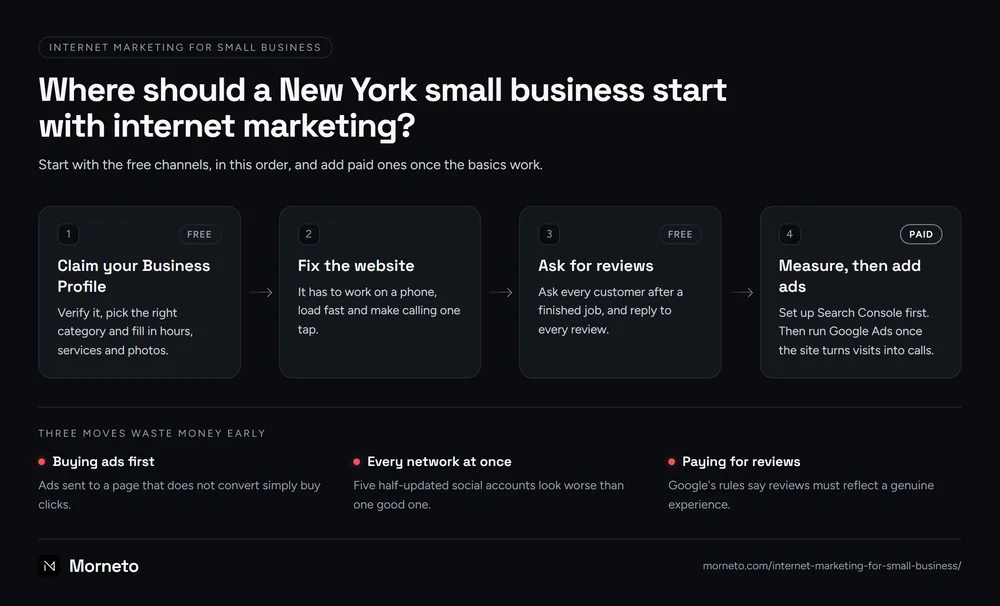
Notice what is missing from that list. Three moves waste money early: buying ads first, being on every network at once and paying for reviews. For example, ads sent to a page that does not convert simply buy clicks. Likewise, five half-updated social accounts look worse than one good one. And Google’s rules say reviews must reflect a genuine experience, so Google can remove paid or rewarded reviews.
That is the short version. Our preparation checklist for getting clients online in New York turns these steps into a 30-day plan, week by week. Once they run on their own, the question becomes what to buy, and when. Our guide to which digital marketing services to buy first puts the website at the top, since every paid channel sends traffic there.
What can you do yourself before you hire anyone?
More than most owners expect. In fact, Google’s own page on hiring an SEO says that if you run a small local business, you can probably do much of the SEO work yourself. Much of internet marketing for a small business is steady routine rather than skill. This is the do-it-yourself list we would start with, and every tool on it is free:
- Complete the profile. Add your category, hours, holiday hours, services and real photos. Then check it again every month.
- Make the review request routine. Send your review link to every customer after a finished job, not only the happy ones. Google’s rules bar selectively asking for positive reviews. They also treat a discount or a gift for a review as fake content.
- Connect Search Console. This free Google service shows which searches bring up your site, and it also flags indexing problems.
- Write one page per service. Answer what customers ask on the phone, such as the price range, the area you serve and how booking works.
- Pick one social channel. Post recent work there, and link it from your profile. Skip the rest until this one runs on its own.
First, budget a few hours a week for this list. After a month, ask whether you would rather spend those hours on your trade. That trade-off, more than skill, is why most owners end up hiring help.
When are small business internet marketing services worth paying for?
Hire help when the work outgrows your hours, or when a mistake would cost more than the fee. Google names one good moment too: a site redesign or a new site launch is a great time to hire an SEO, and the earlier the better. These are the usual signs:
- You are building or rebuilding the site. Search work is easier to build in before launch than to add later. Also, a site that already ranks can lose positions in the move. For that reason, every build at our web development agency in New York starts with discovery: who your customers are and what they search for.
- You want inquiries this month. Paid search can start within days. However, an account without negative keywords and conversion tracking burns budget fast. Our Google Ads management in New York sets up conversion tracking before any bidding for that reason.
- Your map results stay flat. Say the profile is complete, but the map still passes you by. Then local SEO in NYC is often the next step: neighborhood pages and a steady flow of reviews.
- You have no time left. The free list above stops working the week you stop doing it.
Agencies sell small business internet marketing services under both names, so compare the named deliverables, not the label. Before you sign, our guide on how to choose a digital marketing agency in NYC covers the vetting steps and the red flags.
Where does Morneto fit?
Here is where we fit, honestly. Morneto runs the website, SEO and Google Ads as one team, so nobody hands your account between vendors. We leave two channels out on purpose: social media management and email marketing. Search work at our New York SEO firm always starts with an audit, not with guesswork.
| Channel | Start it yourself? | When help pays off | Do we sell it? |
|---|---|---|---|
| Google Business Profile | Yes, it is free | When map results stay flat | Yes, inside SEO |
| Website | Yes, with a site builder | When you build or rebuild | Yes |
| SEO and local SEO | The basics, yes | When pages and links are the gap | Yes |
| Google Ads | Possible, but easy to overspend | When you want inquiries this month | Yes |
| Yes | Once you have a list | No | |
| Social media | Yes | Rarely, for a local business | No |
Our prices are public, too. Websites start at $997 one-time and SEO at $799 a month. Google Ads management is $497 a month for up to $5,000 in ad spend, plus 12% of spend above that. You can check all three on our published price list for web design, SEO and Ads before you talk to anyone. To tell a fair quote from a padded one, read what a small business pays for digital marketing, line by line.
Common questions about internet marketing for small business
Do you need a budget to start internet marketing?
Not to start. A Google Business Profile and Search Console are free, so the first cost is your time. A budget comes in when you buy help or ads. Our published prices start at $997 one-time for a website and $799 a month for SEO. Google Ads management starts at $497 a month, plus the ad budget you pay Google directly.
How can I advertise my small business online for free?
Claim and complete your Google Business Profile, and send your review link to every customer after a finished job. Also keep one social profile up to date. Then add Search Console to see which searches find you.
How long does internet marketing take to work?
It depends on the channel. Google says some search changes take effect in a few hours and others take several months, so judge SEO work after a few weeks at the earliest. Paid ads, by contrast, can start bringing visits within days of a campaign going live.
Is local internet marketing different from SEO?
Local internet marketing covers every channel aimed at customers near you, from the Business Profile and reviews to your website and ads. SEO is one piece of it: the work that earns unpaid visibility in search, including the map results.
Does Morneto offer social media or email marketing?
No. We build websites, run SEO and manage Google Ads, and we do not sell social media management or email marketing. Both are channels a small team can usually run in-house.