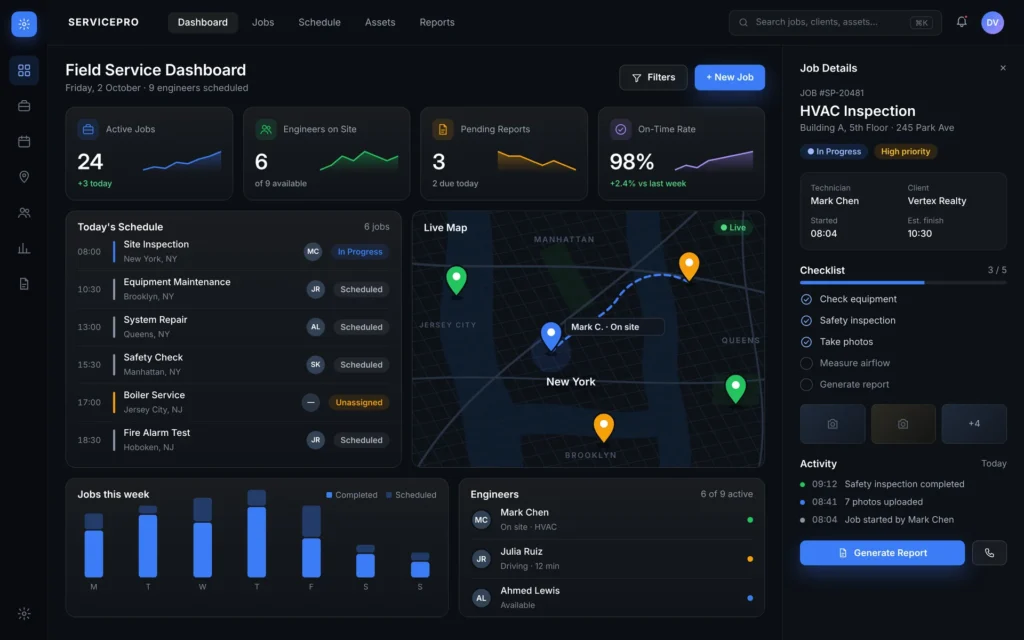
Engineers spend the day in basements and plant rooms. Any internal dashboard that assumes a connection is useless to them by ten in the morning.
Approach
The app fetches everything the engineer needs for the day at the depot and keeps it on the device. Reports written offline queue up and sync on reconnection, with conflict handling that favors the engineer on the ground.
What this approach is built to achieve
The goal is to retire paper job sheets, so reporting that used to arrive a week late lands the same evening.
This is an illustrative sample project, not a client case study.
Building an internal dashboard for people with no signal
Offline-first is a different discipline from a website that happens to cache. If an engineer opens the app in a basement at nine in the morning, the whole day has to already be on the device. Every report they write there also has to survive until signal returns.
That forces decisions most web projects avoid. What happens when two people edit the same job. Whether the server or the person on site wins a conflict. That is a business question rather than a technical one. And how much of the day to fetch up front. Fetching too little strands the engineer, while fetching too much makes the depot start slow.
The browser already provides most of the plumbing. Service workers and local storage let an internal dashboard keep working with no connection, as MDN’s guide to offline and background operation explains. The real work is deciding what to store and when to sync.
Speed matters more than polish. Engineers use a screen that loads in two seconds on a weak connection every day. In contrast, one that spins for twenty seconds loses out to a paper notebook, whatever it cost to build.
Internal tools like this rarely need to be beautiful, but they do need to be fast and honest about state. That work sits under custom development rather than a website build. We quote it the same way, fixed against a written scope.